Terra Galleria Photography

Photo Spot 44: Saguaro National Park – Hugh Norris Trail

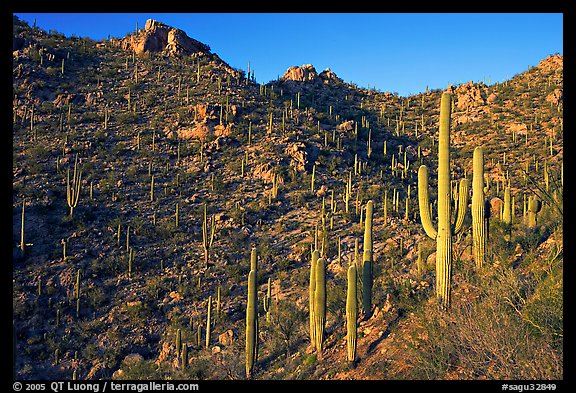
The saguaro cactus, with its multiple arms, is an icon of the American West. Although Western Films place them all over the place, they actually grow natively only in the Sonoran Desert, whose US portion is all included in southern Arizona. Around Tucson, the higher rate of precipitation causes the saguaro to grow twice as fast as saguaros in drier areas. This is where Saguaro National Park is located, making it the National Park closest to a major city.

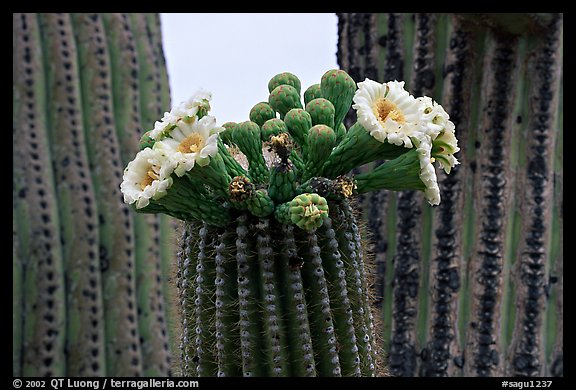
I had come to the Park earlier on a previous visit, enjoying moderate temperatures, and a desert floor carpeted with annual flowers. On that May visit my main goal was to photograph the saguaro blooms, which occur in May and June.

In my explorations of the flats, I had found it difficult to photograph the delicate flowers, as they are clustered near the ends of branches of cactus that grow to sizes between 15 feet and 50 feet. I thought that a hillside would give the most opportunities, as I could be level or look down to some of the saguaros.

I went back to the Hugh Norris trail, the longest in the Park. The traihead is located on the Bajada Loop Drive, 3.5 miles north of the Red Hills Visitor Center in the Tucson Mountain District (West Unit) of Saguaro National Park. Unlike the East Unit, the West Unit is open 24 hours a day.

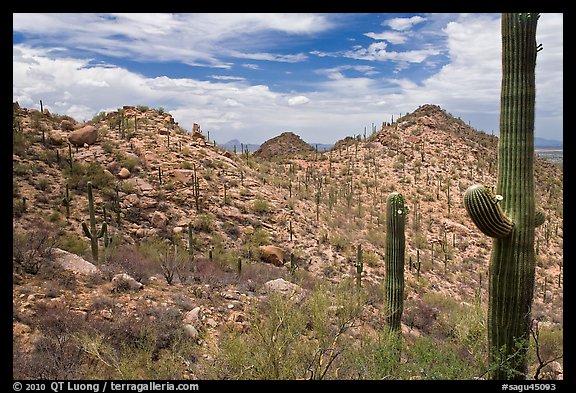
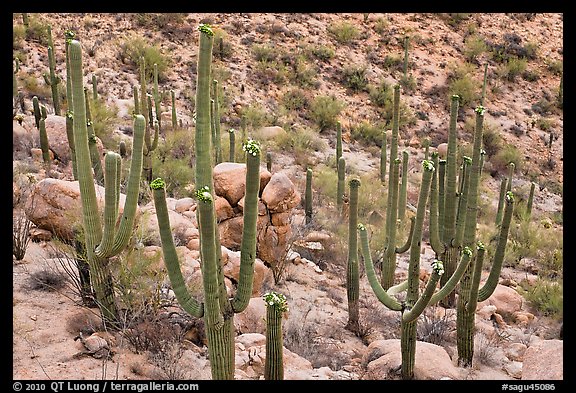
The first part of the trail climbs steadily up a canyon, whose sides are lined up with some of the most impressive saguaro forests in the park. Thousands of giant saguaros spread across the bajada, a Spanish term indicating the transition zone between the mountain and the valley. The steep location offered more varied compositions and a clearer views of the spread of the saguaros than the flats below. On a previous visit, I had found great light there in the late afternoon, with slopes nicely illuminated by the low sun.

The saguaro flowers last only half a day, opening at night, to close by next midday, never to open again. Because of that, and also in order to avoid the mid-day heat, this time I started to hike early in the morning. I was glad I took plenty of water, as it was quite hot in spite of the overcast sky.

As the drainage narrowed, the trail steepened and became a series of switchbacks leading to the top of the ridge. After hiking for a steep mile (which took me about 45 minutes) the trail reached a saddle. I followed a side path from which I found some of the nicest clusters of saguaro cactus, high above the visitor center, which could be seen in the distance. Almost each of the stems were completely encircled by creamy-white, 3-inch-wide flowers with yellow centers flowers.

I continued on the trail towards the top of Wasson Peak, 4 miles further. While in the canyon the views were only towards the west, they now opened up in other directions. The trail was meandering from one side of the ridge to the other and occasionally going along the top, with views changing from one side to the other. However, as the clouds got darker, I turned around before reaching the top, wary of being caught in an afternoon thunderstorm high on an exposed ridge. I will have to come back another time.

See more images of Saguaro National Park
See more images from the Hugh Norris Trail

North Cascades National Park New Images: Hidden Lake

It’s been a few months since I posted about new images in this blog. Although there are a lot of Yosemite and New York images I’d yet to comment on, in an effort to catch up, I am fast-forwarding to the most recent National Parks trip of this fall.

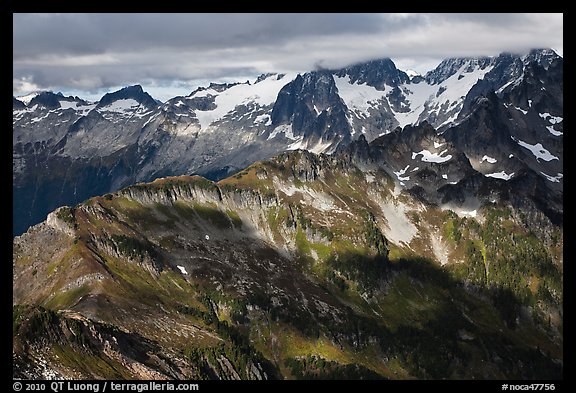
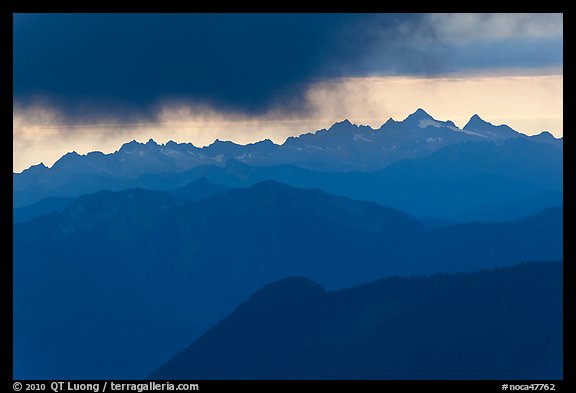
The first objective of my visit to North Cascades National Park was to seek more expansive views. I remembered from my previous visit a vast wilderness of rugged mountains, but on that trip I didn’t stand on a mountain top at sunrise or sunset. The mid-day light from Sahale Peak wasn’t too interesting. That what happens if your partners are normal people (as opposed to photographers :-)).

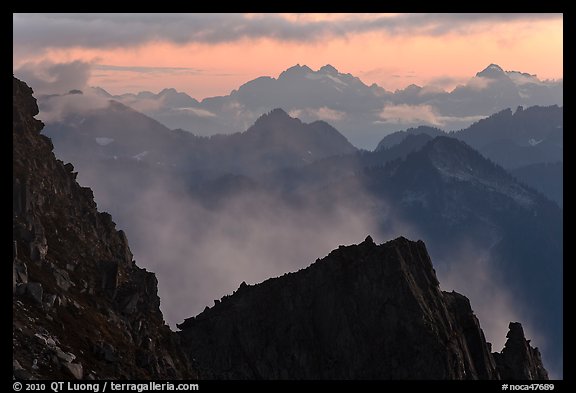
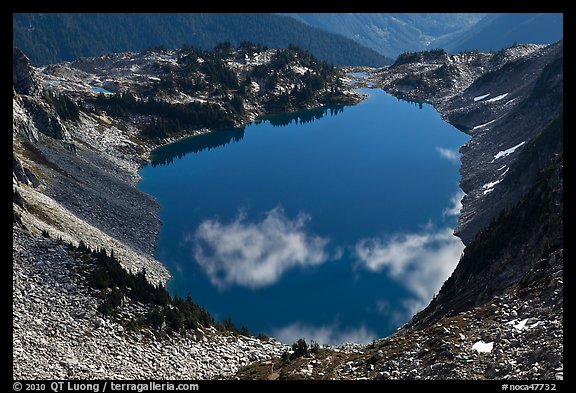
Based on photographer Jon Cornforth suggestion for Sibley Creek, I hiked the Hidden Lake trail. After about 3000 feet of elevation gain, I left my sleeping and cooking gear at a pass between the two Hidden Lake Peaks, and proceeded with the camera gear in the dense fog towards the higher of the two peaks. The lake below was often obscured. I was hoping that the fog would clear later, and it did, revealing spectacular views, but only after the sun had set.

After a rewarding session of dusk and night photography, greatly aided by the full moon, I scrambled by night to the retired Hidden Lake Peak lookout, situated on the other peak. I found the gear that I had left at the pass coated with a layer of frost in just a few hours. The air in the North Cascades is definitively more moist than in the Sierras. The lookout turned out to be of the nicest places I’ve stayed in the mountains, with stunning 360 degrees views, and a cozy interior well maintained by volunteers. I was glad I didn’t have to bivy outside.

The morning was clear, but views towards North Cascades National Park, on the edge of which the lookout is situated, were backlit. Every rock was coated with a layer of hoar frost. Because they were so slippery, I didn’t depart the lookout until mid-morning after the sun had melted some of that frost. By that time, clouds had already built up. I explored again on the ridges around Hidden Lake. One hour before sunset, it was clear that the summits would stay again engulfed in the clouds. I began to descend in order to get under the clouds. The sun emerged for a new minutes. I paused to make a few photographs, then quickly resumed scrambling down. Since this evening there would be no moonlight, I made sure to reach the trail before it was totally dark. Making few stops, I reached the trailhead at 10pm. It started raining after midnight.

More views around Hidden Lake: Hidden Lake, Mountains

Photo Spot 43: Great Sand Dunes National Park – Entrance road

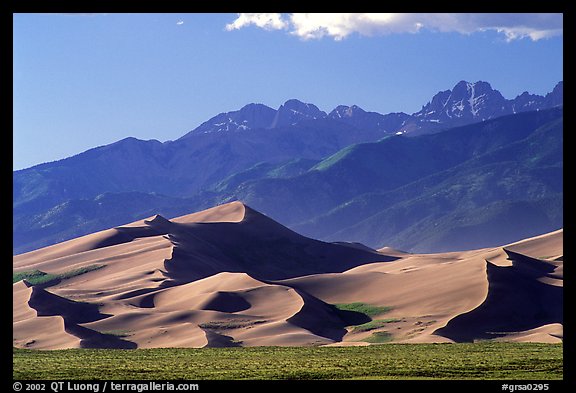
The Great Sand Dunes protected by the National Park of the same name have the distinction of being the tallest dunes in North America, raising to heights of 750 feet.

Climbing the dunes proved quite an exercise. I was making one step backwards for every two steps forward on the deep sand. It took me one hour of hiking, from the time I stepped on the first dunes, to reach the top of the tallest dune. I was glad this was still May, when the temperatures were pleasant, and the mosquitoes hadn’t arrived yet, as I’ve read that the surface temperature of the sand can reach 140 degrees in the summer.

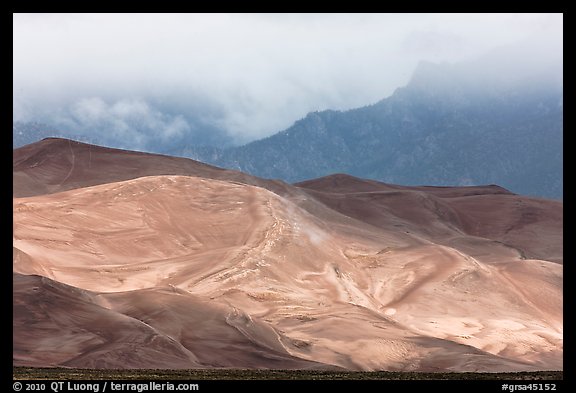
While I enjoyed the 360 degrees view, I didn’t think that it gave a good sense of the size of the dunes. When you are standing on the top of a mountain, you don’t see the mountain itself, right ? I remembered the first glimpse of the dunes I got upon entering the park. Because of the high sun, the dunes lacked relief then, but by late afternoon, the light should be just right.

I hiked down quickly, and crossed Medano Creek to get back to my car. I drove the access road a couple of miles past the visitor center and then past the park headquarters to maybe a mile before the private lodge, and then set up not too far from the road. Sometimes, the view you are looking for is the easiest to get to !

After a few tight shots with my 35mm camera and the 100-400mm, I reached for my large format camera and the longest lens that I own, a 720mm. Although this sounds impressive, on the 5×7 camera this is equivalent to a very modest 160mm on 35mm. Because of the extension and the relatively long exposure time of about 1/2 a second, I also needed to use two tripods to support the camera adequately and prevent vibrations that would have ruined the sharpness of the image.

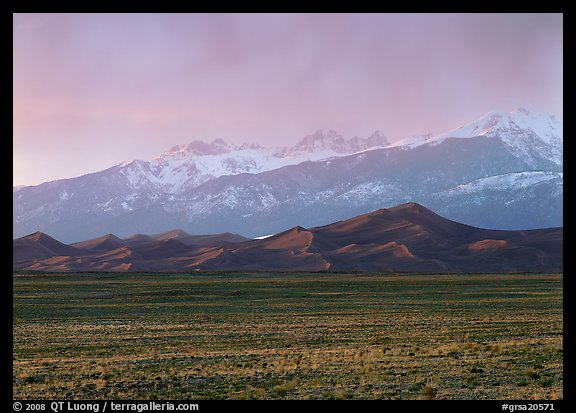
The lens was not long enough to frame tightly the dunes and Sangre de Cristo Mountains, but I knew that the image would crop perfectly to a panoramic 6×17. I liked anyways the greater context it provided to the picture. The flats, accentuated by the grazing light, begin here and extend towards the East for most of the continent’s interior. Framing tightly often results in a more striking image, as no “uninteresting” element distracts from the main subject, yet the image with the broader context often rewards a more sustained viewing.

View all images of Great Sand Dunes National Park

Calendars 2011

This year, two different retail calendars feature exclusively my images. I have received some copies from the publisher that I an offering for sale. Images below are to exact relative scale.

The first one, similar to last year’s National Park Calendar, is almost an exhibit piece, at 23×16″. If you are interested, you should place an order as soon as possible, as it is almost sold out, and I do not anticipate receiving more copies.

The second one is a more standard (practical ?) 12×12″ size with a full page grid below each image for notes. All the images are from Yosemite National Park. I find the choice of images slightly odd, but it is a precursor of a more notable product by the same publisher, Rizzoli Universe, that I’ll announce in time next year.

See the images inside the calendars.

Photo Spot 42: Channel Islands National Park – Inspiration Point

The Channel Islands of California are situated off the Santa Barbara and Los Angeles coast. Five of those islands form Channel Islands National Park.

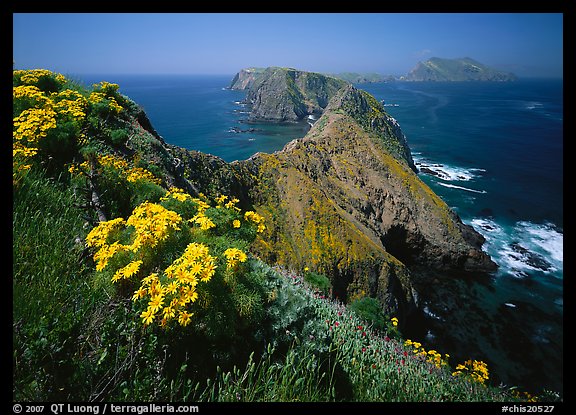
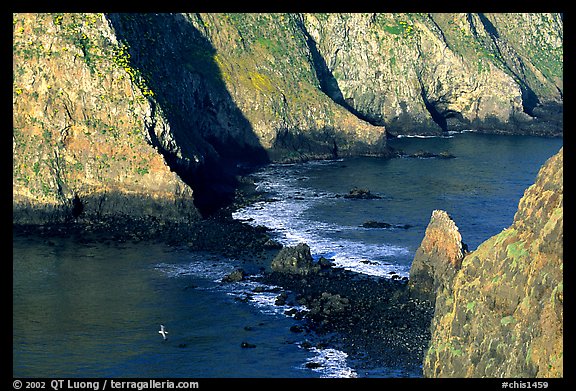
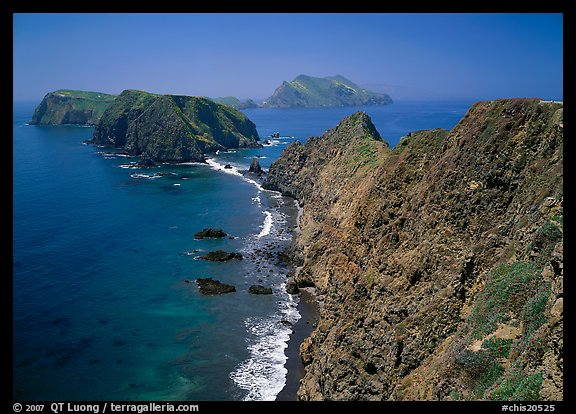
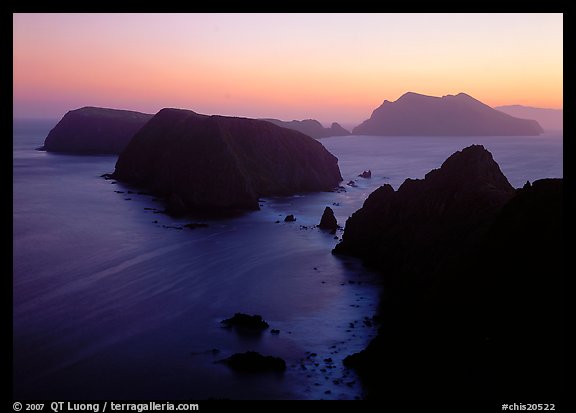
Inspiration point, on East Anacapa Island, where I am standing, offers possibly the most spectacular view on the entire US West Coast. Earlier in the day, a misty marine layer (a frequent ocurence) had obscured the views I was hoping to capture at sunrise. But now the cool mist has evaporated, revealing beyond a ridge of East Anacapa a striking chain of three islands, Middle Anacapa, West Anacapa and Santa Cruz Island. Standing 250 feet above the narrow strait separating East and Middle Anacapa, I absorbed the dynamic spectacle of pelicans, gulls, and guillemots soaring below me, above a backdrop of deep blue waters and crashing waves.

Stepping gingerly near the edge of the sea cliff, I looked for a position where I would be able to include a set of Coreopsis flowers as a background to the dramatic view. Inspiration Point is spectacular at any time of the day and year, however, like most of the California hills, the islands are at their greenest at the end of the winter, before returning to brown by the end of April. The strange tree sun-flower, or Coreopsis, blossoms with bright yellow bouquets for a short period of time from the end of March to Mid-April. Although they nest in even larger numbers later in the spring, when every inch of the island seems inhabited by them, in April there were already an impressive number of Western Gulls on the island plateau, each of them sitting on a shallow nest with eggs.

Of all the Channel Islands, East Anacapa Island is the closest to the mainland, only 12 miles – a short hour crossing – from Oxnard, with boats from the concessionaire running all year. Yet the islands are at a same time a world apart. Isolation over thousands of years has created unique animals and plants found nowhere else on Earth, like the Coreopsis.

Although I live in California, I visited 41 National Parks all over the country before my first visit to Channel Islands. Despite being so close to the heavily populated mainland, the islands are little known. They see only light visitation and have preserved a wild character. Since East Anacapa Island is so small, only 3/4 mile long, all of its trails can easily be hiked in a couple of hours, so almost all visits are day trips. I shared the small campground where I had been staying overnight with only two other tents. As the concessionaire had a weight limit of 45 pounds for each bag that can be transported on the boat, I just packed my photography gear and camping gear in two bags, that I carried on two hikes over the 1/2 mile from the landing cove. Not being used to it, the sound of the lighthouse fog horn prevented me from getting a good night of sleep, but being able to stand at Inspiration Point at sunset, and then early in the morning made it well worth it.

See more images from Inspiration Point
See more images from Channel Islands National Park

Treasured Lands: extension, installation photos

Treasured Lands, the exhibition of my 58 images of the National Parks at the National Heritage Museum was initially scheduled to close this week.

I am pleased to announce that due to its success, the Museum has decided to extend the exhibition until Spring 2011.

Treasured Lands is the main feature of the summer issue of the Museum Newsletter (PDF) which reproduces a selection of images and accompanying commentaries from some of the lesser known parks.

If you are curious about how the exhibition looks, but cannot make it to Lexington, MA, have a look at newly posted installation images for Treasured Lands. I have also posted installation images from assorted exhibits of the past two years.

Photo Spot 41: Badlands National Park – Red Shirt Table Overlook

Like in Theodore Roosevelt National Park that we visited two weeks ago, badlands dominate the landscape of Badlands National Park (surprise !).

However, there is a striking difference of scenery. While in Theodore Roosevelt National Park I saw the badlands mixed with shrubs, conifers, and aspens (which provide some color accents in autumn), in Badlands National Park, the vegetation consists only of stretches of prairie.

This absence of high vegetation made the Badlands landscape more stark, revealing the effects of erosion on a large scale. Standing on the overlooks reminded me of the landscapes of the Colorado Plateau where canyons and ridges seemed to stretch as far as the eye can see. The same forces of water were at play here, although on a shorter geological time scale, as the sediments and mud that makes up the Badlands is much softer.

Although many of the easily accessible overlooks in the park main North unit (including Pinnacles, right off the Wall entrance) provide excellent perspectives, I remember most the Stronghold Unit, as it provided a remarkable solitude – it is seen by only 1% of the visitors to Badlands National Park – extensive views, and a connection to Indian history.

The whole Black Hills of South Dakota rightfully belongs to the Lakota people. In 1851, the boundaries of Lakota land were clearly marked in the first Treaty of Fort Laramie. They were reaffirmed in the second Fort Laramie Treaty of 1868, after the Lakota defeated the US army several times, making it the only war in American history in which the US negotiated peace by conceding everything demanded. Yet the US found ways to get around the Treaty. The Indian Wars ended with in 1890 at the Wounded Knee massacre where 300 men, women, and children were indiscriminately shot using the new Hotchkiss gun, a rapid fire weapon that fired exploding shells. Today, their descendants are confined to the Pine Ridge Reservation, one of the poorest areas in the country, with rates of unemployment, illness, and mortality comparable to some of the most troubled third-world countries.

The South Units of Badlands National Park (Stronghold Unit, and the inaccessible Palmer Unit) are made up of lands that belong to the Pine Ridge Reservation, however, even those lands were appropriated by the US in 1942 for a gunnery and bombing range. Today those lands are still administered by the National Park service. There is currently a serious proposal to give back the National Park Service South Unit lands to the Oglala Sioux Tribe for management as America’s first tribal national park. However, a return of the Black Hills to the Lakota is very unlikely: the Supreme Court, even as it agreed in 1980 that the Black Hills were illegally taken, just offered a payment of $106 million as compensation, which was refused by the tribes.

State Road 40 follows the western boundary of the Stronghold Unit inside the Pine Ridge Reservation. I was looking for the Red Shirt Table Overlook, clearly marked on the map provided by the National Park Service, but not so easy to locate on the terrain in the pre-dawn dark. After a few hesitations, I left the main road and drove through an open gate to the overlook, a few hundred yards right to the edge of the plateau. There was nothing there except for a few portable toilets.

An immense basin, filled with innumerable spires stretched before me, filling up the whole eastern view. I could see in the distance the Stronghold Table, where the last Ghost Dance was performed. The darkness gradually gave way to a dim light. Since I would be shooting towards the East, I expected the best light to be in the quarter-hour at dawn starting half an hour before sunrise. The light is generally too flat at mid-day in the Badlands to shoot expansive landscapes. The flat horizon made it possible to use a strong graduated neutral density filter that preserved some of the subtle color in the sky while I exposed for badlands, which were illuminated by a dim, but directional light. After the sun rose, the contrast increased quickly. I tried another composition, then just sat there to enjoy the place and try to feel the native spirits. I did not see a single other soul until I departed.

View more images of Badlands National Park.

Photo Spot 40: Wind Cave National Park – Boxwork

Wind Cave National Park, one of the three National Parks (together with Mammoth Cave and Carlsbad Caverns) centered around a cave, was the first cave anywhere in the world to be designated a national park.

Although its 134 miles of mapped galleries make it the fourth longest cave in the world, I had heard of Wind Cave for its unusual formations, specifically boxwork, which is its signature feature. Boxwork is a type of mineral formation that resembles a honeycomb pattern of intersecting thin blades of calcite or other minerals. It is very rare and the result of a combination of geological processes, the specific composition of the minerals involved, and the protective environment of the cave.

In general, I prefer to photograph in caves using the cave lighting, which has been carefully designed to emphasize the cave’s features. By contrast, on-camera flash lighting is too flat, and to do use effective off-camera lighting in caves often requires one or more assistants or light stands. For conservation purposes, cave lighting is kept quite dim, requiring a long exposure. Like in most caves, tripods are not allowed during the tours. However, for once, the bad weather helped me.

Two days before, I had encountered a storm system with winds so severe that I was barely able to pitch my tent. Once I got inside, I felt like I was trying to sleep in a washing machine. Needless to say, this wasn’t too successful. The next day, as I was driving past daytime in the continuing storm, I stopped in an isolated country restaurant seemingly in the middle of nowhere, surrounded by vast plains. There, after engaging me in conversation, and learning that I had no place to stay, a woman offered me a place in their family home. I was immensely grateful to be able to stay out of the weather. I still remember the Dakotas as the first place in America where I had benefited from the hospitality of strangers.

Early this morning, I was the first visitor to drip into the Wind Cave National Park visitor center. Seeing that I had braved the weather to get there, the ranger on duty agreed to give me a private tour without an advance notice.

On such a tour, I was allowed to bring along my tripod, since it would not constitute a tripping hazard for the other participants. The ranger pointed me to the nicest displays of boxwork. the unusual cave formation composed of thin calcite fins resembling honeycombs, for which the cave is known. As formations were lining up the ceiling, the photography with the large format camera required quite a few contortions.

Back on the surface, I felt eager to explore the park’s mixed-grass prairie, but given the weather, this would have to wait for a return trip.

See more images of Wind Cave National Park

Photo Spot 39: Theodore Roosevelt National Park – Cannonball concretions

Theodore Roosevelt National Park preserves not only a rugged landscape, but also the memory of a man, who has done so much for conservation through his support of the National Parks. It started oddly, though. The impetus for the young Theodore Roosevelt to head to North Dakota was reading in the newspaper that bison were being exterminated. He hoped on a train to be able to kill one himself before they were all gone. However, the badlands taught him respect for nature, while toughening him. He would later say “I would not have been president, had it not for my experience in North Dakota”.

I came to Theodore Roosevelt National Park to collect a different type of trophy. One of the things that fascinated me most about the Parks was not only the extraordinary diversity of the landscapes they featured, but also how those landscapes were inter-related, yet different from each other. Having seen badlands terrain elsewhere made me more curious about how the North Dakota badlands would compare.

I found the two units of the park to have a different character, with the North Unit being more wild and scenic. What struck me the most North was the variety of the erosion formations. Theodore Roosevelt described them as “so fantastically broken in form and so bizarre in color as to seem hardly properly to belong to this earth”. In particular, I discovered numerous cap rocks of different shapes, and even a large, little-known, petrified forest in the South Unit. Getting to some of them required a bit of hiking.

However, the most unique formations I saw were situated next to the road in the North Unit. At the aptly named “Canonball Concretions pullout”, next to the spur road to the campground, I found almost perfect rock spheres of up to five feet diameter, their symmetrical shape contrasting with the chaotic badlands. I was saddened to see that some visitors had traced words in their soft rock, and only hope that this was done in earlier years, when environmental awareness hadn’t reached today’s levels. Yet, after searching around, I concluded that the nicest specimen were the ones that had been defaced, so I resolved to photograph them nevertheless.

As nature photographers, we tend to exclude the hand of man to emphasize the eternal character and the magnificence of the untouched land. However, images showing the impact of man in an otherwise pristine setting are useful, as they could raise awareness that some actions are not to be repeated.

View more images of Theodore Roosevelt National Park

Photo Spot 38: Rocky Mountain National Park – Trail Ridge Road

The Front Range of the Rocky Mountains provides one of the most abrupt changes of scenery and elevation anywhere. The western edge of the Great Plains transitions quickly to the mountains that form the Continental Divide, two miles higher. Those Colorado mountains include some of the most accessible high-altitude terrain in North America, including Mount Evans (14,264 ft, 4348 m), reached by a road that has long been the highest paved road in the world.

Further south, Trail Ridge Road, which bisects Rocky Mountain National Park, has the distinction of being the highest continuous motorway in the United States. More than eight miles lie above 11,000 feet, reaching a maximum elevation of 12,183 feet. As expected with such an elevation, the Trail Ridge Road is closed during winter and remains closed until early summer.

Driving the road, I felt I was moving in a short amount of time from a high prairie environment to the Arctic tundra. After a steady uphill section, I emerged above treeline. Starting at Rainbow Curve, I couldn’t decide which panoramic views from the overlooks was the more vertiginous and impressive. However, it’s only when I began to stroll on the tundra that I discovered the richness and variety of the tiny plants that grow there. The tiny sedges, mosses, and alpine flowers, invisible from a distance, formed a rich tapestry revealed by kneeling down. Stones covered with colorful lichens dotted the tundra. I was careful to walk on them in order not to tramp the fragile alpine vegetation. Although I concentrated on the landscape, I noticed pika and marmots.

The legs of my Gitzo tripod could spread almost flat, yet the regular center column was getting in the way of placing the camera low enough. I wished I had remembered to pack the short center column. Instead, I placed the camera directly on flat rocks, doing all sort of contortions in order to be able to focus on the ground glass. The alpine flowers were too tiny for a balanced composition with mountains in the background, but in the course of exploring along the Trail Ridge Road, I eventually found a patch of larger flowers. As the afternoon thunderstorm was moving in, I retreated to the car, wary of the danger of lighting. The rain eventually stopped, leaving me with a dramatic sky as the clouds were clearing.

After photographing the tundra, I looked for some larger features further West. The most interesting I found were the rock formations and summer snow fields at Rock Cut that came alive in the last light before sunset. If instead of going West, I had planned to return towards the East, I would have tried to photograph twisted pines about a mile West of the Rainbow Curve overlook.

View more images of Rocky Mountain National Park