Happy New Year 2011
I wish everyone a year 2011 full of happiness, health, and success. My sincere thanks for your continuing readership and interest in my photography.

|
The Terra Galleria Blog – QT LuongNotes on photography, nature, and place
|
The difference is that while the volcano on the Big Island of Hawaii exhibits plenty of activity, the fire has left Maui for a few centuries, as the Pacific plate carrying the Hawaiian islands has moved it away from the hot spot. In that relatively short amount of time, vegetation has taken root on the slopes and down to the Pacific, creating a tropical paradise, whereas the coastline near the Chain of Craters road stays absolutely bare. At the summit, erosion has carved the summit of the volcano into a grandiose crater – 3000 feet deep, 7.5 miles long, 2.5 miles wide – full of interesting shapes and colors, whereas the summit of Mauna Loa remains just a gentle slope.
Unlike the Mauna Loa summit, which requires a difficult hike, you drive to the Haleakala Crater (which despite its name was not created by an eruption). The road, route 378, has the distinction of being one of steepest in the world, rising from 2000 feet to above 10,000 feet in about 20 miles. Since it takes at least one hour and half to drive the 40 miles from Kahului, and I wasn’t too eager to get up at 3 in the morning, I chose to stay at the National Park Service campground. At 6,800 feet, the first-come, first-served campground, located in the delightful Hosmer eucalyptus grove, provides fresher air than the coastal locations.
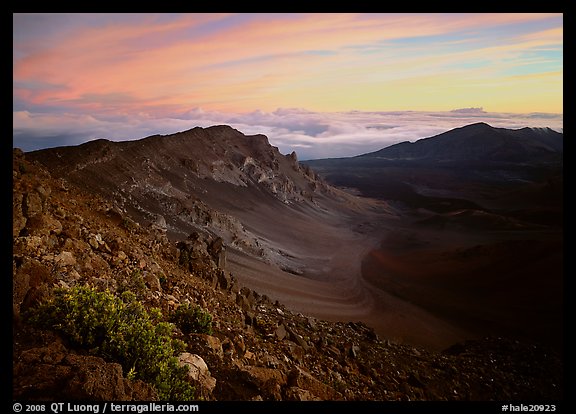
The next day, I arrived at the visitor center almost an hour before sunrise. Some light already illuminated the sky, growing brighter quickly, as it took on wonderful hues. The crater felt immense, and lunar-like, but looked quite dark.
Although the actual temperature stayed probably slightly above freezing, it felt much colder with the fierce wind blowing. Fortunately, I had packed for this “tropical vacation” a fleece jacket, a mountaineering-grade shell, and gloves. Almost a hundred people already huddled near the visitor center to seek protection from the wind. I left them by hiking half a mile to the summit of White Hill. Since I had slept at high elevation the night before, I was well acclimatized and did not feel the effect of hiking in the thin air.
Everybody wants to experience a sunrise on the “House of the Sun”, but in fact the light is quite difficult at that time. When I looked directly east, the contrast between the sky and the portion of the crater beneath, backlit and shaded by a ridge, was too extreme to yield a good photograph even with the aid of a graduated neutral filter – which also caused a lot of flare. Instead, I pointed my camera north, creating a image all about the contrast between the brilliant pre-dawn sky, the rim beginning the receive some light, and the rest of the crater is in darkness.
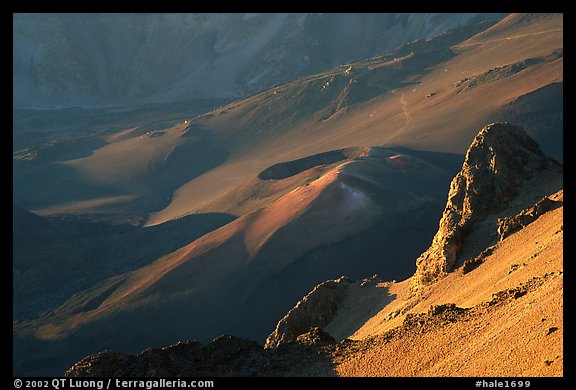
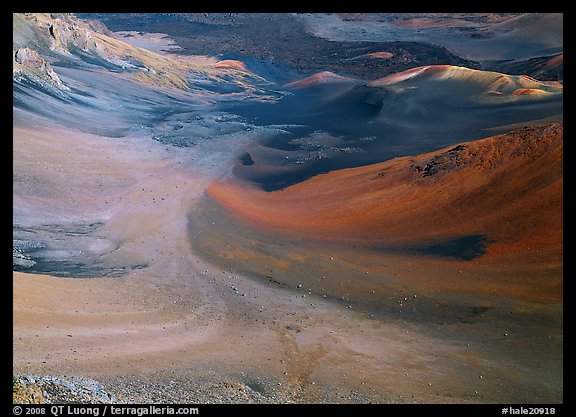
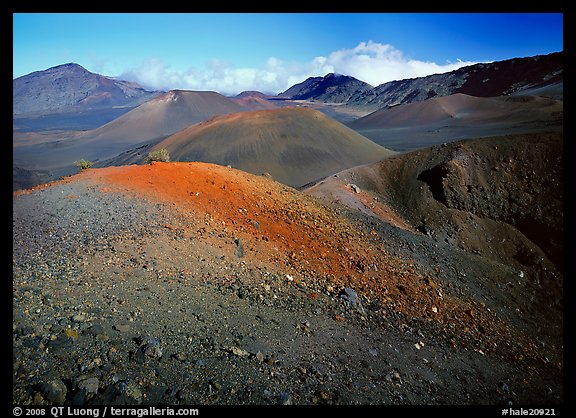
Although they were difficult to see at that time, I noticed within the crater some interesting color patterns created by the ash flows that looked promising. In the morning, I did more exploration around the crater, planning for my next sunrise shot a few miles down the road, from Kalahaku, where I would on the distinctive cinder cones within the crater – with a more favorable light direction. At mid-day, I returned to the White Hill. The direct, bright light revealed the bright ash colors that the pre-dawn light had only hinted too. The image was all about those colors and patterns. I then found more of those colors by hiking down a portion of the Sliding Sands Trail in the afternoon, when the light on the crater is actually better. On that winter day, I was lucky that the view remained clear all day, as clouds often roll in as early as mid-morning.
View more images of Haleakala National Park
View more images of Haleakala Crater
The application functions like an almost unlimited coffee-table book, showcasing images in an attractive format, with many smart features including tags, interactive maps, descriptions, favorites, and suggestions, all taking advantage of the new capacities of the Apple mobile devices.
As there are more than 900 UNESCO World Heritage Sites in 150 countries, the collaboration mechanisms of Fotopedia allowed to gather more than 25,000 images, selected collectively by the Fotopedia community. The exceptional breath of the collection had the flipside that the quality of the photography was not always consistent, despite a great curating effort. This was because the curators had to pick exclusively from Creative Commons images with no restrictions, mostly by amateur photographers, either contributed directly to Fotopedia or imported from other photo sharing sites such as Flickr.
This winter, Fotopedia has released its second application, Fotopedia National Parks, a electronic photo book of US National Parks. The format is the same as Fotopedia Heritage, but unlike it, Fotopedia National Parks uses images from only one photographer: me.
I am very pleased and honored that Fotopedia has chosen to showcase my work in their first “Pro” App – a paid ($4.99) application featuring professional photography. As readers of this blog are familiar with my work in the National Parks, I will not discuss it.
Instead, I will point out to reasons why the application Fotopedia National Parks is worth having, even though the same images are publicly available for free viewing on this website.
First, the application is a great way to view images:


The entire island was created by the Mauna Loa volcano, which now towers 13700 feet above sea level (the world highest peak on an island) and 42000 below the sea, making its total height above the ocean floor the largest of any mountain on earth.
What makes the park one of the most dynamic places on earth is the other volcano, Kilauea. It is one of the world’s most active volcanoes, erupting continuously for thirty years. Unlike other dangerous volcanoes such as Merapi in Indonesia (in the vicinity of which I had actually planned to travel in November 2010… that is until I learned about the deadly eruption), the Hawaii volcanoes do not have an explosive eruption. Instead, they spew a fluid and slow moving flow of molten lava, which makes them the most approachable of any volcanoes on earth.
Most of the relatively accessible live lava flows in the park have taken place on the coastal plain lying past the Chain of Craters Road. In fact, lava flows have buried the very end of this road, and rangers direct visitors to a makeshift parking area.
On my first visit, in January 2001, the closest flows required a hike of about 4 miles from the end of the Chains of Craters road. While this doesn’t seem that much, my fiancee and I soon found out that hiking on a recently formed hardened lava field was tough work, in the tropical heat and humidity. You hike cross-country on a very chaotic terrain with unpredictable obstacles, and lava can be very sharp !
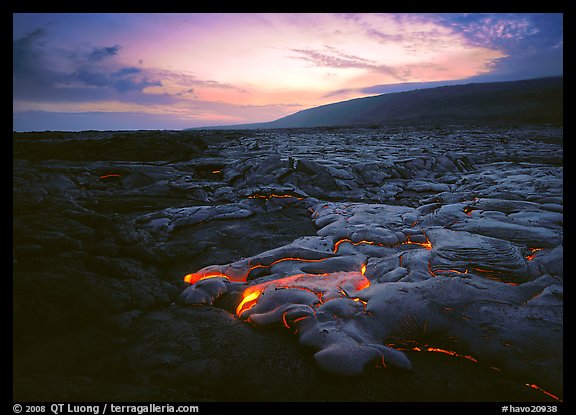
During the day, the red glow of the lava is almost invisible. Molten lava looks a metallic grey which isn’t that different from freshly hardened lava, while old lava is more dark. By the time we got to the flow, since the hike had taken so much longer than we had planned, the night had fallen for a while. The glow of the flow was very bright in the dark, but the rest of the landscape was pitch black, which did not provide for particularly interesting images. Although it was sure heavy to lug around, I did not even bother to set up the large format camera.
On the way back, we were startled and quite frightened to notice that the red light underfoot indicated that lava was actually flowing beneath some of the spots that we had previously crossed by daylight. Where we thought that the lava had long hardened, the flow was still live beneath our feet. We made some long detours, and did not go to bed until a few hours before dawn. We decided against making another attempt on the same trip. This was supposed to be a tropical vacation !
The volcanic activity is constantly changing, so depending on timing there can be no flow at all in the park, or in the best case, the flow can form a spectacular ocean entry close to the road. For a year and half, I monitored the USGS Hawaiian Volcano Observatory website, the best place to get accurate information about the Kilauea eruption.
When I returned, in the summer of 2002, the flow was only a fifteen minute hike from the end of the Chain of Craters road, making it possible for to return multiple times to catch the best conditions at dusk and at dawn. As the lava was oozing very slowy, I was able to get close enough to feel my skin burning, and compose images with a wide-angle lens, as I witnessed the creation of a new layer of land in front of my eyes.


View more images of Hawaii Volcanoes National Park
View more images of live lava flows
Today, among the rubble, a small group of workers are sitting around a tiny plastic table, apparently eating. Although I have decided for my last day in Saigon not to make any photographs, the scene is so visually striking that I cannot help but stop to have an extended stare. The construction workers notice me, and motion for me to join them. A plastic chair is pulled.
They are in fact having rounds of shots. The liquor is quite strong. As I am quite sensitive to alcohol, after three rounds, I manage to excuse myself. In the while, most passing tourists stop to snap a photo of the scene. Everybody seems to be happy that I can speak Vietnamese with them. I am given warm accolades and even kisses as I announce that I’ll most likely be back in half a year.
Of the Lonely Planet list of “top ten” experiences in Vietnam, I was missing the round of drinks in a bar. I guess this will do. What I liked so much here is being an inside outsider, or maybe an outside insider ?
Unlike other Alaska parks, one section of the park can be easily reached. After my extended backcountry adventure in Gates of the Arctic National Park, the complicated logistics of Denali National Park, not to mention Wrangell St Elias, I was feeling ready for a easier trip.
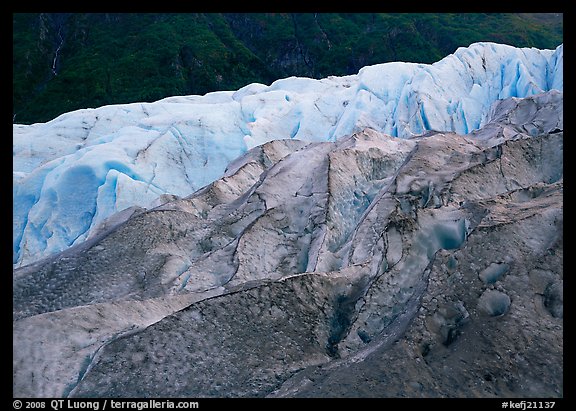
I drove the Exit Glacier Road just a few miles out of the town of Seward. Although the signs there pointed out to winter travel by snowmobiles and skis, in September, it looked like the snow season was still far way, making access through the 9 mile, well paved road, a breeze. From the Nature Center, a half-mile, flat trail (also paved !) lead through a cottonwood forest to a panoramic vista of Exit Glacier. Along the trail signs indicated the date at which the front of the glacier reached that particular position. I was surprised to see how recent those dates were, even though the ice looked quite a distance away.
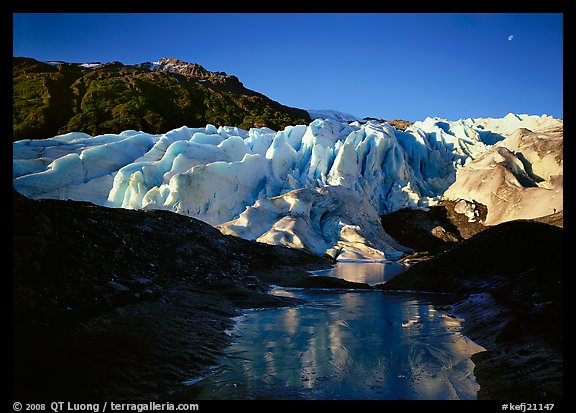
From the glacier viewpoint, the trail branched to two areas of that offer a closer view of the glacier. The trail to the Edge of the Glacier took me near walls of ice. After the sun had disappeared, in the late afternoon, the soft light helped reveal the delicate shades of blue of the ice.
I returned early in the morning the next day, easily hiking the short distance in the dark. I stopped at a small glacial pond that I had spotted the day before, thinking that it would provide interesting reflections when the first rays of sun would hit the front of the glacier. I was pleased to see that it was now frozen with delicately textured ice on its surface adding more interest to the image as two types of ice temporary existed together.
View more images of Kenai Fjords National Park
View more images of Exit Glacier
The park is so vast that many are just content of photographing it from the air, but I wanted to create a large format image that showed some of the Park’s vast glaciers. The scenic Mc Carthy road posed no particular problem for my rental compact car, despite the fact that the car rental companies prohibit driving there. I parked at the footbridge at the end of the road, crossed the bridge on foot, then hitched a ride to the impressive abandoned old copper mining town of Kennecott, situated right above the glacier of the same name. After visiting the ghost town, I hiked to a campsite 1.4 miles north of town to spend the night.
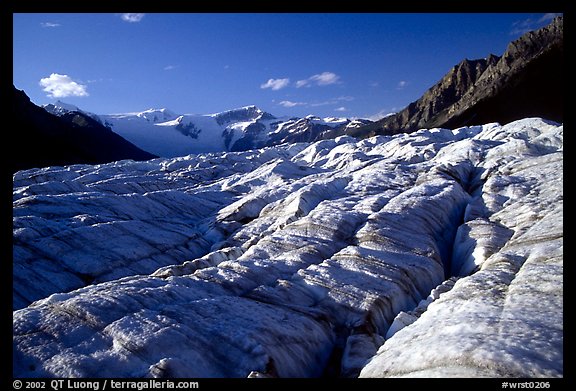
I planned to spend the next few days climbing Donoho Peak, a mountain which lies like an island between the Kennicott and Root glaciers. The first day, I crossed the Root glacier. Since the ice was not snow-covered, there was no danger of falling into a crevasse after a snow bridge collapse, yet navigating around the crevasses and glacial streams proved somehow tricky. The ice was not slippery most of the time, but at one point I had to put my crampons on to tackle more steep slopes. As I was making many photographs along the way, the glacier crossing took a whole day. I set up a base camp at the base of Donoho Peak.
On the second day, I proceeded up the steep scree slopes of Donoho Peak. As I arrived at the top in late afternoon, I was disappointed to notice that the air was extremely hazy, due to distant forest wildfires. The backlit light over the Wrangell range was also not favorable. Although I didn’t carry my sleeping gear with me, having left it at base camp, I decided to spend the night there, in order to capture a hopefully better photograph in the morning. I had my stove with me (an habit left over from my alpine days), so I was able to melt some snow to make water and cook myself a hot meal. I then rearranged rocks to make a flat surface and shelter myself against the wind, slipped my legs into my backpack, covered myself with a survival blanket, and settled for a rather cold Alaskan mountaintop night.
I wasn’t too lucky with sunrise for which I had been waiting, as low clouds blocked the light. Since I didn’t sleep too well during the night, I drifted back to sleep in the warmer temperatures. Eventually, in the early morning, with the clouds parting, the light got brighter. Upon waking up for good, I was rewarded by a commanding view. As I had hoped, the summit of Donoho Peak provided me with a viewpoint which made it possible to picture the sheer size of the glaciers and the Wrangell Range.
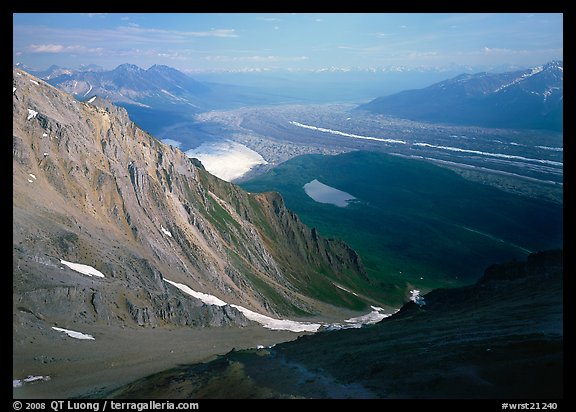
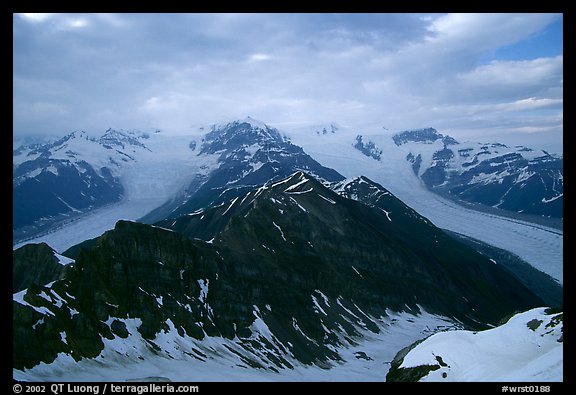
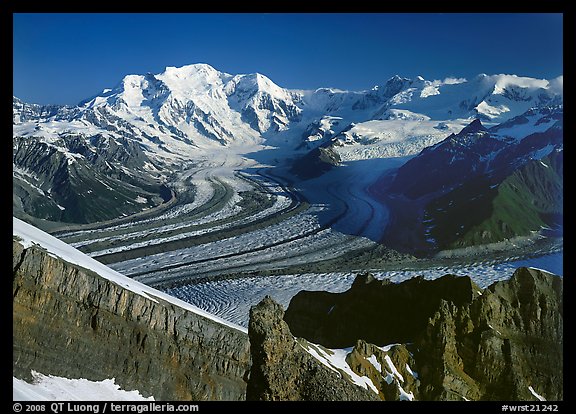
View more Wrangell-St. Elias National Park
View more images taken from Mt Donoho
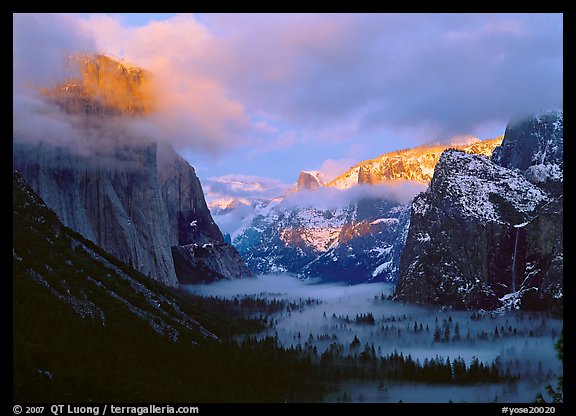


Ansel Adams photographed many times from this viewpoint, as can be seen for example in his book “American Wilderness” and the centennial retrospective “Ansel Adams at 100”. It is the spot where I felt in love with Yosemite. No matter how hard I looked around for a less photographed view, I could not find a viewpoint that captured the “essence” of the Valley better. I felt that Ansel Adams “owned” the view so much that I consider my images made there an homage. However, even when using one of his most often repeated compositions, I still sought a distinctive photograph. An obvious way to differentiate my photographs from his would be to fully use color. That means not merely making a color version of a black and white photograph, but designing the photograph around color, making one that would not work in black and white. I thought about ways to maximize the color contrast. Since the Yosemite granite walls are gray, the most color contrast would be found at sunset between the yellow/orange illuminated cliff tops and the valley bottom, which would turn blue because of the open shade conditions. Blue and orange are opposite colors. Most evenings, the valley bottom would be too dark, but I pre-visualized that fog in the bottom would lighten the valley bottom and enhance the blue tint. One evening, as I was in the Valley, I noticed the fog forming and a hole in the clouds on the western horizon. I rushed to Tunnel View, and here was the image, almost a decade and a hundred visits after I first set foot in Yosemite. A great reward for perseverance!
Gates of the Arctic National Park is one of the largest protected wilderness areas of the world, four times the size of Yellowstone, almost the same size as the entire country of Switzerland.
After flying from San Francisco to Anchorage, and then Fairbanks, we caught a commuter flight into Bettles, the gateway to Gates of the Arctic National Park. As it names implies, this is the routine way to get to Bettles, since the frontier town cannot be reached by road in summer. This was clearly going to be the same for the park. From Bettles, we chartered a floatplane who dropped us off at Circle Lake, inside Gates of the Arctic National Park.
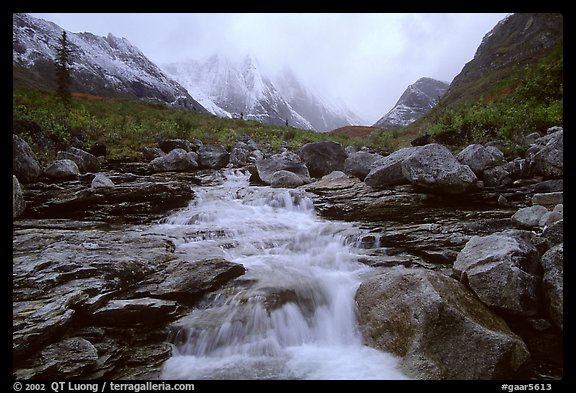
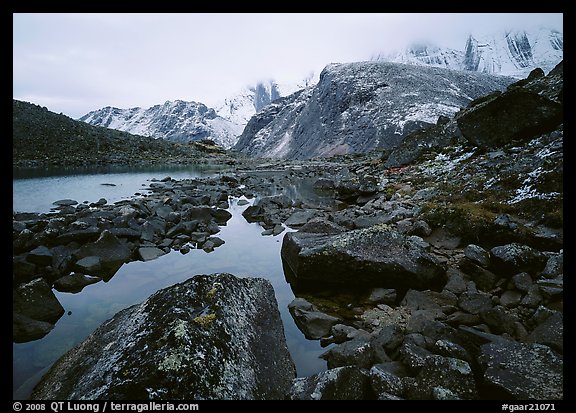
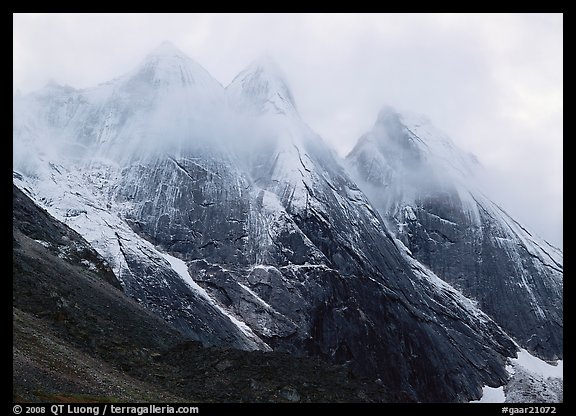
After the plane took off, my friend and I were on our own. With no trails inside the park, we had to find and earn our way, step by step, into the vast tundra. My backpack weighted close to 70lbs (30 kg), with about 25lbs of camera gear and film, nine days of food, and 28 lbs of gear to survive in the harsh conditions found above the Arctic Circle – we found one morning the tent covered with snow in August. Our objective for this trip was the Arrigetch Peaks area, a place of gothic black granite spires and pinnacles considered to be one of the most beautiful mountains inside the vast Brooks Range.
After two days of backpacking along the Arrigetch Creek, we caught our first good sight of one of the most striking group of peaks in the area, called the Maidens. They were obscured by the clouds most of the time, but the few time they revealed themselves made it all the more rewarding, as I was able to picture them reaching for the clouds above one of the most stark mountain landscapes I have seen.
Read detailed account of Gates of the Arctic trip, plus logistics details to help plan your own adventure
This blog, at terragalleria.com/blog, shares field notes from long-term work on public lands along with updates on newer projects. The broader Terra Galleria archive is at terragalleria.com. For QT Luong’s current fine-art projects, please visit qtluong.com.
QT Luong was the first to photograph all 63 U.S. national parks in large format. His honors include the Sierra Club’s Ansel Adams Award for Photography and the National Parks Conservation Association’s Robin W. Winks Award for Enhancing Public Understanding of National Parks. He was featured in The National Parks: America’s Best Idea and profiled in numerous newspapers and magazines. His photographs have been the subject of five books, including Treasured Lands, winner of twelve national and international awards, and solo gallery and museum exhibitions across the U.S. and abroad.