Terra Galleria Photography

Events and exhibits fall 2009

I will be headed for New York City at the end of the week to attend two events in conjunction with National Parks Week NYC. The first event on Tuesday, Sept 22 is a Green Carpet Gala at Ellis Island that promises to be a quite formal fundraiser. A few of my prints will be offered for silent auction there. Since I don’t own a tuxedo, I will be dusting up the suit I bought for my wedding, hope it won’t be too tight :-). In contrast, on Wednesday Sept 23, there will be a free event at the East Meadow of Central Park that includes a concert, appearances, and a preview of the Ken Burns film on National Parks. 8 of my National Parks images – printed on canvas by a third party rather than original prints – will be on view in the VIP tent.

There has been a selection of those National Parks images on display since August at the Balboa Theater in the Richmond District of San Francisco. For a report, see here. That exhibit will run through the end of October, and there might be a talk/slide-show planned for a Sunday, so stay tuned for details.

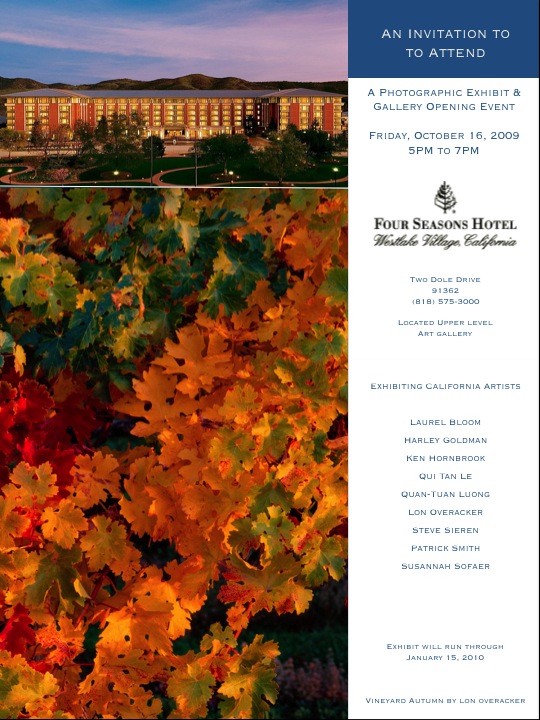
Last, I will be participating in a group exhibit at the Four Seasons Hotel & Resort in Westlake Village, California (near Los Angeles), from October 16th, 2009 thru Jan 16th, 2010.

Book: “The Printed Picture”, by Richard Benson

I have seen many of my images reproduced on a variety of mass media (editorial publishers usually send a copy), sometimes in a somewhat unsatisfactory way. I understood that the limitation of reproductions are due to the problem of having to render continuous varying tones with discrete dots of inks, and that the primary mass color printing process used to solve the problem involved halftone and offset printing, but I never knew how those techniques worked, and why they became so dominant.

In the eighties, I dabbled in darkroom work, doing both black and white and color printing which gave me some grasp of the silver processes. However, I did not know much about the long evolutionary history of those processes, how they came to be that way.

Besides my own photographic practice, I try to see many as many photographs as I can, either in exhibits or in books. This made me aware of the variety of methods that can be used to make a print, such as carbon printing, cyanotype, platinium/palladium, contact printing on azo and dye transfer. And then, there are all of the “historic” processes, such as wet-plate, who have been revived with great effect by photographers such as Sally Mann (whose new show, Proud Flesh opens today in NYC). I had a basic knowledge about all those, but never really understood the relationships between them, and why those various prints look the way they do.

Reading The Printed Picture by Richard Benson answered all those questions.

Richard Benson is possibly the most authoritative voice on printing today. A former dean of the Yale School of Art, he is a photographer exhibited in such venues as the Museum of Modern Art (NY) and the Pace McGill gallery. As a offset printing expert, he helped create reproductions of the seminal “The Work of Atget”. His personal interest in printing led him to collect many historic prints and reproductions, some of which are shown in the book.

The Printed Picture surveys the whole history of image printing processes, from the earliest books to today’s digital processes, with a particular emphasis on the photographic image and its reproduction.

Venerable process such as woodcut, engraving, etching, and lithography are first described. The attention then turns to the fundamental principles of silver-based photography, including the latent image, through an examination of daguerreotypes, early silver papers, and tintypes, before the innovation of the dry-plate that opened the door for photography to “become more like poetry than carpentry”. The problem of reproducing photography in ink is tackled next, through letterpress halftone, gravure, collotype, and then photo offset lithography. A short discussion of digital printing concludes the book. Benson has a word there to say about inkjet prints versus lightjet prints, but that would be a subject for another post.

Although I haven’t counted them, there are probably more than a hundred processes described. For each of them the ideas and mechanics are described concisely but precisely, in a one-page essay facing at least one visual example, which is enlarged so that the astonishing craftmanship of some the earlier methods can be seen. Understanding all the steps involved in some of the processes still require quite a bit of concentration, not because the description is confusing, but because those processes are so complex. One cannot help but marvel at the ingenuity used to produce something that nowadays we tend to take for granted.

What is most remarkable is that Benson manages, despite the tremendous amount of information provided, to weave threads through clear classifications that illuminate the evolution of each process through its relationship with previous processes. One example of such classification is his division of processes between relief methods (ink is laid on raised surfaces), intaglio methods ((ink is laid in depressions), and planographic methods (ink is laid on a flat surface). The evolution from stone lithography to modern offset printing, or from early engravings to rotogravure becomes clear. Color reproduction, with its unique challenges, is given a distinct thread that ends with some warnings about the limits of color management that echo my experience, and that of other experienced printers I have talked to.

Beyond the technical explanations, which are presented with the highest clarity I have seen, the book is much enriched by Benson’s musings on esthetics. Much of the book has a lively and conversational tone. The author is never afraid to tell us his personal opinion about each of the process described. For example: “Despite its occasional successes, gum bichromate is a poor process, unable to render the clear and beautiful tonalities that lie at the core of the photographic medium”. He even goes on more philosophical considerations about photography in general, and its enormous cultural and social influence, such as “The power that the photograph gets out of its assumed connection to the world from which it was made is almost always stronger than the idea of the artist who tries to alter it”.

The idea that the medium’s artistic accomplishments cannot be separated from its technological innovations was the main organizing theme of John Szarkowski’s history of photography, Photography Until Now. In turn The Printed Picture makes the point that the characteristics of a given process affect the meaning of the image reproduced by it. I’ve learned a lot from the book and highly recommend it to anyone interested in the medium.

National Parks Travelers

If you’ve followed the PBS link at the end of my post about the Ken Burns National Parks film, you’ve seen that collecting the National Parks stamps that can be obtained at visitor centers has been a popular hobby. More than a million of the “Passport” books designed to collect the stamps have been sold. There are stamps not only in the 58 National Parks, but also at each of the 391 National Park Service units that include a hodgepodge of designations, such National Monuments, National Historical Sites, National Lakeshore, National Memorial, etc…

I knew that others make an obsessive pursuit of visiting National Parks and NPS units. I had read about a person who visited all the units. However, I was surprised when I received an email last week from Nancy Bandley, the president of the National Park Travelers Club (NPTC). Some of the descriptions here are straight from that email. Nancy pointed out that the club includes 14 members who have not only visited all the 58 national parks, but all 391 national park sites in the NPS system. They even have a program with the NPS to write letters of congratulations to any one in the club who achieves what they call the Platinum Member status- visiting all 391.

The website of the club is http://www.parkstamps.org. Access to most of the site’s contents requires a free registration. There is a forum full of trip reports, where members quiz each other by posting “mystery photos”, details of obscure parks that are in general, amazingly, quickly solved.

At first, you get the impression that the club is heavily focussed on collecting the stamps. Parks with several visitor center locations have several different stamps, whose exact locations are listed. The passport stamps continue to grow rather exponentially with the addition beyond the 391 to National Trails, and National Heritage Corridors. One corridor, Hudson River Valley, has 61 stamps in it alone. They helped Eastern National, the organization who created the passport program for the national parks, design a new passport called the explorer edition- it is larger, has a loose leaf binder arrangement to add in more pages, which is rapidly becoming more imperative to the serious visitor and stamp collector. This month alone brought 13 new stamps for a new Heritage Corridor, the Gallah Geechee. However, Nancy kindly made it clear that although it may seem that the emphasis is on stamps, it is not the primary purpose of the group, that is park visitation.

Ken Burns used the “stamps” sequence out of an hour-long interview for the film. However, in my quest, the focus has never been into just visiting the parks, but rather (a) to photograph each park with a large format camera (b) to photograph each park extensively enough so that the image collection is truly representative of the place. To this effect, I have visited each of the National Parks on average more than 3 times, being less than 10 parks away from having visited them all twice, returning to many locations several times, in different weather and seasons.

I do not even have the Passport. Instead, I just used the front endpaper pages of the National Geographic guide to collect the stamps. Mine was the first edition of that guide. Although subsequently I sought a number of publications more specifically geared towards the photographer (this would be the subject of another post), I have found the National Geographic Guide to the National Parks of the United States, now it its 6th edition, to the best all-around guide to the National Parks. That was the book used to plan most of my travels.

It would be nice if modesty prevented me from mentioning that in 5th and 6th edition, National Geographic used more than 40 of my images, including the sunrise image of Cholla Cactus in Joshua Tree National Park as the book opener in the 5th.

Speaking of resources for National Parks travelers, let me also mention a few free ones, besides, of course, the NPS site. That site has much improved over the years, and now gives easy access to all the official maps (which used to be buried in a hard-to-locate section) and brochures. They are still lacking a bit in the photo department, though 🙂 The aptly named http://www.nationalparkstraveler.com is the best source for daily news and updates about the parks. In addition, Kurt Repanshek, the editor, and his collaborators also regularly post great features, such as the traveler’s checklist. The National Parks Foundation offers the extensive National Parks Owner Guide for download. There is also a section with a lot of information at the National Parks Conservation association.

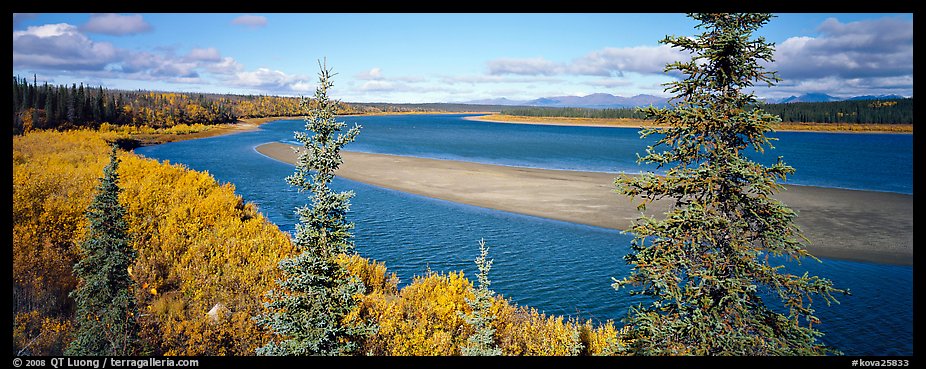
By he way, the first photo is from Kobuk Valley National Park, the least visited of the 58 National Parks. That quiz was not even in the ballpark in listing Big Bend as least visited (NPS statistics). The previously cited sites are much less likely to have that kind of errors !

New images: Sonoma Coast

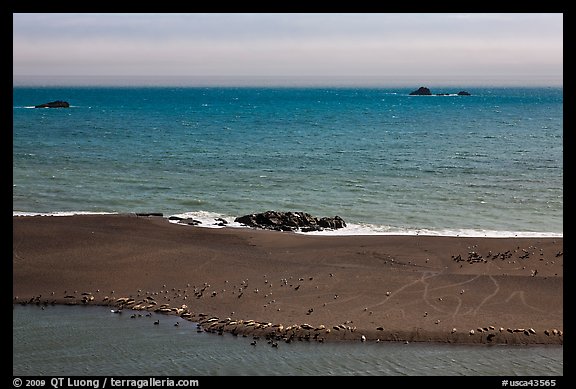
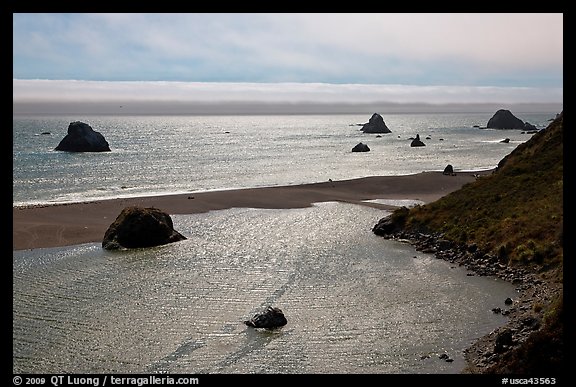
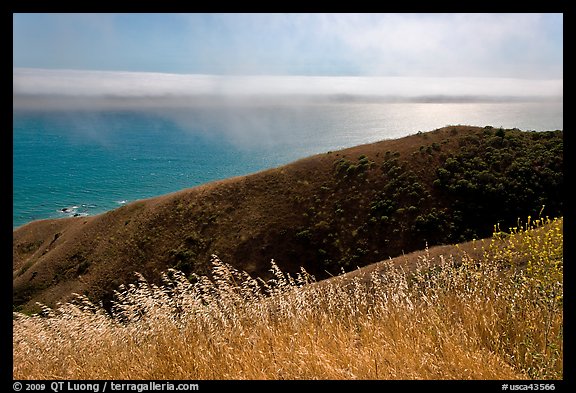
I’ve posted new images from all areas of Northern California . In this note, I will highlight a few favorites from the Sonoma Coast.

It is rugged, isolated, sparsely populated and relatively sparsely visited section of coast, which is often shrouded in fog during the summer. When the fog lifts, before burning out it creates a thin veil that softens the otherwise harsh California light, and can help reveal shimmers and colors, as in the images below, taken between Jenner and Fort Ross. Just out of the town of Jenner, there is a wide pull-out, which is several hundreds of feet above the beach, from which you can often look straight down a large colony of harbor seals. The next few miles, Highway 1 climbs five hundred feet above the Ocean, with spectacular views. With hairpins turns, and sharp drops, that’s probably the most impressive section of Highway 1 on the entire coast.

Administrative note: when I post new images in existing galleries, they are often mixed with older images, and often the pages are rearranged. If you want to see only the new images, use the button “List most recent images”, which was in the advanced search page, but that I have recently repeated on the home page. So far, I’ve tended to update the site twice a month, with releases of around 100-150 images. In the future, I will probably do more frequent, but smaller updates, that will be easier to follow.

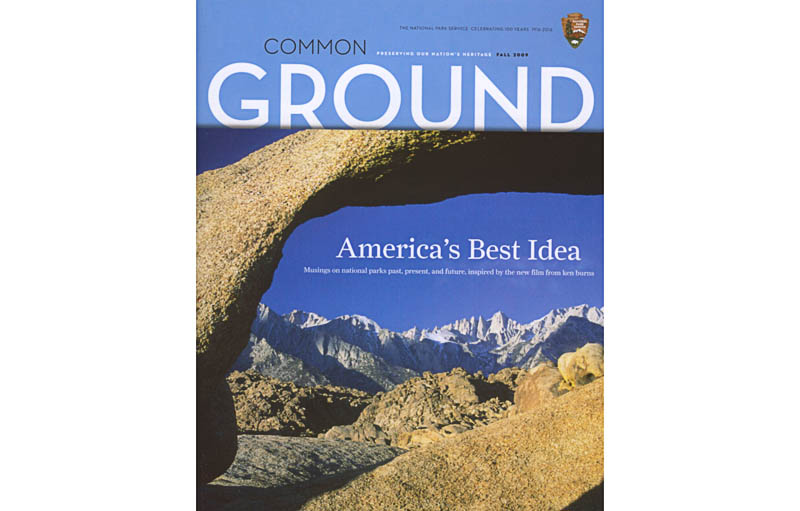
The National Parks, Ken Burns, and Photography

(original image)

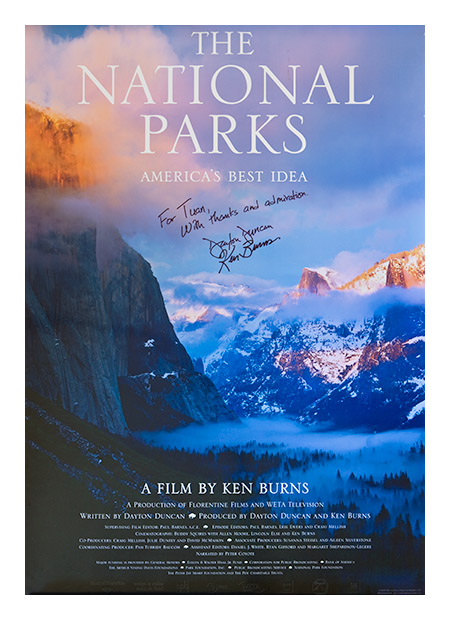
Ken Burns doesn’t need an introduction, especially from me. Unlike most everyone who begins his speech this way, I will actually not provide one, but instead focus on his new film, The National Parks, America’s Best Idea, and my small part in it. The film is coming to PBS in exactly a month, between September 27 and October 2, two hours a night. I cannot recommend it highly enough.

I first saw previews of the film in San Francisco in April this year. In May, I was invited to Mountainfilm in Telluride, where I exhibited a dozen of images and participated in a joint Q&A session with Ken Burns. I had the pleasure to share a suite with Shelton Johnson, a Yosemite NP ranger with such a great personality, voice, and insight that he appears in each of the six episodes of the film. During the festival, where the “The National Parks, America’s Best Idea” premiered, I saw the entire 12 hours of the film.
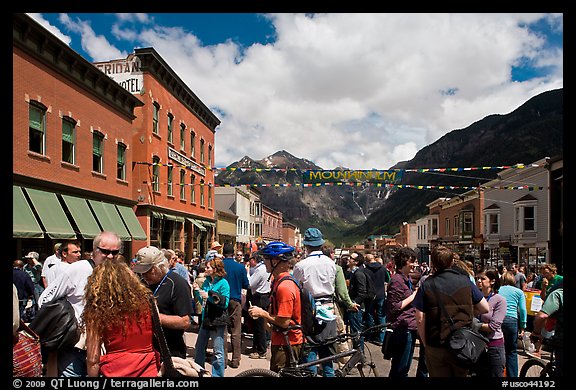
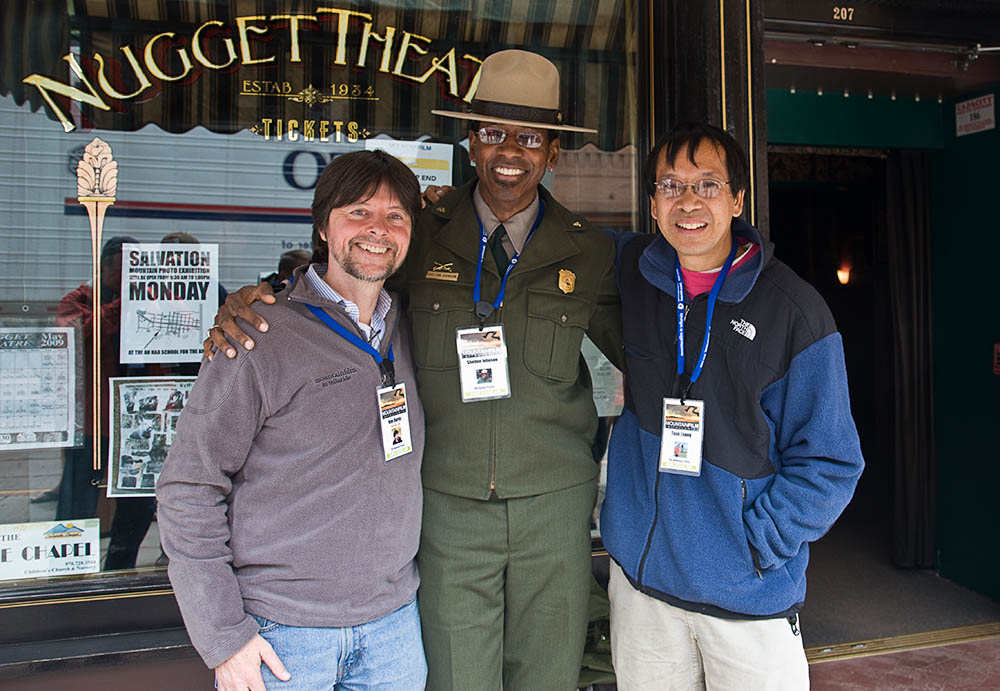
The beautiful cinematography was a treat on the large screen, all the more enjoyable because I was able to recognize most locations. However, the focus of the film was not on the scenery, but on the human history. Like all the previous Ken Burns series, the film chronicles an important aspect of American history and invention. It is a story of democracy in action, through a uniquely American idea: that the most special places in the country should be preserved, not for some privileged people, but for everyone.

I learned so much about the dramatic struggles and historical characters who made the National Parks possible. They ranged from icons such as John Muir, whose remarkable story is told in great detail, to a score of people whose name I hadn’t heard before, in spite of their importance to the National Parks. For instance, before George Melendez Wright undertook his studies, it was an official policy to feed garbage to the Yellowstone bears in front of tourists.

Most unexpectedly, I was very moved, often to tears, by several episodes. It is a absolutely compelling story, marvelously told.

As photography had, from the start, played an important role in helping the parks get establish, many photographers are featured in the film, incidently all of them working in large format. William Henry Jackson’s photographs helped convince people back East that the wonders of Yellowstone were real. The Kolb Brothers pioneered photography in the Grand Canyon. George Masa, a Japanese immigrant, was instrumental in the founding of The Great Smoky Mountains National Park and the mapping and building of the Appalachian Trail. Ansel Adams took the images that convinced FD Roosevelt to approve Kings Canyon National Park – although FDR knew that he would never personally get to see those scenes himself. To this effect, Ansel sent a portfolio to the secretary of the interior, who showed it to FDR. However, FDR decided to keep the portfolio for himself. Ansel Adams was subsequently hired to photograph each of the National Parks. At that time, there were only about 25 of them, but he missed one. Almost last, Bradford Washburn, used large format aerial photography to map Denali and then pioneer a new climbing route to the summit. His appearance on camera was particularly moving, as he has since passed away.
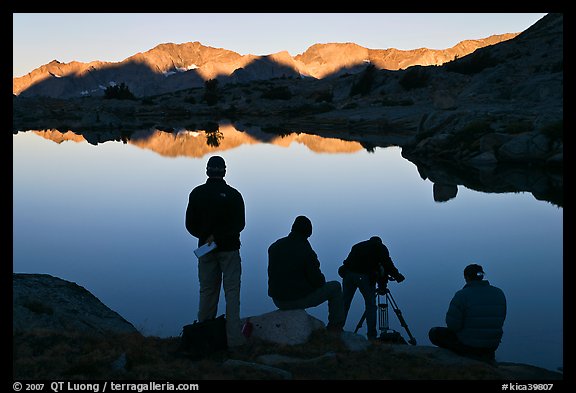
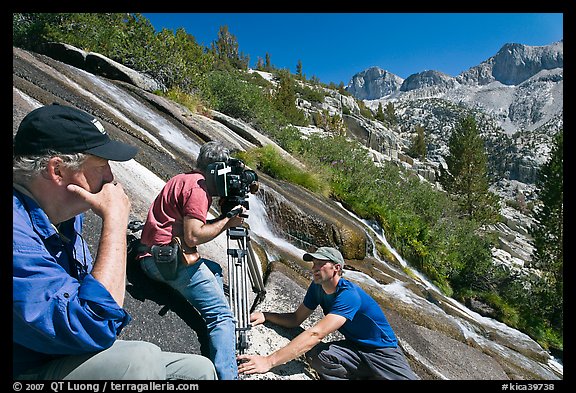
As the Parks themselves are characters in the film, Ken Burns and Dayton Duncan undertook an extensive location filming program, taking them to 53 of the 58 Parks. In the course of researching those locations, they found my National Parks gallery. At that time, I had already visited each of the 58 National Parks, and my website offered a wealth and quality of images of the Parks not available anywhere else, including on the National Park Service website. Many people have written to me to tell me how the images have helped them plan their visits. Much in the same way, the film crew used them to help plan their production.

Subsequently, they became interested in using images to fill missing sequences in their cinematography, as well as to illustrate the companion book since they had only movie footage that does not print as well as still images. In the process of conversations, they became intrigued by the story of my life, which had been changed so much by my project. That would be a subject for another post, but in short it was my involvement with the parks that inspired me to make my home in America, and eventually quit a noted career in Artificial Intelligence to become a full time photographer. My project to photograph all the National Parks, despite the daunting task of lugging a 5×7 inch large format camera anywhere, had been accomplished in the most “democratic” fashion, self-financed, often alone, with no more support than any ordinary visitor to the parks in their own travels.

Dayton Duncan invited me to join their crew on location, which I did twice. In Glacier Bay National Park, a boat was chartered. In Kings Canyon National Park, a pack of mules helped to transport the gear. It was interesting to see how a film crew worked, and to compare the different operating modes of a cinematographer and a photographer. They would look for views where panning adds interest by revealing features that were not visible at the beginning of the sequence. They would notice and try to capture even the most subtle motions, such as the shimmer of water on a Iake, or grasses swaying in the wind. There were similarities, too, besides getting up one our before sunrise. Their hefty tripod reminded me of my first Zone VI wooden tripod (a modified surveyor’s tripod). They even used a changing bag on location to load and unload film rolls. For those not familiar with large format photography, that’s a lightproofed bag with holes for your arms that you use as a “portable darkroom”.
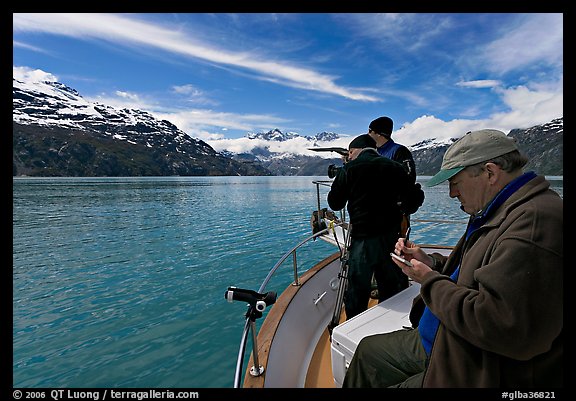
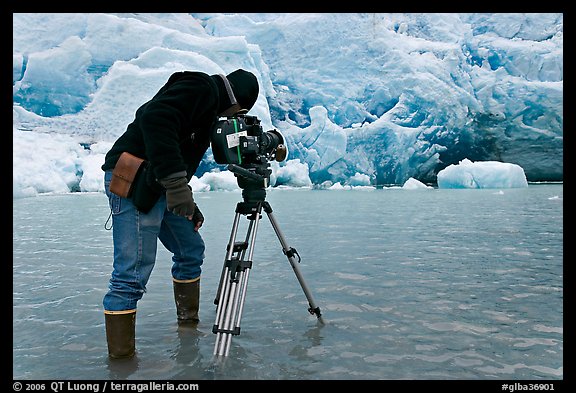
They filmed a sequence of me working on location in Glacier Bay National Park. Previously, Ken Burns had interviewed me in San Francisco for the film. Knowing all his achievements, I was initially quite intimidated on that occasion, so it was a surprise to see how young he looked, and how friendly he was.

I felt very honored to be one of the few living characters featured in the film. From the beginning, I had sought to raise awareness and respect for those treasured lands, a goal I felt I shared with the makers of the film. Part of episode 4, you can see the short segment where I appear on the PBS site. When I saw the film segment in May, I was shocked to hear my thick French accent. I knew that sometimes people had difficulties to understand what I was saying, but that was the first time since becoming an adult that I saw myself on any footage!

Update: Check this post for a more recent link to the clip.

The Beginning

Since I’ve been often asked how I got into photography, I’d like to look back with you two decades ago, when photography took a front row position in my life.

Although the first camera that I used was a prize won in a photo contest (cameras were loaned to contestants for a day) at about age 10, as a child and teenager I was more actively involved in music (I used to play the violin). When it came to art appreciation, I was much more interested in paintings than photography. A favorite hobby was to visit the great European museums.

Vietnamese families in general are not outdoorsy, and mine, although better than most, was no exception. Even though, in France, skiing is such a popular vacation activity that I grew to like the sport. In the eighties, friends in my college’s mountaineering club invited me to join a ski-mountaineering outing. You use downhill skis with a special binding where your heel can be freed for walking up with the aid of skins that you stick below your skis so that you don’t slide backwards while climbing. Free from the need of ski lifts, pristine mountains become your playground, away from the crowds, machinery, and development.

My life, which so far had been largely urban, was quickly transformed by the wilderness of mountains. I felt that although so close, the High Alps were a world apart from anything I had seen so far in my life. The engagement and effort of mountain climbing only magnified the emotions of being in such a special place.

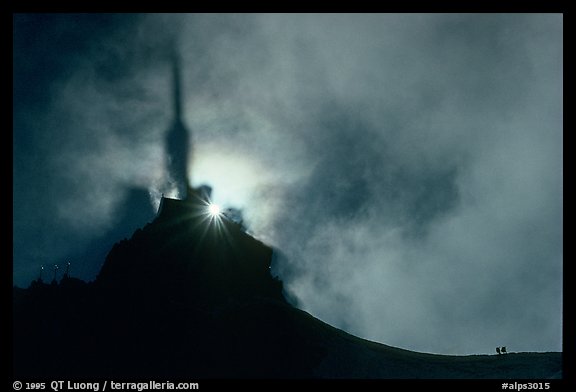
Much like Galen Rowell before, as I became a climber and then a mountain guide, I got interested in photography as a means to communicate to people who weren’t there the wonders I had seen on the high peaks of the Alps. This is one of my first memorable image. It captures an example of the magic of the high mountains, the “Broken Spectre”, an apparition-like atmospheric condition of shadows thrown up clouds behind an object.

This was taken with a Minox camera that I always carried in the chest pocket of my climbing bibs. Although it can look large compared to today’s ultra-compact digital cameras, in the days of film, because of the size of the cartridge and the need for the lens to illuminate a “full-size” 24x36mm frame – which is larger than 99.9% of today’s digital cameras – the Minox was truly tiny compared to other cameras with manual controls. I was very fond of the Minox. For a few years, this was all I was willing to commit to photography while climbing.

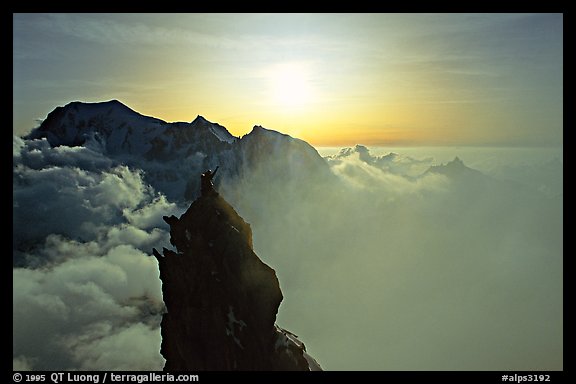
On one of the last days of the summer of 1992, I guided a group from the French Alpine Club up the Dent du Geant (Giant’s Tooth), in the Mont-Blanc range. Because the route, steep and technical, was on the South Face of the peak, the view of Mont-Blanc was obscured. One of my fascination with climbing mountains has always been the curiosity about what you can see on the other side, when you got to the top. That evening, clouds and fog rolling in below us close to sunset time, the view from the top was just stunning. The peak had two distinct pinnacles at the top, which allowed me to frame that view of the other members of the group from the main pinnacle, as they stood from the secondary pinnacle.

Now, if you have any experience in technical mountaineering, you will ask: “What were you doing there on that peak that late, since the climb isn’t that long ?”. The answer is that the timing was planned that way, so that we would reach the peak in time for the “golden light” before having to descent the peak with our headlamps in partial darkness. I was also carrying a SLR camera with a 24mm wide-angle lens (the Minox was limited to a fixed 35mm lens). Photography had become the main goal, rather than simply climbing, with recording images a byproduct.

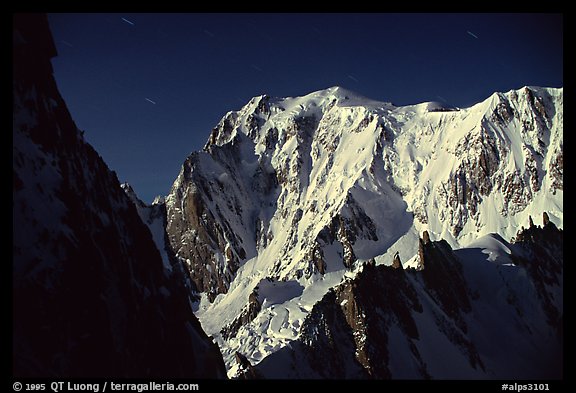
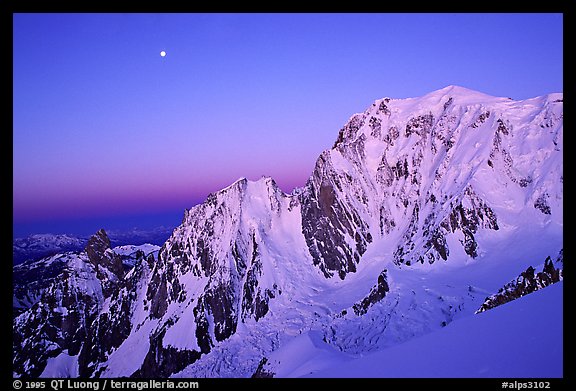
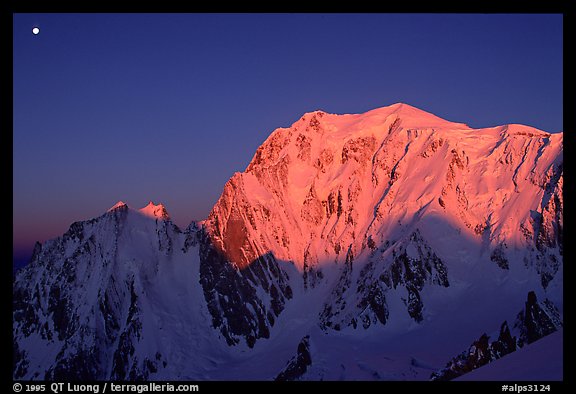
This was actually not the first time I planned a climb for photography. Earlier in that 1992 summer, I bivied on the summit of the Tour Ronde, so that I would be able to photograph the dawn and sunrise light on the East Face of Mont Blanc.

However, what makes the Dent du Geant special is that it happened to be my last alpine climb in the Alps, a mountain range that had giving me so much, awakening me to a new world. A few weeks latter, I would hurt my knee in a bicycle accident, which would put me out of commission for the rest of the year. In early 1993, I would travel to the US, for what was initially planned as a short term stay as a visiting researcher at UC Berkeley. I came to the US simply out of curiosity, as I wanted to see and experience up close a country that was some dominant. I could not guess that I was soon due for another life-changing experience.