Terra Galleria Photography

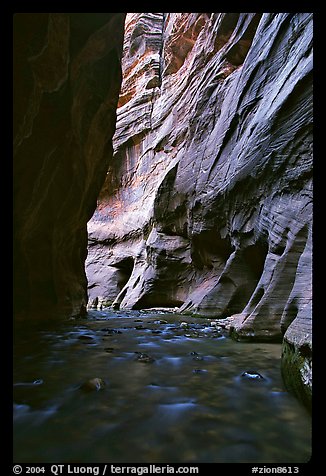
Photo spot 10 : Zion National Park – The Narrows

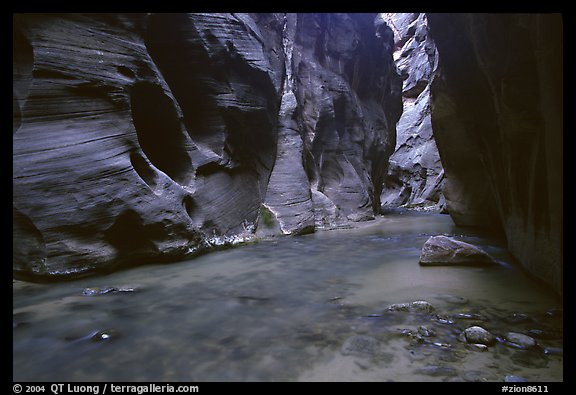
Zion National Park has sometimes been called a “Yosemite in color”. The comparison is apt, since both share a great variety of beauty, both in large scenery and intimate details. Like Yosemite, Zion features at its heart a narrow valley with a beautiful river and vegetation, flanked by sheer cliffs and rock towers.

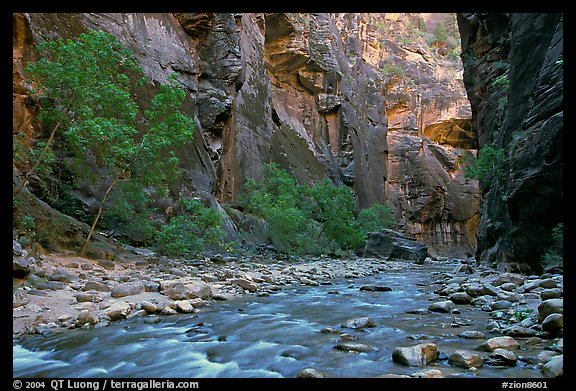
However, unlike Yosemite, the Zion valley hasn’t been carved by glaciers, but instead by the Virgin River. The rock isn’t granite, but sandstone. This soft rock has allowed the river to gouge the Narrows, a deep gorge which in some places is only a dozen of feet wide, between walls that reach a thousand of feet high and spread only slightly to reveal a narrow sliver of sky. Hiking into the Narrows is one of the most unique experiences to be had in a national park, as you are most of the time wading in the river itself.

When to go is decided by a combination of factors. You’ll want to avoid high water flow (spring run-off from March to late May, later in years of heavy snowfall), flash flood danger (at its highest during the monsoon season in summer – if there is a risk of thunderstorm, the Park service will close the Narrows to hiking), high traffic (during the summer), and freezing temperatures (in winter).

My preferred time of the year to hike the Narrows would be in the late autumn. The small maple trees growing on the riverbanks turn shades of yellow and orange. The water level is at its lowest, which makes it easier to carry camera equipment. The cold water temperatures discourage crowds, which are much more abundant in the spring, and at their peak in the summer.

The key is to equip yourself appropriately by renting from an outfitter in Springsdale. At a minimum, canyoneering shoes will help protect your feet from the rocks that litter the riverbed, as well as provide you enough traction to avoid slipping – and falling in the water with your camera equipment – while neoprene socks will keep your wet feet warm. If the temperatures are cold, a dry suit would be useful as well, but don’t worry, as the outfitter will advise you. If you are going to be in the canyon all day, take a warm jacket for the return trip, as temperatures dip in late afternoon.

You also need something to help with your balance, as well as prob the river depth, since the water is not clear enough for you to see the bottom. At the start of the wet part of the hike, there is usually a stockpile of sticks that you can borrow, but a pair of hiking poles is more efficient. Or you could just use your extended tripod. It gets heavy in your hands, but you’d lighten your pack and be able to set-up faster.

The hike starts at the end of Zion Canyon with a mile-long surfaced trail called the River Walk, which in itself is quite nice. At the end of that trail almost everyone turns around, but you will simply step down into the river to continue.

During the fall, in the lower part of the Narrows, the water is between ankle and knee-high, and you can sometimes walk on the edge of the stream, but a few miles up, you may encounter pools that are waist-high.

You could hike up the Narrows for two days (although usually overnight trips are done in the opposite direction, down river, using a shuttle), but to see the narrowest part of the canyon, you just have to go a bit beyond the junction with the Orderville canyon, which takes about 1 hour and half to reach from the end of the Riverside Walk. Another hour and half makes it possible to reach the other end of the narrowest part. You should start as early as you can, so that you reach the narrowest part by mid-day, when there is more light. At the least, you should hike about half an hour to the Mystery Falls.

Like in many locations in the South West, you will be photographing in reflected light, avoiding directly lit spots (that produce excessive contrast). Even by mid-day, it can get quite dark in the canyon, especially during the fall. You will also be making many compositions with moving water, for which a slow shutter speed can be desirable. For both those reasons, a tripod is essential. It is wise to pack your equipment so that a fall in the water would not ruin it. A specialized water proof photo backpack would be handy, although I just used ziplock bags inside a regular backpack. In many places, the canyon exposes a small riverbank where you can set up your gear.
More images of the Zion Narrows
View all images of Zion National Park

QT Luong in Ken Burns’ National Parks series

Missed Ken Burns’ “The National Parks: America’s Best Idea” last fall? The series returns to prime time this winter, with the first episode airing this Wednesday, Jan 27 on PBS, and then appearing on consecutive Wednesdays through March 3. For local times, check the PBS site. Each episode will be also available for online viewing for a week, following its airing. Note that the DVDs have now been released, if you prefer to watch at your own pace. Ken likes to joke that the series is a great excuse to upgrade to HDTV.

I have written before about my role in the movie, but did not provide a clip. Here it is, from Episode 4, considered to be the masterpiece of the series by this reviewer.

This appearance was short, but there were only a few other living characters (as opposed to commentators) and the movie was seen by more than 30 million people. I am often asked, what impact did the newfound fame have?

Not much happened on the web (where I conduct my business exclusively). Immediately after the broadcast, just a few dozens of people added me as their friend on Facebook, or followed me on Twitter. At first, I couldn’t even see any difference in web traffic in terms of numbers of visitors, although I could see that they were more engaged from the number of page views. It’s only when I used the beta Intelligence function of Google Analytics – which makes it possible to monitor events by analyzing logs in a very sophisticated way – that I could quantify the number of new visitors from the first broadcast: about a thousand, a number drowned in the usual thirty thousand daily visitors. Besides a number of queries for my National Parks book (which doesn’t exist yet), impact on the business was minimal.

However, from October to this date, I went to five gatherings: a group show opening in Thousand Oaks, a diving trip to the Channel Islands, a company function for a client in Walnut Creek, a gallery opening for another artist (Jock Sturges) in San Francisco, and a wedding in Anaheim. In each of those instances, I was surprised that one or more persons recognized me from the movie.

The most pleasant, and unexpected surprise is that I was able to reconnect with several old friends with whom I hadn’t been in touch for sometimes more than a decade, as they emailed me upon watching the series.

Photo spot 9: Grand Canyon National Park – Toroweap

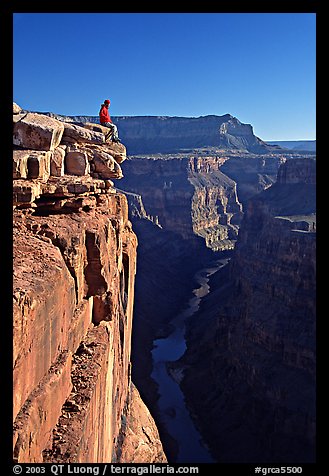
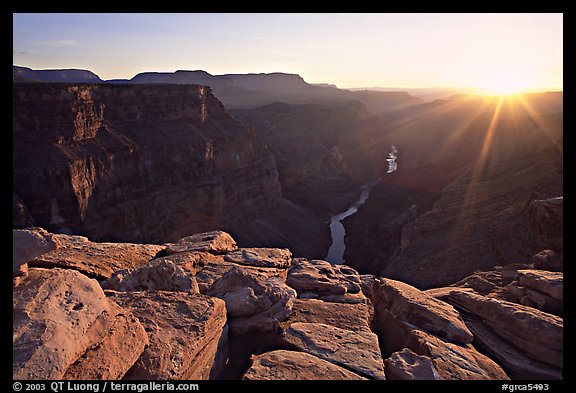
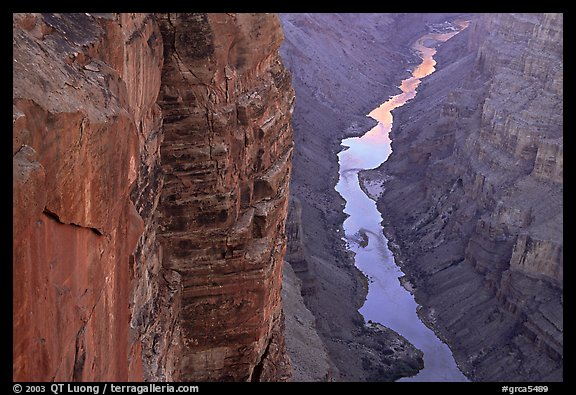
The Grand Canyon defines immensity. It is so vast that the Colorado River, which has carved it, is a distant sight from most overlooks. The only place in Grand Canyon National Park where you can look straight down to the Colorado River from the rim is Toroweap. You will stand at the edge of a shear cliff with a 3000 ft drop with no railings.

While during the summer the overlooks on the South Rim can get crowded well before sunrise, at Toroweap, there is a chance you’ll have the view for yourself, as Toroweap is within the Tuweep Wilderness, one of the most remote areas in the United States. From the North Rim, the driving time is almost four hours.

Toroweap is reached by driving CR 109, a 60+ mile graded, unpaved road that starts 9 miles west of Fredonia on hwy 389. Stay on the most heavily-traveled branch, and you’ll arrive to a ranger station. After 5 more easy miles, the road crosses solid slickrock for the last 2 miles. With careful driving, a normal car can pass that section (I drove a Subaru Legacy), but watch for sharp edges that can cause tire punctures. When you reach the edge of the canyon, the road loops in a circle. You’ll be only a hundred feet from the rim.

One of the most spectacular locations for a sunrise in the Park, the classic view looks northeast as the rising sun illuminates the vertiginous cliff below. For a change, I am displaying a photo of myself, taken with a programmable self-timer. Had my wife been with me, she wouldn’t have let me even think about doing that. Views in both directions are interesting and should also be tried at sunset. You would be camping at a nice, but primitive site just fifty feet from the rim. Do not wander in the dark !

View all images of Grand Canyon National Park

Images of India on exhibit at Balboa Theater, SF

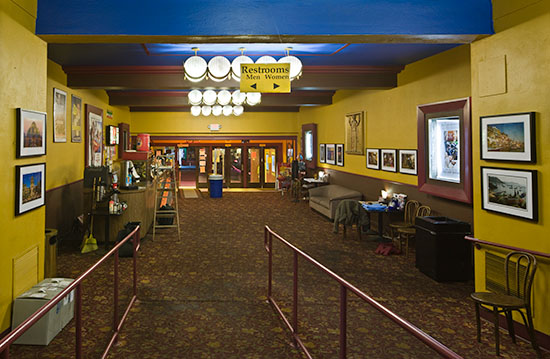
Tired of seeing images of the US National Parks ? Ten of my images from India are on display in the lobby of the Balboa Theater, in the Richmond District of San Francisco, until early March.

It is clearly not possible to portray a multi-religious, multi-lingual, multi-ethic, and multi-cultural country of over one billion people with so few images, but I have tried to create a good mix with a few themes. Each of the images is from a different site in the country, visited during just 12 days of travel in 2007.

New images: Death Valley National Park

Over the course of the next month and half, I will continue posting new images of Western National Parks. Those are of course already well covered on this site, so each update will be rather small, covering either areas for which I had not published images before, or picturing areas with existing images in new light.

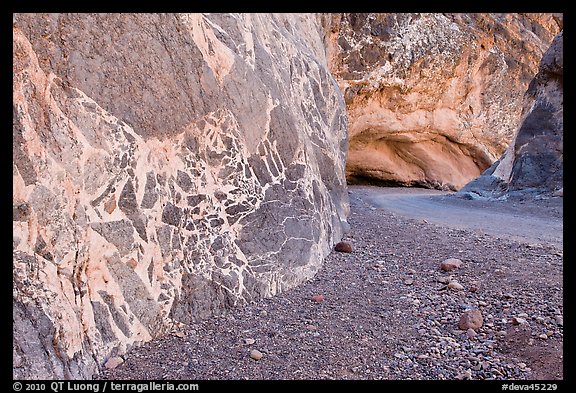
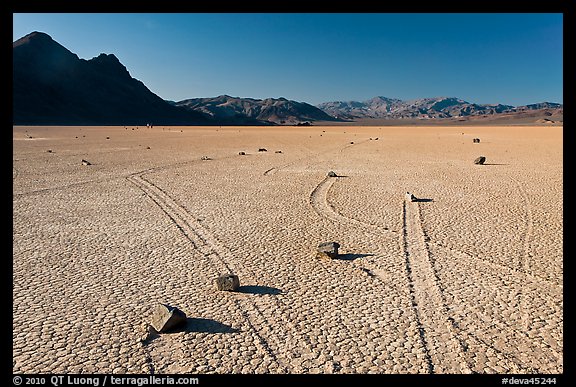
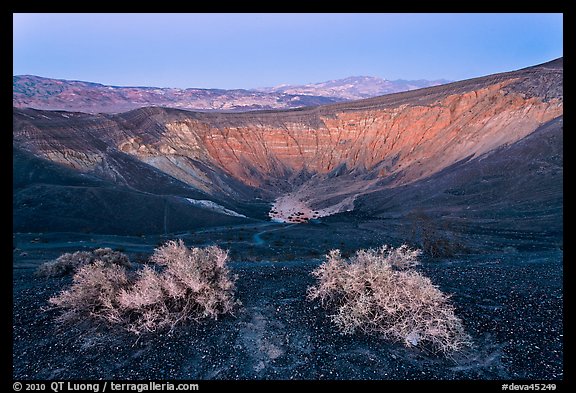
Today’s update is Death Valley National Park, with images taken during a family visit during which we drove down Titus Canyon, stopped at Scotty’s Castle, and then made it to the Racetrack.

Contrary to some reports of a rough road, we had no difficulty with our Toyoto Sienna minivan, taking only about one hour and fifteen minutes from Ubehebe Crater to the Racetrack. The vibrations from the washboard are worse if you drive slowly. I had been to the place four times before, but this was the first family visit to the Racetrack, where the infant strollers proved very convenient ! It was great getting others to see for themselves this unique phenomenon. With more people to spread out and explore, we found more complex networks of moving stone tracks than I had seen before. Since the family did not want to drive back by dark, the light of the Racetrack was not the best, but on the other hand, I was able to photograph Ubehebe Crater at dusk, which as often is the case with volcanic landscapes, turned out more interesting than the daytime images.

Photo spot 8: Lassen Volcanic National Park – Cinder Cone

Lassen Volcanic National Park is a real-life dictionary of volcanic geology. The volcano had a series of eruptions less than a century ago, creating cinder cones and hardened lava fields, as well as active features such as hot springs, hissing, steaming fumaroles, boiling mudpots and pungent sulfur vents that are reminiscent of Yellowstone National Park, although at a much smaller scale.

What differs from Yellowstone is the visitation, which is one order of magnitude smaller. Among the best kept secrets of the many natural treasures in California is that even in the middle of summer, a visit to Lassen Volcanic will be uncrowded. This is especially true if you explore areas other than the scenic drive (highway 99), which is the main focus for most visitors.

A wonderfully quiet such out-of-the-way area is found around Butte Lake. The crown jewel there is the Cinder Cone. From its top, which can be reached through a hiking trail (unlike, for instance the Sunset Crater, off limits to hiking), there are impressive views of the volcanic landscape, over the Fantastic Lava Beds, Painted Dunes (that I find particularly unique), and Mt Lassen in the distance. The cone itself is also interesting, as you can hike two concentric crater rims circling a bowl-shaped crater. You can photograph wide panoramics, or concentrate on abstracts.

To get to Butte Lake from the main road through Lassen Volcanic Park (Highway 99), exit the north end of the park, drive Highway 44 to Old Station, head east towards Susanville, and then turn south on gravel road that ends near a pleasant campground.

The trail to the top of Cinder Cone is 4 miles round trip, 5 if you circle the cone by following the trail down on the South Side to get a close view of the Painted Dunes, which I recommend. It starts at the parking lot, and follows the edge of the massive lava flow called Fantastic Lava beds. The Cinder Cone is 800ft high. Being steep, and made of loose cinder (surprised ?), it is quite strenuous to hike up. Volcanic landscapes can be harsh looking at mid-day. If you want to get there for sunrise, you should depart the trailhead in the dark, no later than than one hour before sunrise.

View all images of Lassen Volcanic National Park.

Photo spot 7: Kings Canyon National Park – Dusy Basin

Kings Canyon National Park features two easily accessible sites: a beautiful sequoia grove (Grant Grove) and the deepest canyon in the country (the Middle Fork of the Kings – about twice the depth of the Grand Canyon), however at least 95% of the park is backcountry with no road access. Since in the previous posts of the series, I’ve described locations relatively close to the road, for a change I will now describe a site that requires backpacking (although easy).

In my opinion, the most spectacular parts of the park are those near the Sierra crest. That’s where Ansel Adams took the images that convinced Franklin Roosevelt to approve Kings Canyon National Park – although FDR knew that he would never personally get to see those scenes himself. To this effect, Ansel sent a copy of his first book of landscapes, entitled “Sierra Nevada – The John Muir Trail” to secretary of the interior Harold Ickles. Ickles showed it to FDR, who promptly decided to keep it for himself. Kings Canyon National park was conceived by Ickles as a “wilderness park”, free from roads and large developments, and except for the two previously mentioned sites has remained largely that way.

Dusy basin is one of my favorites high Sierra locations. A number of alpine lakes of various sizes, nested in a huge cirque mostly above tree line, reflect The Palissades, one of the most dramatic mountains in the Sierra.

The location is one of most accessible in the high Sierra. In fact, it could be visited on a long hiking day. Nevertheless, it is best to camp there for one or two nights, as the light would be better and the basin has much to explore. The view towards the Palissades is best at sunset. Being the highest mountain range east of the Pacific Ocean, the Sierra crest can catch remarkable alpenglows if the conditions are right. The Palissades are backlit in the morning, but do not neglect other views at sunrise.

Dusy Basin is free of snow from July to the first fall snowfall, which rarely occurs before late October. The stable summer weather of the Sierra makes it an easy backpacking destination. During my first trip there, my wife and I took only one sleeping bag between the two of us, and we did not carry a tent, as my 5×7 camera kit was already plenty of weight. My second trip was quite a different experience, as I traveled with Dayton Duncan, his son Will, and the Florentine film crew of “The National Parks, America’s Best Idea” all supported by a mule train and two cooks who prepared fresh food. You can hire Rainbow Pack Outfitters (which were great) for yourself too if you want to travel in style and comfort into the backcountry.

Free wilderness permits can be obtained at the ranger station in Bishop, or can be reserved in advance for $5 per person per day. From there, it is a 22 miles drive to the South Lake trailhead (9,800’). The basin is reached through Bishop Pass (11,960’, about 5.5 miles). Less than a mile after the pass, you’ll see a nice bivy spot under a tree, next to the trail. Wander cross-country left (east) of the trail from there to find a nearby attractive campsite next to the closest lake. With time, more lakes with different views can be found by hiking cross-country, or by following the trail that continues down to Le Conte Canyon.

View all images of Dusy Basin

View all images of Kings Canyon National Park

Presentation at NANPA 2010 summit in Reno

Each year the North America Nature Photography Association organizes a conference called the Nature Photography Summit, or in short “Summit”. Diverse presentations, a trade show, multiple opportunities to share images, as well as optional portfolios reviews and workshops make it a great opportunity to be inspired, learn, and network with other nature photographers.

I first attended the 2004 Summit in Portland, Oregon. I had a great time, which inspired me to contribute more actively to the Summit.

The 2010 Summit will be held Feb 16-21 in Reno, Nevada. I will give a presentation on my project to photograph the 58 US National Parks on February 19 from 10:00 AM to 11:30 AM, including a discussion of the project background, a quick tour of the 58 parks, and a behind-the-scenes look.

More details about the summit are here. If you plan on attending any portfolio reviews, you should register as soon as possible, since the most popular reviewers are already sold out. Moreover, to get the early bird discount, you need to register before January 18. If you plan to attend specific talks (including mine), be sure also to enroll in the registration form, since seating is limited.

By the way, the cover image for the 2010 Summit is one of my Lake Tahoe Winter pictures.

Photo spot 6: Capitol Reef National Park – Strike Valley Overlook

Capitol Reef National Park offers more geological variety than any other park on the Colorado Plateau, which itself is possibly the most unique area in America for natural landscapes. You can find there multicolored cliffs and domes, slot canyons, arches, stone monoliths, and badlands.

Most visitors stay on UT 24 and the scenic drive, both of which cover only a tiny portion of the park. Venture on the dirt roads south or north of UT 24, and you’ll make fantastic discoveries. You will see only a few souls during a whole day if you come off-season. These opportunities for solitude, as well as the variety of landscapes make Capitol Reef one of my favorite national parks.

The main feature of Capitol Reef National Park is the Waterpocket Fold, a 100-mile long wrinkle on the earth’s crust consisting of an uplift of sandstone cliffs with colored horizontal layers. After getting the official NPS map of the park, you will notice that they have used an aerial photograph as the cover image, whereas in general the cover images for those maps are landscapes photographed from the ground. This is because it takes a high viewpoint to reveal the structure of the Waterpocket fold, and none is readily available in the park, except for the Strike Valley Overlook, which comes closest.

The Strike Valley Overlook is a remote vista point, far from any facilities, so plan accordingly, which ideally means being ready to camp primitively in the desert under exceptionally clear skies. From the Burr Trail (accessed from Boulder or from the gravel but well maintained Notom Bullfrog Road), take the 3 mile long Upper Muley Twist Canyon road to the north, marked by a “Tour stop” sign. The junction is about a mile from the Burr Trail switchbacks that cannot be missed. The Upper Muley Twist Canyon road can be very rough, but with careful driving does not necessarily require the high-clearance of a 4WD. I have driven it with my Subaru Legacy (not Outback). In doubt, you could always walk. From the trailhead parking, you will see two trails. One heads north into Upper Muley Twist Canyon. The other heads east to the Strike Valley Overlook, first following a sandy wash, and then up a slickrock slope. It takes about half an hour to reach the rim of the Waterpocket fold.

You will be a thousand feet above the Strike Valley with great views. The light is best in the afternoon. Before sunset, the Strike Valley is in the shade, but at dusk, the light becomes even again. I suggest driving by night to Halls Creek overlook, which is nice at sunrise.

View all images of Capitol Reef National Park

New images: Crater Lake National Park

I’ve posted a few new images of Crater Lake National Park from last summer.

I got up twice at 4am for the sunrise, but it didn’t work as planned. I went to an unmarked spot about 2.1 miles west from the Rim drive/Rim village junction. If you are not afraid of heights, from a large pullout, scramble up the slope on the left and then down to a natural promontory atop a narrow pinnacle. You will be on an incredible position with a 180 degree view of the lake.

The first day, a bar of low clouds on the eastern horizon totally suppressed the color at sunrise. I came to that same point the next day, but as a low cloud closed in, reducing the visibility to nothing, I quickly moved further south. This allowed me to capture the sunrise, but due to the lower position, there isn’t a good separation between Wizard Island and the rim in the back.

The third image shows more clouds, this time on Mt Scott, the highest point in the park. I abandoned my plans to hike up that mountain.