Terra Galleria Photography

Photographing the Lava Ocean Entry in Hawaii

Part 1 of 3: 1 | 2 | 3

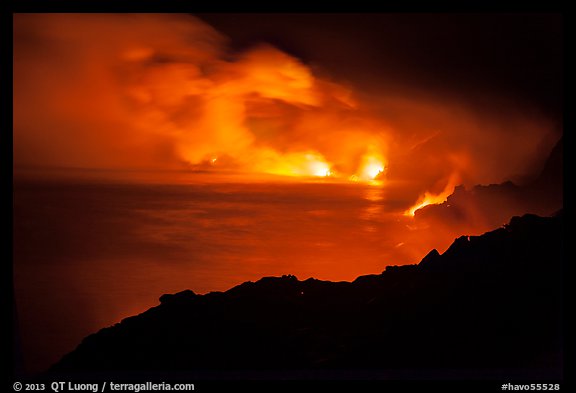
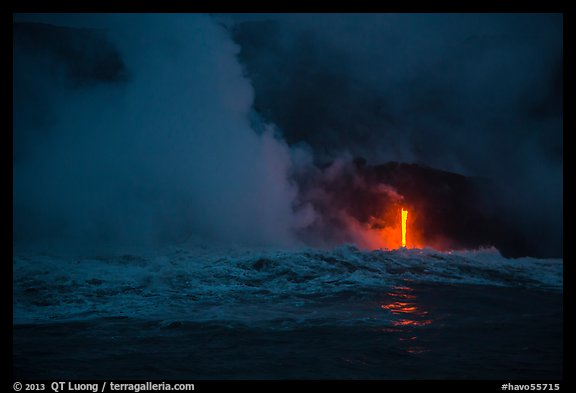
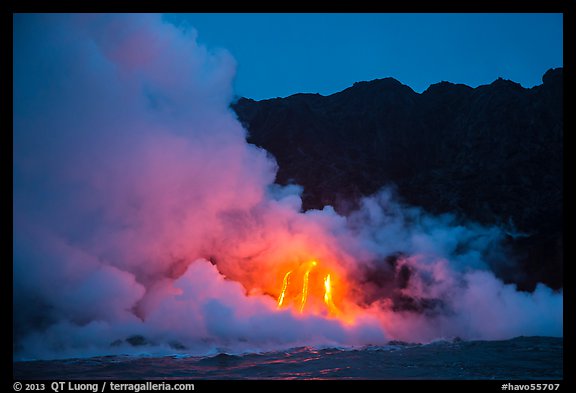
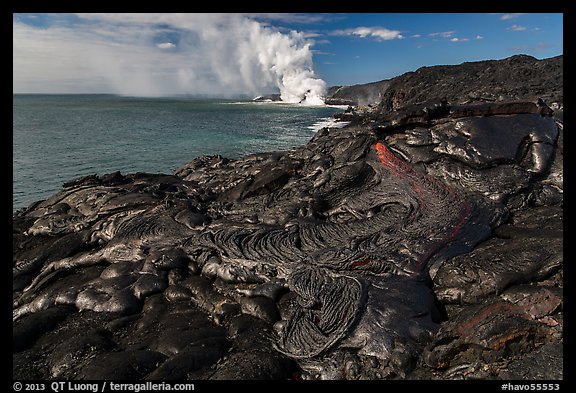
One of the most mesmerizing spectacles of nature you will witness is glowing lava cascading into the ocean to form new land in front of your eyes, as clouds of steam rise from the dynamic meeting of fire and water. This winter, I traveled to the one place where this wonder can be observed readily, the Big Island of Hawaii. In this post, illustrated with recent images, I’ll share what I have learned about visiting and photographing a lava ocean entry by land and boat. I’ll include a number of links to resources as well as detail my own experience.

When ?

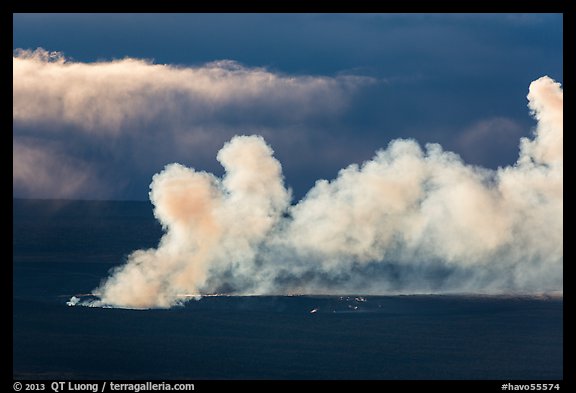
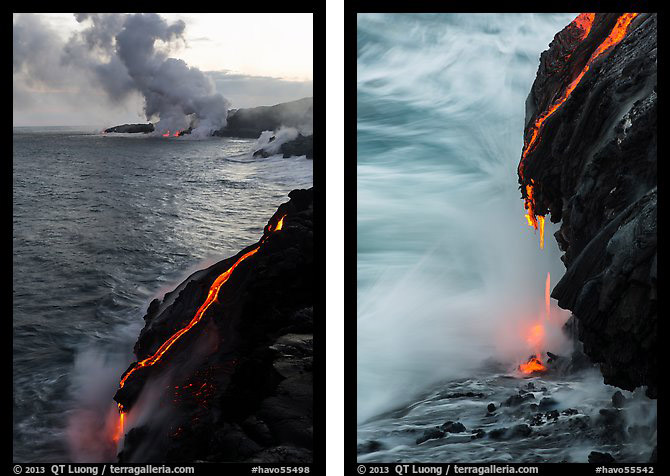
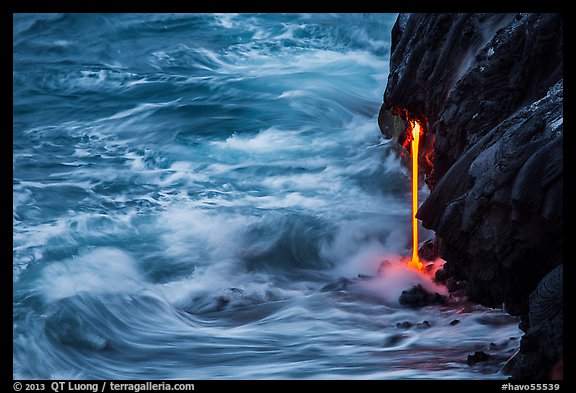
With lava, timing is everything. Although Kilauea has been erupting continuously since 1983, most of the time the lava flows through underground lava tubes which enter the ocean underwater, so there is nothing to see. Visible lava ocean entries occur when the lava pour into the ocean above sea level, often flowing along a sea cliff. Even if most of the lava flows underground, there may be surface flows as well at the same spot, which offer photo opportunities very distinct from the ocean entry itself. Lava ocean entries are visible less than 25% of the time. They can last for a few weeks up to months. Smaller ocean entries are actually easier to photograph because the steam and smoke plume is also smaller. That plume is hazardous and can totally hide the lava flow. During the earlier days of an ocean entry, no significant lava bench is yet built up, which may make it possible to get closer (see below for an explanation). To keep up with the conditions, check the following updates:

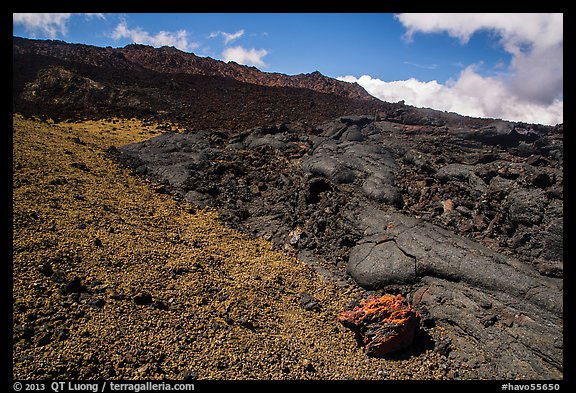
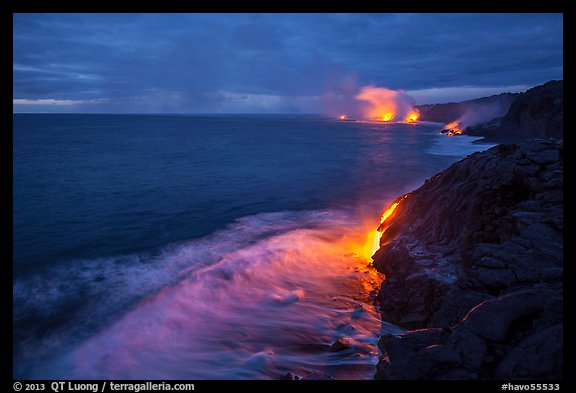
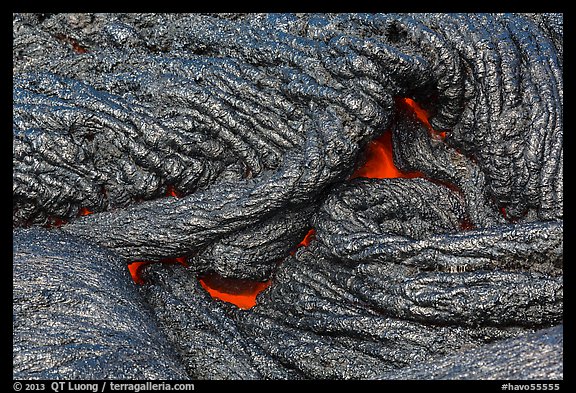
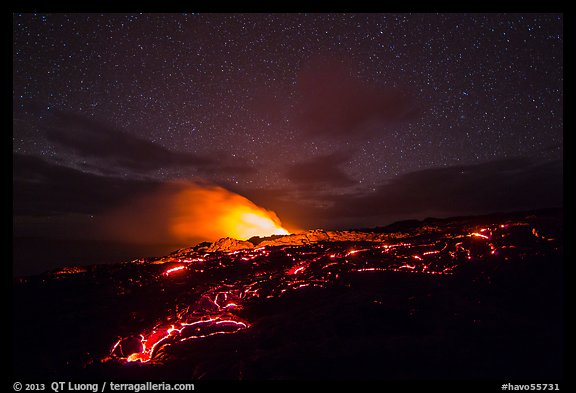
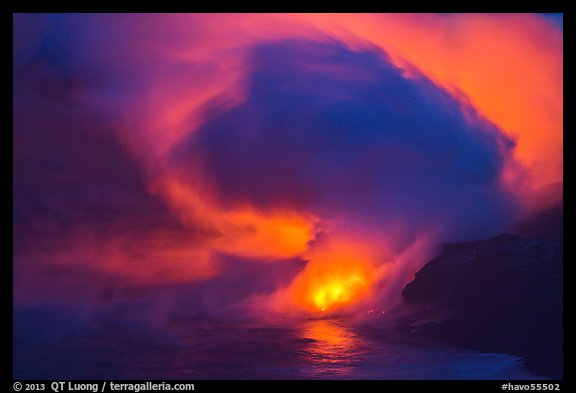
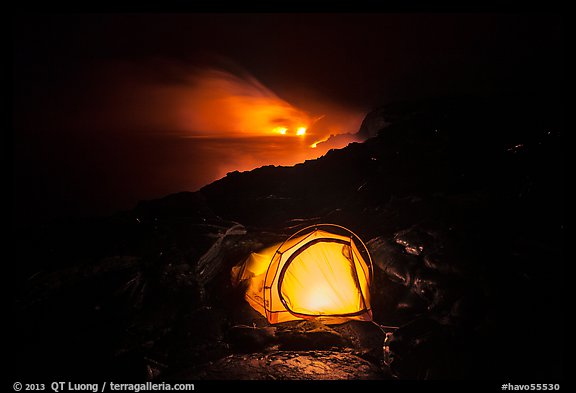
During the day, molten lava can be visible to a close observer as red or yellow patches, but doesn’t appear much brighter than the rest of the land. Most of the time, it will have a grey/silvery color, slightly lighter than hardened lava. An overcast day helps there, as lava glows more in the dimmer light. Twilight and night are when molten lava comes alive, with an impressive glow which also lights up the steam and parts of the ocean and land.

The time around sunrise and sunset, extending to twilight is by far the best for photography. The ideal window is quite brief, so one should plan carefully. During that time, brightness differences between lava and land or sea are small enough that both can be properly exposed in a single exposure: there is enough ambiant light that you can see details in the landscape, but it is dark enough for the lava to glow. In my opinion, dawn is preferable to dusk for several reasons:

  • Arriving in the dark makes it easier to see where the lava flows are.
  • Flow areas can be very crowded at sunset if the hike is short. When I was there, there were more than a hundred visitors, which, besides degrading the experience, makes it difficult to work. By contrast, there were less than a dozen people at sunrise.
  • On that stretch of coast, the sun rises over the ocean, but sets over land.
  • Because of the direction of trade winds, you’ll most likely be standing East of the ocean entry, so the direction of light would be more favorable at dawn.

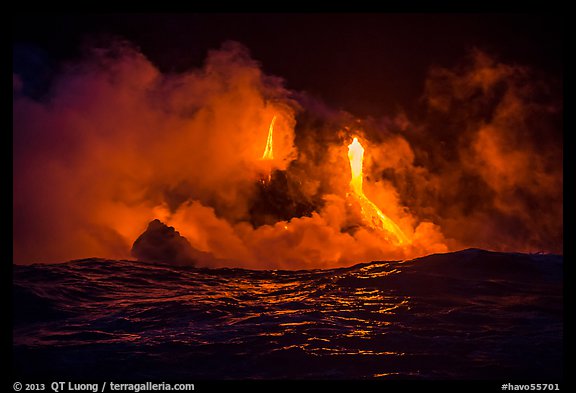
While the sight is most dramatic at night time, I was surprised at how difficult it was to photograph then. Because of the extreme difference of brightness between the flowing lava – which is the light source, the illuminated steam, and the land and sea, multiple exposures are needed (I had to bracket with a 4EV range). Those exposures are not easy to blend: since the steam is constantly shifting, you are not dealing with a static scene. A full moon usually isn’t great for night photography because resulting images look too much day-like, but because of the presence of the lava acting as light source, this is a situation where I think a full moon would work the best.

Where ?

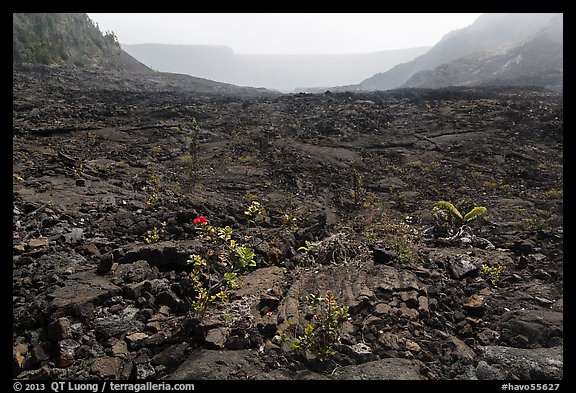
Lava originate at Pu’u O’o vent on the east rift zone of Kilauea volcano. It can enter the ocean anywhere between the end of Chain of Craters Road in Hawaii Volcanoes National Park and the Kalapana Lava Viewing Area. It is about 7 miles from the end of Chain of Craters Road to the boundary of Hawaii Volcanoes National Park, and 2 miles from the Kalapana Lava Viewing Area to the boundary of Hawaii Volcanoes National Park (map).

The National Park rangers will tell you how far it takes to hike to the lava flow from the end of Chain of Craters road. They are unlikely to tell you that a shorter hike may be possible from outside the park (that is Kalapana). If the ocean entry is more than 4.5 miles (one-way) from Chain of Craters Road, then it will be shorter from Kalapana. In 2013, the hike was 13 miles RT from the Chain of Craters Road, but only 4.5 miles RT from Kalapana.

Hawaii Volcanoes National Park is open 24 hours a day, and there are no restrictions on parking at the end of Chain of Craters road. On the Kalapana side, the state of Hawaii has set up a Lava Viewing Area at the end of Highway 130 in lower Puna. The free parking area, not always staffed, is open from 3PM to 9PM. The area so is named because at the time it was set-up, lava was flowing sufficiently close to it that you could see the glow from there. As of winter 2013, this is no longer the case. The problem on the Kalapana side is that you cannot park there for a pre-dawn session, and also you cannot linger at the flow too long after dark if you want to be back at 9PM. In addition, most of lands around the Lava Viewing Area are private – although sparsely populated, so crossing them towards the ocean entry may be trespassing if you go by yourself.

Getting ready

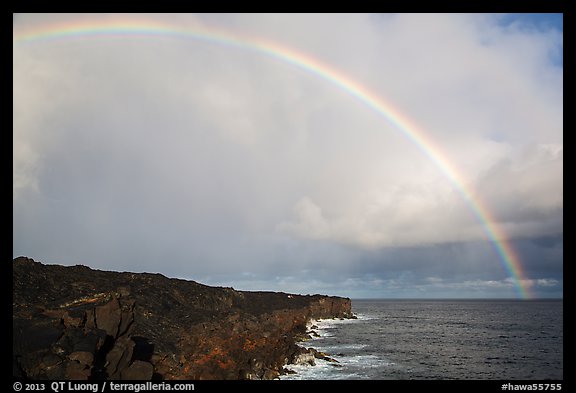
Because you are hiking on recently hardened lava, good walking/hiking boots are a must – it is better to wear boots that are stitched, not glued, since the heat of lava can melt and separate the soles. Long pants and gloves provide some protection in case of falls and also against the heat of hot lava flows. It can rain unpredictably there (makes for great rainbows), so light rain gear may be useful, although getting a bit wet in warm weather isn’t that big of a deal. What is sure is that the weather will be hot and humid regardless of season – not to mention the heat of the lava fields – so bring plenty of water. Despite looking black from a distance, fresh lava has a reflective silvery sheen, so don’t forget sunscreen. Because flashlights are a must in the dark, I recommend to take two, one as a back-up. The brighter the better, since lava is dark.

Although rarely needed, a respirator can be handy, particulary if you plan to stick around areas where you could be exposed to toxic gases. The gases are also bad for your eyes, but a half-mask is enough, maybe in conjuction with goggles if you have sensitive eyes. The volcano photographers I have talked to use a respirator designed for paints and chemicals – good against the hydrochloric acids present in the plume – available in hardware stores such as Home Depot or ACE (I carried this one from Walmart).

For photographing the cascades of lava pouring into the ocean, you will want a telephoto lens, since you won’t be able to get very close. A super tele (400mm or longer) is useful for close-up of spigots, while a short tele or normal lens frames the whole coastline. A wide-angle lens is mostly useful for photographing the surface flows rather than the ocean entries: you can get as close to those slow lava flows as you can bear the intense heat. Since the best photography is at twilight, you’ll need a tripod. Bring a good one, since it is often windy there, and you’ll be using telephotos.

The hike

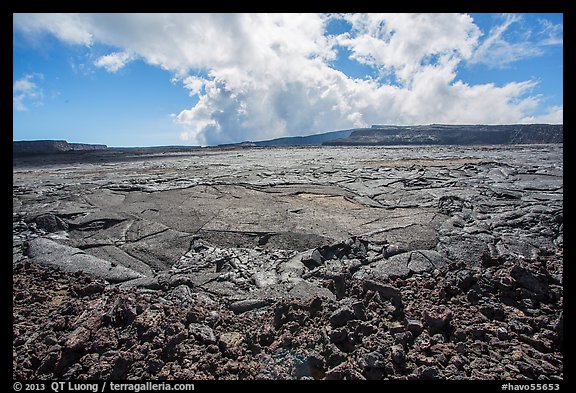
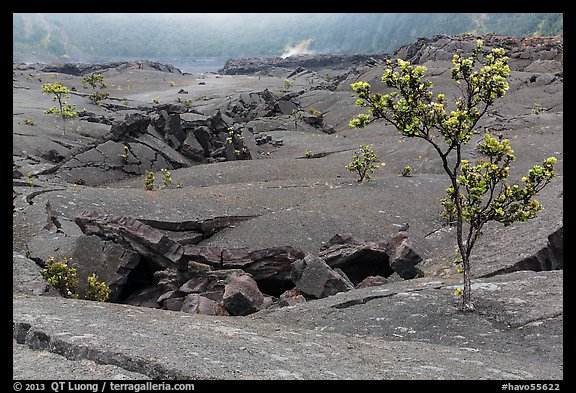
Although the terrain looks flat, you’ll be hopping up and down due to irregular surface structure consisting of hardened lava rocks which are jagged, uneven and sharp. Unless hiking on trail where you place one feet in front of the other, you cannot get into a rhythm because you need constant concentration. This makes it more challenging than it looks from distance alone. Unless familiar with the terrain, you should count on hiking about one mile per hour, esp. by night. A huge steam and smoke flume forms where the lava flows into the ocean. It is simple enough to just walk towards this plume.

Once you get to the ocean entry, there are a number of potentially lethal hazards to be aware of. The most obvious, is that you may have to cross surface flows, walking directly above lava which is flowing under a thin crust of hardened lava (the outer shell of a lava tube). Even if you cannot see the glow by daylight, the intense heat will leave no doubt as to the nature of what lies underneath. As long as the hardened lava doesn’t crack when you step on it, you are probably safe. Lava hardens surprisingly fast: after just 10 minutes of cooling, one inch of crust can support the weight of a person. Besides, the molten lava within helps support the crust. The risk of falling through the crust is low, because the heat will keep you from crossing where it is too recent and hot. Crossing hot lava is actually more scary than dangerous. On the other hand, a cold, empty lava crust is more likely to collapse because it is not supported by molten rock.

Next, the plume contains sulphuric acid, hydrochloric acid, and all sorts of bad caustic stuff. The trade winds normally blow consistenly towards the southwest, so if you viewing from the other direction, you should be able to usually stay upwind of them. However, the winds can change, esp. if you get close to the ocean entry. When I was there, the guide showed me a viewpoint which he thought would be interesting, but said that he wouln’d walk here himself, since on that evening he did not have a respirator with him. Unless you have a respirator, you should always stay out of the steam (even with one, I’ve read it is bad for clothing and camera equipment).

The most dangerous and less obvious hazard are lava benches: that new land may collapse unpredictably off the coast in chunks the size of a football field, because it builds up so quickly that it fractures. If falling from that height together with tons of lava rocks into scalding water, your chances to survive are small. You should never step on a lava bench. In the National Park, benches are sometimes marked as closed areas, but don’t count on it. Lava benches are always the cliff lowest, and closest to the ocean. Older cliffs are higher, so in doubt do not go low. Someone familiar with the area will know which cliffs are lava benches because they are the most recently formed land, whereas the cliffs they’ve seen in previous visits are safe. You can sometimes feel the vibration of the waves on them. I’ve read a photographer giving the advice “if you hear a crack from under you, run”, but I doubt you’d always be able to run fast enough. The more established an ocean entry is, the fastest it will build a lava bench, whereas with a sporadic ocean entry, ocean action can destroy the new land as fast as it is created.

Detailed lava safety information:

Guide services

From the Chain of Crater Road, no guide services are available, since the National Park does not issue permits for guiding. If the ocean entry is close enough to the road, they may install trail markers and even send rangers there.

From Kalapana, there are no trail markers, so better knowledge of the terrain will save some effort since some parts of the hardened lava flow are easier to cross than others. If you are not familiar with the hazards mentioned above, a good guide may provide a safer experience. Last, but not least, guides have permission to cross private lands, and can provide a spot where to park your car outside of the Kalapana Viewing Area opening hours.

Not all guides are safe. In particular, some will take you on new lava benches, where you may get better pictures, but also die if the bench collapses. Here are a few guides recommended by other photographers:

If you want a photo tour, here are some local photographers who may help you. If anything, check out their incredible images (some of them involved significant risks) to see what’s possible !

The boat tour

Although working from the land will provide the best opportunities, in no small part because you can use a tripod and lower shutter speeds, a boat tour can provide you a different angle not available from the land. In particular, you are able to photograph lava flowing down cliffs that are difficult to see from the land, as well as reflections in the water. It is also a good solution for those who cannot or do not want to hike, although note that the ride can be pretty rough. When riding against the swell, the boat to rises up and then slaps the water at the back of the swells very hard, which is why the operators warm that the trip is unsuitable for people with neck/back/spine injuries. Also, there is no protection against rain and often huge waves in the open boat.

Because of high cliffs, the closest point where the boat can be put in the water is Isaac Hale Beach Park/Pohoiki Boat Harbor (13-101 Kalapana Kapoho Road Pahoa, Hawaii), a good distance from Kalapana. There is a campground right there, which is helpful since the sunrise tour starts at 5am. It takes about 50 minutes each way to ride from there to the National Park boundary, and the boat will hang out at the ocean entry for about 30 minutes. You are not allowed to walk around the boat. You must remain seated at all times, however the captain will frequently turn the boat around so each side get equal viewing time. Just like for the hike, a sunrise tour is preferable to a sunset tour. The main reason is that morning seas are calmer. Besides a smoother ride, calmer seas are much more favorable to photography: the boot moves less, letting you use longer shutter speeds and/or lower ISO. Not only longer lenses are practical, but also the captain can position the boat closer to shore. A calm water surface also let you capture beautiful reflections.

The sunrise and sunset tours are quite popular, so I’d advise to make reservations at least a week in advance, although it means taking your chances with the weather. Be sure to dress up very warmly, because once you get soaked (and if it rains or the sea is rough, you will, even with raingear), no matter what the air temperature is, you will not feel warm. I would also bring an extra jacket or cushion you could put between your back and the seat for absorbing the shock of the hard hitting of the ocean by the bottom of the boat. Some water protection for your camera equipment is very handy, as is an easily cleaned filter and water-absorbing cloth for wiping the lens or filter. Because you are shooting from a boat, fast medium tele lenses, such as a 70-200/2.8, with stabilization would be ideal.

Boat operators include:

The helicopter tour

This being Hawaii, land, sea and air tours are all available. During the day, helicopters constantly buzz above the ocean entry. I did not take an helicopter tour because I was skeptical that such a tour would yield good lava images. Although one of the operators (Paradise Helicopters) claims to be flying doors off close enough for you to feel the lava heat, at the ocean entry the helicopters hover quite far – I’ve been told because of a crash in the past. In addition, they are not allowed to take off before sunrise nor to land after sunset. Since then a photographer who took such a tour has confirmed this.

My experience

For the hike, I signed up with the friendly and laid-back David Ewing because (unlike others) he agreed to let me stay there for the night with my car parked at his home on the lava flows and come back by myself the next day. The hike was actually lead by his assistant Skylar, a very nice young man. Although the flow was only a 2 1/4 mile (each way) from David’s house, overnighting certainly beat spending only about an hour there, then hiking back in the dark, and forth again in the dark for dawn. I brought sleeping gear consisting of a thin sleeping bag, short foam mat, and one-person shelter (against wind and rain), a gallon of water, and some cold food. Although I wasn’t sure if this was going to be possible, I found a spot suitable for sleeping very close to the flow. Was it preferable to sleep, or be up all night – like the Man, Bryan Lowry, whom I had the pleasure to see in the morning ? I am not sure. By being up all night, one certainly could be alert for the best configurations since they change constantly. One could also scout more areas to be ready for a great sunrise. On the other hand, since this was the beginning of the trip, I was still feeling quite tired, and I thought that the best opportunities were at twilight anyways. My night was pretty short, and I cherished every minute of the time I spent with the flow, especially after the other visitors had departed, when the only sound I could hear besides the crashing waves was the crackling of the lava.

For the boat tour, I traveled with Lava Ocean Adventures. All the sunrise tours were sold out for 5 days. Although the booking was less than smooth, things got ironed out. A few reviewers have described them as unsafe for running tours in borderline conditions, but although I felt that the ride was uncomfortably bumpy, I never thought it was out of control. The passengers in front of me even seemed to enjoy it, hollering each time the front of the boat jumped 6 feet in the air. It was quite thrilling the first few times, when we were heading out in the dark, but on the return trip, jarred and soaking wet, I couldn’t wait to return to “port” – you actually get in and out of the boat through a ladder on the campground’s parking lot. When we got back, many people, who had already paid, were lining up for the next tour, but the captain cancelled it because of ocean conditions. During my tour, the conditions were awful for photography. The seas were so choppy and it was so dark (because of the rain clouds, no pre-dawn glow nor sunrise !) that I used mostly my 24-105. The boat was rocking so much that longer focal lengths were problematic. As it wasn’t raining when we departed, I forgot to pack my rain cover. It started to rain heavily at the ocean entry. My 100-400 got wet and unusable for the rest of the trip. I had to send it to CPS where they diagnosed it as “submerged in water” and charged hundreds dollars for repair. I am still glad to have taken the boat tour for the different perspective, interesting images that I managed to squeeze out (largely thanks to a new processing technique) and experience, but I am not sure I would repeat it when hiking offers such a rich and satisfying connection to the land.

More images of Hawaii Volcanoes National Park

Part 1 of 3: 1 | 2 | 3

Oct 2013 Canyonlands Maze Backcountry Photo Tour with QT Luong

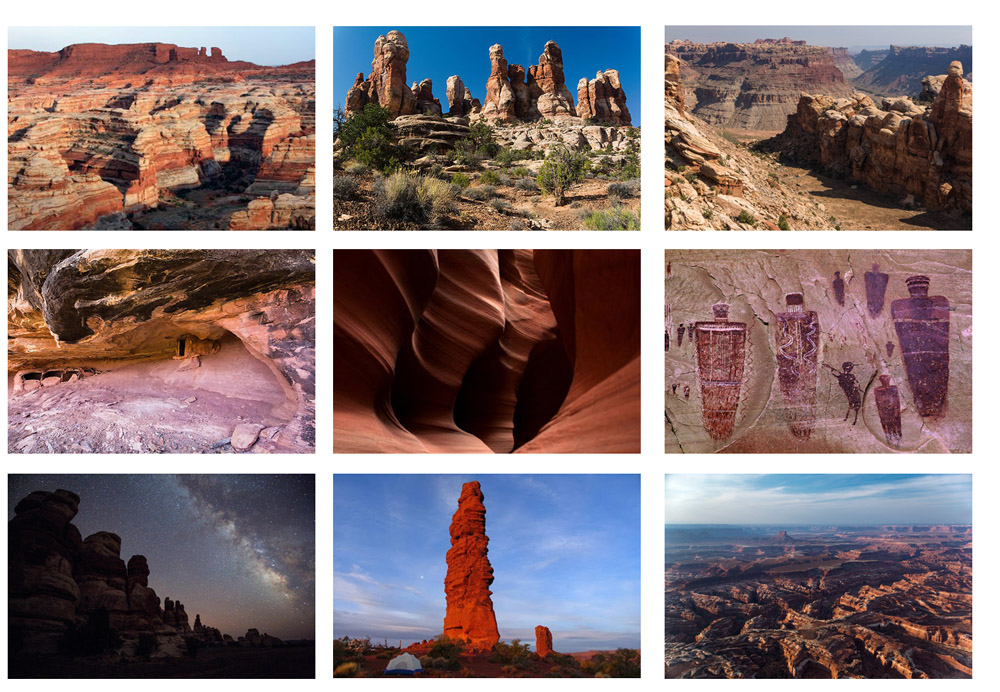
Imagine camping surrounded by a landscape of vividly colored hoodoos, lit by a crescent moon as the Milky Way appears, bright in a sky free of light pollution. This is your view as you enjoy a hearty dinner, cooked by our guides cowboy-style, as we sit nearly a hundred miles away from the closest paved road

During the day, we hike into maze-like canyons, rewarded for our efforts with some of the largest and most significant panels of rock art in America, twisted slots, and grandiose views that only few get to see. This is an awesome tour for the adventurous photographer in good shape, with endless possibilities for exploration into one of the most remote areas in the whole American West, the Maze District of Canyonlands National Park. We even have a great aerial photo opportunity when we take a scenic light in late afternoon light to return to Moab.
You will certainly not be fighting with other photographers for a sunrise spot, nor will you visit cliche scenes. National Geographic writes “The Maze can make parts of The Needles or Island in the Sky appear as civilized as Central Park … any visit should entail a serious amount of planning, gear, and fortitude”. Backpacker Magazine rated the Maze the riskiest of America’s 10 most dangerous hikes, but on this trip, everything will be taken care of. All you have to do is hike and photograph.

This is the only photo tour into the Maze, led jointly by a professional photographer (me), and local guides with decades of experience in this remote environment. They have all the difficult logistics, 4WD driving, and navigation drilled down so that we can concentrate on photography on our own schedule. I will be shooting next to you so that you can learn by example. I can offer tips and suggestions and will make sure we are at the best places for the best light.

Learn more about this unique photo tour: Canyonlands Maze Photo Tour.

Taroko Gorge National Park, Taiwan

While Sun Moon Lake is a scenic area with a fair amount of development, Taroko Gorge, Taiwan’s most well-known natural attraction, has been protected as a National Park since 1986.

The day before my visit, I traveled by rail to Hualien. From the station, I walked to the Amigos hotel, only to find out that it was closed for renovation. The owners referred me to a hotel on the same block, where I happened to be the only guest – the door was even locked when I arrived. Little did I imagine the hospitality. The host, although extremely friendly and eager to help, didn’t speak English. Fortunately his wife was Vietnamese. Although she was not home when I arrived, she served as an interpreter via phone. The host drove me around the city on the back of his motorbike to look for a vegetarian restaurant. This wasn’t successful, so upon returning, the wife fixed me a meal and declined any payment for it. They arranged a day trip to the Gorge by taxi for about $70, whereas the recommended price in the Lonely Planet was about $100. The driver turned out to be a woman, which is uncommon. She didn’t speak a single word of English, however she was also very nice. I realized she was an aboriginal native when at the end of the day she handed me a business card portraying her in a colorful traditional costume.

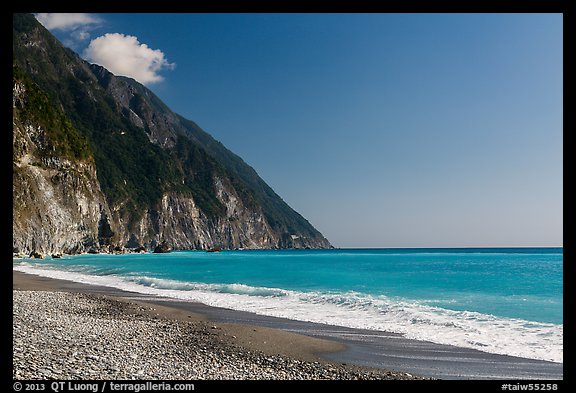
I started the day walking on a deserted azure beach. Seeing how mountains drop precipitously into the ocean, I understood why Taiwan’s East Coast is so scenic and undeveloped compared to the West Coast.

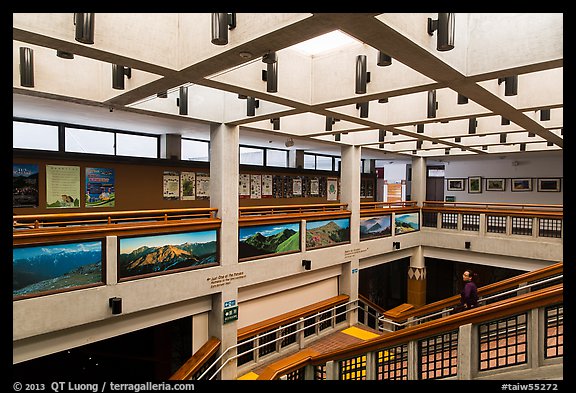
I was curious to see the local implementation of “America’s Best Idea”, so we stopped at a large visitor center, which looked familiar as I noticed a number of interpretative exhibits and an information desk where rangers provide information and bilingual free maps.

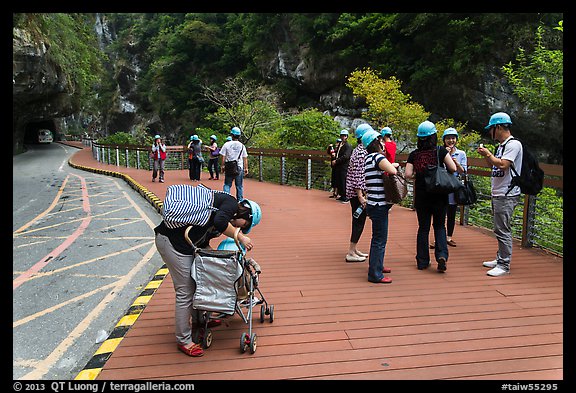
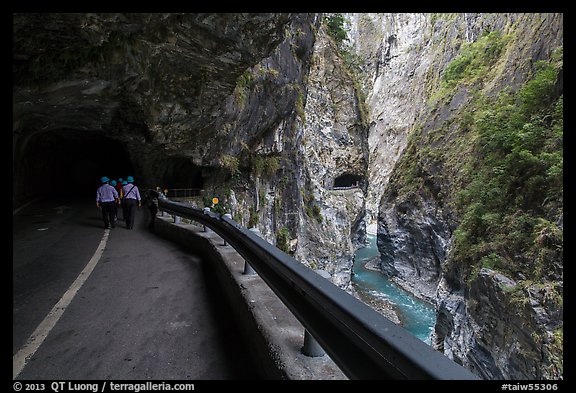
In keeping with Taiwan’s safety-conscious psyche, the park loans helmets to keep visitors safe from rockfall.

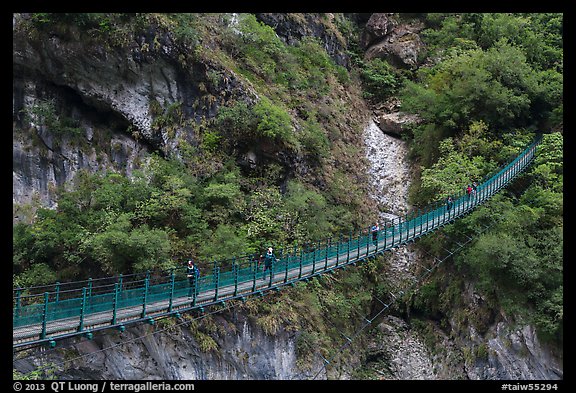
On the first stop, I hiked past the Eternal Shrine – dedicated to the 450 workers who lost their lives building the road, up onto a steep trail carved on the side of a cliff.

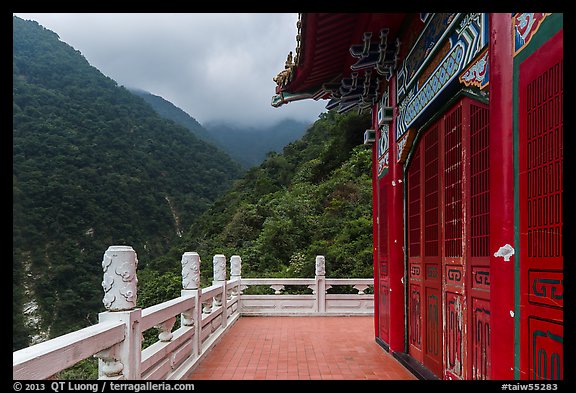
This led to a temple high above the valley with great views of the lush mountains above. Taroko’s natural beauty is complemented by a number of temples and shrines.

According to the map, Taroko Gorge has a large trail network, but because of my limited time, for the rest of the day I wouldn’t venture too far from the road.

To enjoy the narrowest part of the Gorge, you can simply walk on the side of the road, looking through the tunnel openings. Your driver waits for you at a parking area ahead.

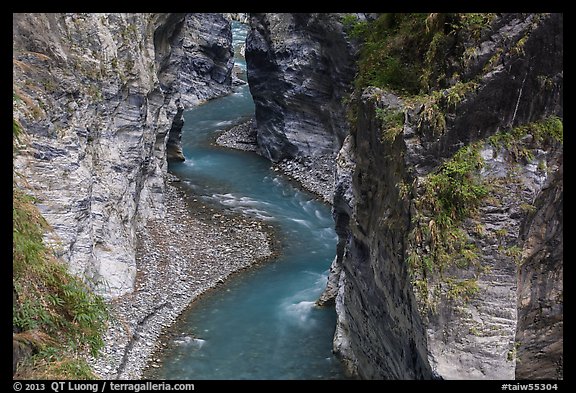
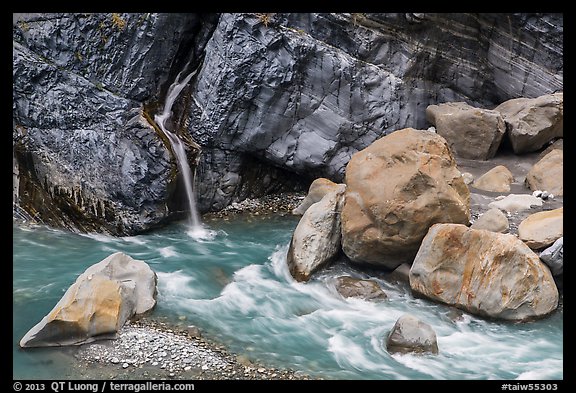
The blue-green Liwu River has carved a narrow gorge in marble rock full of patterns, a unique sight.

The sections called “Tunnel of Nine Turns” and “Swallow Grotto” were particularly remarkable.

Having visited a sophisticated capital, an old city, a scenic area, my quick visit to the Taroko Gorge provided me with another glimpse of Taiwan’s natural beauty, hinting at its former name “Ihla Formosa”, the Beautiful Isle.

View more images of Taroko Gorge

Part 4 of 4: 1 | 2 | 3 | 4

Philip Hyde books

After Ansel Adams and Eliot Porter, the third pillar of conservation photography in the 20th century was Philip Hyde (1921-2006). In fact, it can be argued that Philip Hyde was more instrumental in this role than his two more famous counterparts, and that it was precisely for that reason that he is less known. A quiet and humble giant, living a simple life out of the spotlight, he always felt that his own art was secondary to nature’s beauty and fragility, to the environmental campaigns he participated in – more numerous and successful than any other photographer. As an artist, this belief was reflected in his direct style, which appears deceptively descriptive, favoring truthfulness and understatement rather than dramatization, but upon closer examination represents a uniquely personal approach to landscape photography. Today it may be easy to take his compositions for granted, but that’s mostly because they have been emulated countless times. The work was pioneering. William Neil writes in a penetrating tribute: “I have little doubt that every published nature photographer of my generation has been inspired by Philip’s efforts”. I must confess that I discovered the work of Philip Hyde past my formative years. However, I actually find more common ground with him than with the other large format masters. Studying his work has confirmed my choices to photograph also in ordinary light, without radical angles or over-manipulation, and generally to try to show what is there, rather than what I want the viewer to see.
The essay linked above is part of a blog created by David Leland Hyde, Philip’s only son, who is doing a great job to keep alive his legacy. Together with philiphyde.com where portfolios are presented, it is the best resource to learn more about Philip Hyde’s art, life and times. I am grateful to David for suggestions in preparing this article. Here is a short video about Philip, narrated by David:

Although Philip Hyde was an excellent printer who had learned from the very best and was often approached and shown by the finest institutions, because of his focus on conservation, he rarely sought to exhibit his work, instead contributing images for publications that were likely to reach influencers as well as masses. The photography book was therefore his natural medium. By David’s count, Philip Hyde was a primary photographer for at least thirty books. Since none of them are retrospectives, a publication which is certainly long overdue, there is virtually no overlap: each book brings only new images, instead of a rehash of “hits”. Many of them have been reprinted several times, however none of Philip Hyde’s books are currently in print. This is not an impediment since almost all of them can easily be purchased in used bookstores, often for an incredibly low price. I am discussing below all the Philip Hyde books that I own, presented in chronological order of publication.
This is Dinosaur: Echo Park Country and Its Magic Rivers

This book broke new grounds on several accounts. Prepared to advocate against the proposed Echo Park and Split Mountain dams in Dinosaur National Monument, it is possibly the first conservation photography book ever published. Philip Hyde, who just recently graduated from the California School of Fine Arts, studying under Ansel Adams, Edward Weston, and other luminaries, was a young and motivated photographer ready to go to work on short notice, for little money. He was sent on the first conservation-oriented freelance assignment (expenses paid plus $1 per photo published – equivalent to $9 in 2013 !) by the Sierra Club. Although Dinosaur National Monument had expended to over 200,000 acres, few Americans knew anything about it, so the challenge was to inform about what would be lost. Read more about this pioneering campaign – which began the transformation of the Sierra Club into a national organization – and Philip Hyde’s role in it in David Leland Hyde’s 9-part account: The Battle Over Dinosaur: Birth of Modern Environmentalism. The book, published in 1955 (reprinted in 1985) is more notable for its historic importance than as a photography book. It opens with a 36-page picture section consisting of images and extended captions, of which 17 (in B&W) are from Philip Hyde. This is followed by the main section (96 pages) consisting of seven essays by different writers. Because images and text were contributed by many, only the editor, Wallace Stegner, who also wrote the first essay, is listed on the title page.

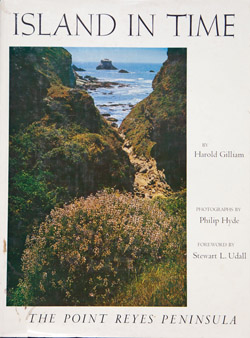
Island In Time: The Point Reyes Peninsula

The first title on which Philip Hyde is listed as a co-author, this was published in 1962, the same year the Sierra Club published “In Wildness Is The Preservation Of The World”. The difference of approaches is telling. While the later was a well-planned art project, on which Porter had been working since the 40s, Island In Time was a much less expensive book expressly published to save Point Reyes from development. It was quickly put together to assist fundraising efforts to buy the ranches of Point Reyes before developers bought the land to build homes, an urgency typical of the books in which Philip Hyde contributed. Although the text, which aims to introduce and describe the Peninsula to the general public, is the most extensive part of the book, it incorporates a number of plate sections, mostly black and white, but also some color. This mix is unusual for most photographers, but Philip Hyde was early on proficient in both media, able to print silver gelatin, dye transfer, and Cibachrome. He would gravitate to color in his later years describing how it fits better his goals “Black-and-white lends itself to manipulation that can dramatize a subject. Color tends to record what is seen, so it is no coincidence that I use color for that purpose. I don’t feel nature needs to be dramatized: it is dramatic enough!”.

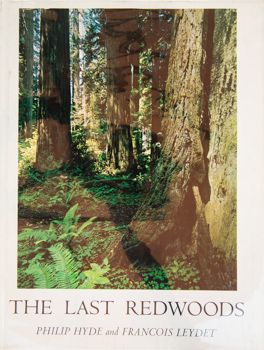
The Last Redwoods

The first book of Philip Hyde in the Sierra Club Exhibit Format Series (1963) was co-authored with nature writer Francois Leydet, whose text emphasizes not only the beauty of the ancient trees, but also the threats to them. It was part of a campaign that helped establish Redwood National Park. Except for 8 color pages, the photographs are in black and white (a few are from Ansel Adams and others). Besides nature images of pristine redwood forests, we also see depictions of forestry operations and devastating clear cuts which anticipate photographs by Robert Adams of the same subjects in the Northwest. The Sierra Club Exhibit Format publishing program created the first coffee-table nature photography books: volumes of unprecedented quality, in a large (10 x 13) size that David Brower thought necessary to immerse the viewer into the photographs, therefore maximizing their impact to argue the cause of conservation. The series brought Sierra Club national recognition, while helping to establish landscape photography as a popular art form. Ansel Adams role was prominent in the first volumes, but he disengaged himself after the books turned to color photography. Eliot Porter authored more Exhibit Format titles, but Philip Hyde was the workhorse, providing images for nearly every environmental battle of the Sierra Club in the 1960s and 1970s. Read more about the series and Philip Hyde’s role in it in David Leland Hyde’s account: Sierra Club Books: Exhibit Format Series.

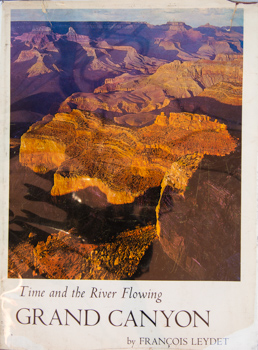
Time and The River Flowing: Grand Canyon

Francois Leydet investigates and reports on the significance of a living river, in support of a multi-faceted campaign to prevent dams to be built within the Grand Canyon. The book (1964), famous for being an important tool in saving the Grand Canyon, is illustrated by color photographs from many photographers – some of them reproduced small and combined on a page, as the priority is given to the story. Philip Hyde had more images than any other photographer in the book (Ansel Adams, Eliot Porter, Martin Litton, Clyde Childress, Richard Norgaard, P. T. Reilly, Joseph Wood Krutch, Katie Lee and others), and would go on to contribute to five books about the Colorado River: The Grand Colorado (1969), Glen Canyon Before Lake Powell (1970), The Wilderness World of the Grand Canyon (1971), Glen Canyon Portfolio (1979), Ghosts of Glen Canyon (2009). Part of the Sierra Club Exhibit Format Series.

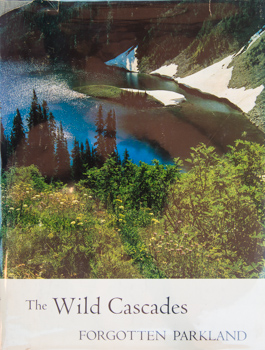
The Wild Cascades: Forgotten Parkland

Harvey Manning (editor of Mountaineering: The Freedom of the Hills) makes the case for the establishment of North Cascades National Park, in a format similar to the previous book, except for the fact that he combined poetry by Theodore Roethke with photographs. Both black and white and color (16 pages), they are from a number of photographers (including Ansel Adams, Martin Litton, Bob and Ira Spring, David Simmons, John Warth). Part of the Sierra Club Exhibit Format (1965). Like the three previous books, it is historically significant. Unlike Adams and Porter who put much emphasis on establishing themselves as artists, Philip Hyde’s focus was in conservation, and at this point in his career, he viewed himself mostly as Sierra Club team player, therefore contributing to books without seeking cover credits. From my exchanges with David Leland Hyde, I got the impression that Philip Hyde was exactly the opposite of a credit-seeker, which certainly contributed to his relative lack of renown compared to some contemporaries.

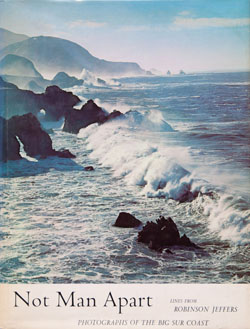
Not Man Apart

The Big Sur coast is celebrated by paragraphs of poetry from Robinson Jeffers, interspersed with photographs generously reproduced in a clean design, both in color and black and white. Unlike the three previous books, photography is given the primary role, resulting in a more beautiful book. The list of the other contributing photographers reads like a who’s who of West Coast photography: Ansel Adams, Morley Baer, Wynn Bullock, William Garnett, Eliot Porter, Cole & Edward Weston, Don Worth, Cedric Wright… Part of the Sierra Club Exhibit Format Series (1965).

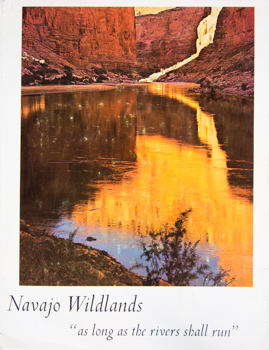
Navajo Wildlands: As Long as the Rivers Shall Run

The second book of Philip Hyde in the Sierra Club Exhibit Format Series (1967) was co-authored with notable archaeologist Stephen Jett who appraises the great scenic resource of the Navajo country and the understanding of the native inhabitants towards the land. Unlike the previous ones, this book uses exclusively images from Philip Hyde. While he continued until at least the 70s to do black and white photography on the West Coast and Sierra Nevada, Philip Hyde felt early that color was better at depicting the Southwest, his other stomping grounds. All photographs for this book are in color, and reproduced large with a clean design which gives them prominence on the page. Because of the design, excellent selection of quietly luminous images, and evocative nature of the book (as opposed to the “activist” volumes – although it should be noted that Navajo Wildlands was part of the inspiration for the establishment of many Navajo Tribal Parks), reinforced by the spiritual focus of the text, I feel that this is the most beautiful of Philip Hyde’s numerous books about the Southwest that I’ve seen.

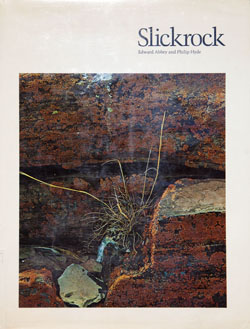
Slickrock

Maybe deservedly the most well-known book of Philip Hyde, because of the complementarity of his color photography with text by the celebrated desert writer Edward Abbey. In a beautifully written, and informative text, they both evoke the canyon country of Southeast Utah, gently advocating for protection of the Escalante Canyons, extension of Capitol Reef National Monument (to include southern parts of the Waterpocket Fold) and Canyonlands National Park (to include the Maze District) – all goals that were subsequently met at one point in time. Travel to some of those areas remain difficult in 2013, so think about the sense of exploration and discovery that those hardy wilderness travelers must have been felt in 1971. The first part of the book, sparsely illustrated, is written by Abbey. The second part consists of three portfolios with full-page reproductions (some maybe a bit too contrasty) each excellently introduced by Philip Hyde himself, whose voice begins to be heard in his books. Although it was not officially part of the Exhibit Format Series which at this point had been stopped, it was published by the Sierra Club with the same presentation as those books, making it a beautiful volume.

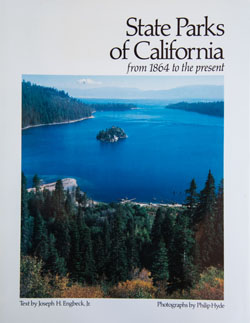
State Parks Of California: from 1864 to the present

Philip Hyde contributed to nearly 80 books, so some are bound to be photographically less interesting. I’m mentionning this one as an example, since it is on my bookshelf. Philip Hyde’s contribution to this book (1980) is similar to mine to The National Parks: America’s Best Idea: he provided all the contemporary landscape photographs, but the bulk of the book’s illustrations consists of black and white historical photographs originating from various archives. Those books are also similar in the preponderance of the text, which reminds us of how hard early conservationists had to work to establish the parks.

Drylands: The deserts of North America

Put together by the packager of several Galen Rowell books, this is the most sumptuously produced book (1987) by Philip Hyde, with a large 13×15 horizontal trim, the largest number of pages of any of his books, and modern color reproductions – don’t judge them by my copy’s cover, it was discolored by sun exposure. The scope is also his most ambitious, since not only his photographs cover all the five North American Deserts in the US and Mexico, but Philip Hyde also wrote most of the text, which includes descriptions of the areas and reminiscences of his own travels. The introduction and naturalist’s notes are by best-selling and prize-winning nature writer David Rains Wallace. This is a remarkable production, the culmination of his years working in the Southwest, possibly his most important book. Maybe it’s just me, but although I like the educational aspect, I have mixed feelings about the focus on geography and its resulting design with maps and drawings of plants and animals, and also the colored borders around images and full bleeds. For some reason that I cannot exactly pinpoint, although technically much better reproduced, many images in this book feel to me more descriptive than those in the two previously mentioned Southwest books, esp. Navajo Wildlands. That’s not the case of all of them, of course, an example being the superb “Craters of the Moon National Monument and Preserve, Idaho”.

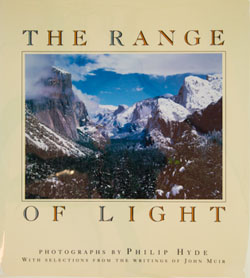
The Range of Light

The last book (1992) by Philip Hyde, about the Sierra Nevada close to his home, is also his most personal. It consists of three parts. The first one shows black and white photographs paired on the same page with a quotation from John Muir selected by Philip Hyde – a concept similar to the one used by Porter in his first book. The second one continues the same format, but using color photographs. The co-existence of both portfolios is an impressive achievement. The last part is an autobiographical essay in which he reflects on his life as a photographer, evoking Sierra Nevada trips, and friendships with his noted West Coast photographers peers, and his personal philosophy. Philip Hyde was generally a quiet giant, a self-effacing man, so I am glad that at least he has chosen to give us a glimpse of his life and thoughts. Because of the printing quality of the book, the control he had over its contents, and the window its offers into several aspects of Philip Hyde’s art, this would be my first recommendation for an introduction to his work. Complement it with at least one of the three latter Southwest books I listed (Navajo Wildlands, Slickrock, Drylands).

Were you aware of all this work ? Did you have any of those books ? Did they influence you ?

Part 4 of 5: 1 | 2 | 3 | 4 | 5

Sun Moon Lake, Taiwan

Taiwan’s cities (including Taipei and Lukang) lie on the Western part of the island, which is a plain. I was surprised to find out that the other two-thirds of Taiwan is covered by mountains.

Sun Moon Lake is considered to be one of the most scenic areas in Taiwan. My wife, who had never been to Taiwan, had heard of it, because of the many Asian romance novels that use it as a background. As expected, it turned out to be very popular with local tourists. Most stay in Shueishe Village, the main town around the lake. When I arrived there in early afternoon after taking the HSR train from Taipei and then a bus, I asked the visitor center for help in locating an inexpensive room. They were very nice, but all the hotels they called were full. Upon walking the main street, I quickly found one.

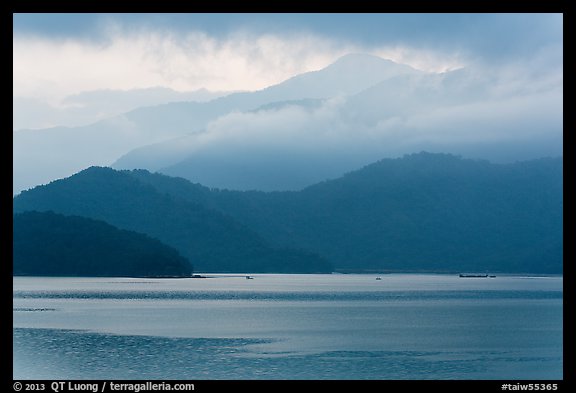
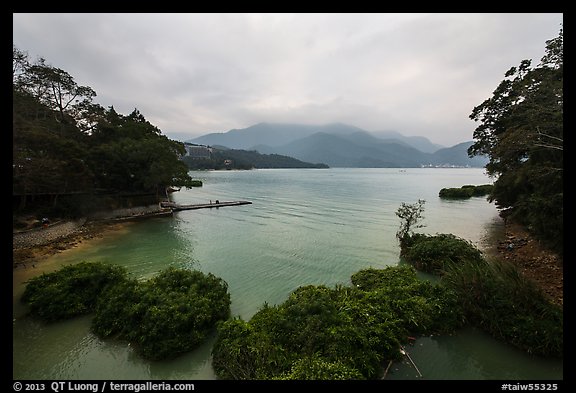
Surrounded by mountains, Sun Moon Lake’s color changes constantly with weather and light, although blue often dominates.

I walked a lakeside trail that hugged the North Shore, noticing floating rafts on which plants are being grown.

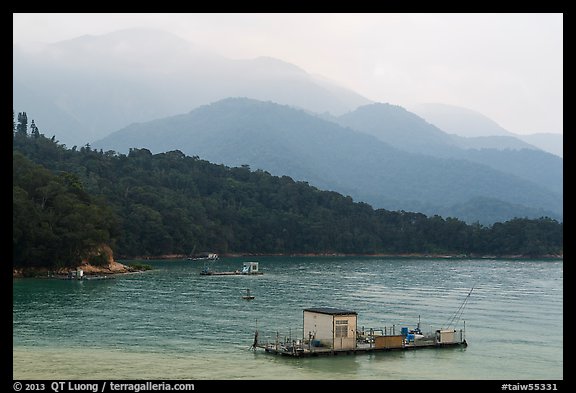
Although the lake is a prime tourist destination in Taiwan, I saw some traditional lifestyle, for instance curious houseboats.

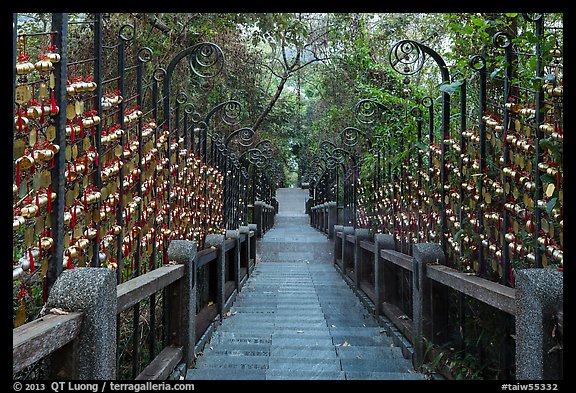
I climbed steep stairs lined up with blessing wind chimes brought by pilgrims.

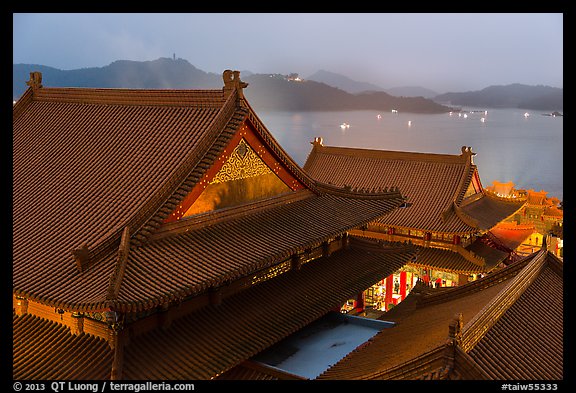
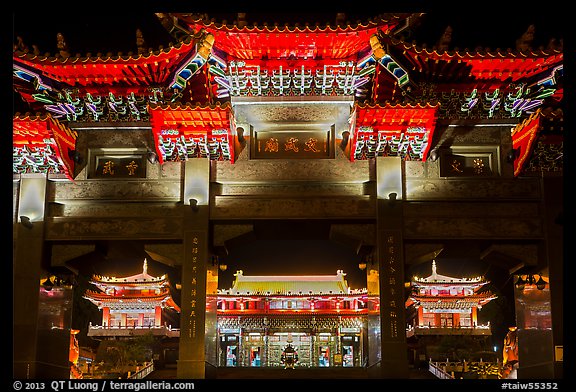
The lights were just coming up after I found a point of view above the roofs of the large Wen Wu temple, overlooking the lake.

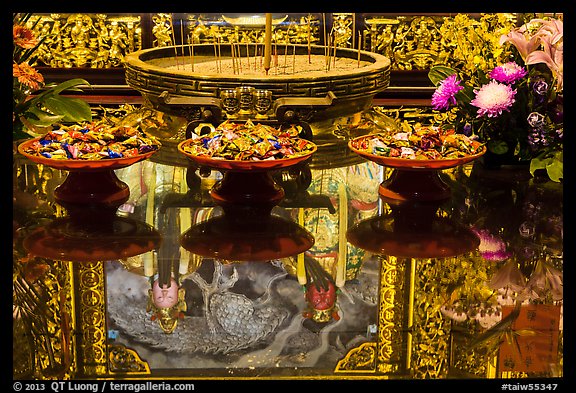
I checked out the rich temple interior. I was one of the last visitors inside. The place, quite crowded just an hour ago, had become deserted.

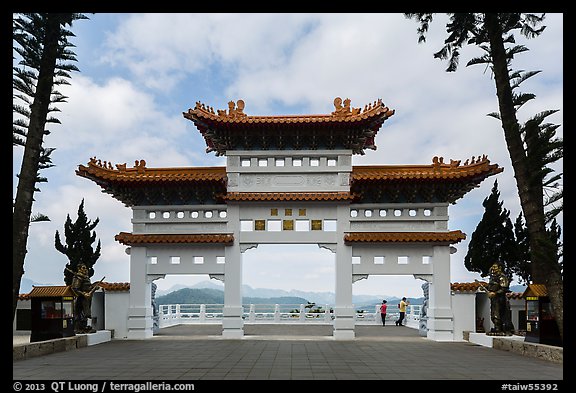
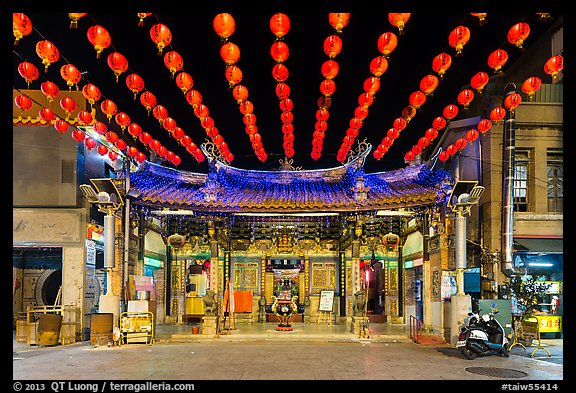
I photographed the temple gate from outside. Because there was no more traffic I could place the tripod right in the middle of the road (no adjusting the framing by zooming with a TS lens !), however I was beginning to worry about having to walk a long way back to Shueishe Village. Fortunately, as I was going to try to hitch a ride (not easy without speaking Mandarin), a taxi showed up.

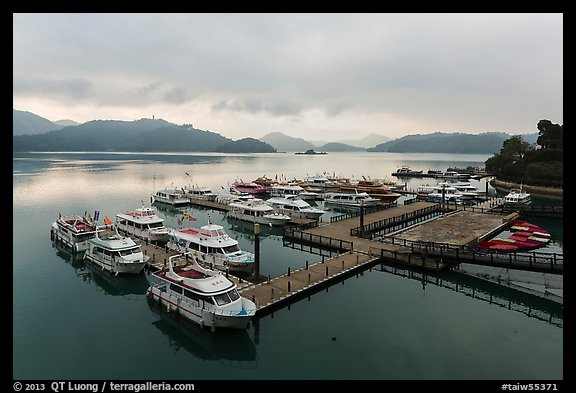
The next morning, I set up to explore the South Shore, trying to get to the tower on the top of the hill on the left in the picture. During the day, a multitude of tour boats ply the lake’s waters, departing almost every few minutes. I bought a ticket at one of the several booths lining up main street, and strolled down to the pier.

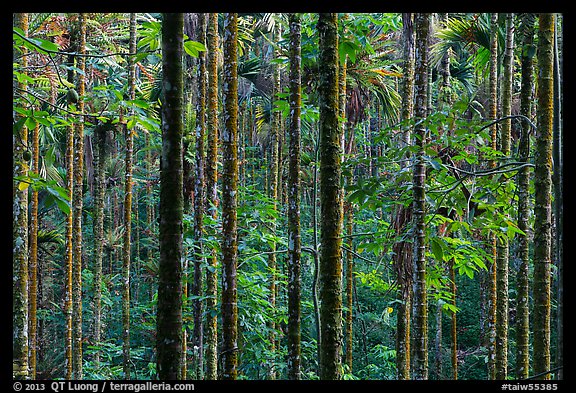
I hiked a path through the forest up the hill, past a crowded temple near the pier.

The terrace of Syuanzang Temple offered a nice view of the lake, but the best was yet to come.

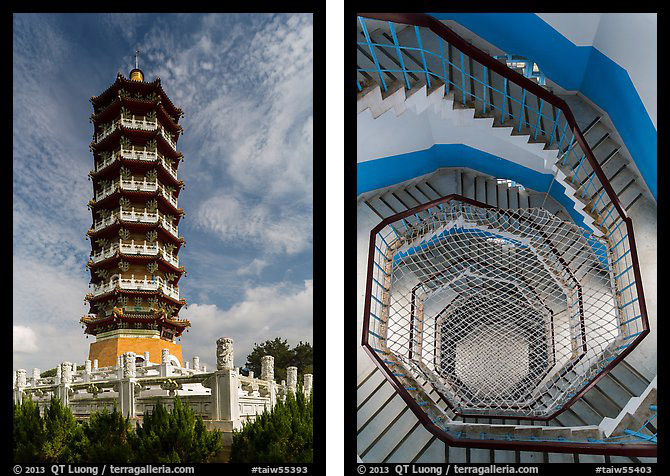
I reached the upper level of the Tsen Pagoda.

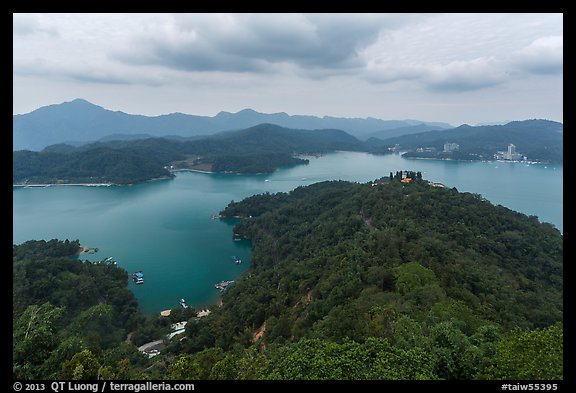
From there, I saw the lake in its entirety, recognizing that Sun Moon Lake is named so because its east side resembles a sun while the west side resembles a moon.

View more images of Sun Moon Lake

Part 3 of 4: 1 | 2 | 3 | 4

Lukang, Taiwan – image sequence explained

Taichung is linked to Taipei by a High Speed Rail line, whereas there is no train station in Lukang because in the past the city refused to allow railroads to pass through. This, combined with the silting of its port, led to Lukang’s economic decline. However, that economic decline averted the modernization that demolished historical buildings elsewhere, preserving buildings dating from Lukang’s heyday as an important trading port with mainland China.

For a contrast with Taipei, I traveled to Lukang to see old Taiwan. It took almost as much time to travel from nearby Taichung to Lukang than it did from Taipei to Taichung. Sitting on a local bus, it’s never clear when I have arrived, since all the signs are in Chinese that I can’t read. Instead of a proper bus station or stop, the bus arrived in a dark depot with no businesses around. The spot was sketchy-looking, but when I asked the driver “Lukang ?”, he nodded. I began to wander the streets, still a bit shaken by this arrival, until I ran into this scene. From there, I knew that some wonderful exploring lied ahead.

For this particular blog post, I am not going to embed more images, instead referring you to my main site. When I embed images in a blog post, their order often follows my story. However, on the photo galleries, this order is usually different, as it aims to tell a story about a place rather than about me. You’ll notice that it finishes with the first subject I actually photographed. In the rest of this post, I am going to explain my sequencing of the Lukang photo gallery – link opens a new window so that you can follow comments below.

  • We begin our exploration of the city with a typical, busy, modern commercial street, which is what your first impression of the city would be.
  • If you look more closely at sidewalks on even such a generic street, you’ll see a glimpse of the past, such as traditional craftmen at work. Wu Tun-Hou Lantern shop is one of the most renowned in Taiwan.
  • We now move into a network of twisting narrow alleys. The visual link between the first three images are the paper lanterns. There are a few people in the alley besides the man on bicycle.
  • Next, there is only a man on bicycle left, and most of the image area is now taken by a building’s facade rather than the alley.
  • We now see a series of close-ups of facades and doors with nobody. The visual link between the last three images are the bicycles.
  • We zoom from a facade to a door detail, then back again but with the buildings showing more sign of wear. Images are tied by several elements such as the Chinese characters on red around the door, inside the door, blue color, Chinese characters in white around the doors.
  • We jump from one entrance (a modest grey weathered door) to another (the Hall of five gates, Longshan Temple, whose dragons carved in greyish rock are one of the most famous symbols of Taiwan). All the images up until now had prominent Chinese script, which disappears from the next images as the subjects switch to the spiritual.
  • After entering through the gate, we walk into the main courtyard of Longshan Temple (site of four images) then attend a Buddhist religious service in the main section of the temple. Upon exiting, we take a look above us, noticing an intricate wooden plafond ceiling.
  • It is now dark as make a similar visit to the other noted temple in Lukang, the Matzu Taoist Temple (site of three images), walk through its gate, into its courtyard, then to its main altar. Matzu is one of the most venerated deities in Taiwan, and this particular figure has been blacked by centuries of exposure to incense.
  • We are then out, but like in the previous image, an altar – this one anonymous – is still visible in the distance.
  • We continue to wander in alleys, which are the theme of those three images. They become progressively less dark, and the space more public.
  • Guided by the paper lanterns which are the link between the last three images – as they were the link between the three first images – we end up back on the street, where we started. In addition to shops, there is also a temple in this concluding image to remind us of everything we’ve seen in this journey.

Here you are, I hope to have provided you with a new appreciation of the thought that goes behind my image presentation. Almost each of my photo gallery pages is carefully sequenced, although the sequencing method varies. In addition, they need to show a representative sample of images. It’s much more work than throwing together a bunch of images randomly !

Did you notice some of my sequencing elements ? Do you think that the image sequence matters when viewing the photo galleries ?

Part 2 of 4: 1 | 2 | 3 | 4

Taipei, Taiwan

After the Vietnam photo tour, I took advantage of the fact that Eva Air was making a transit in Taipei to spend a week in Taiwan. Before the trip, I did not know much about the country besides its separatist history and the label “made in Taiwan”. I had planned to read my guidebook during the flight from Hanoi to Taipei, but the Vietnamese man sitting next to me (are you reading ?) identified me and then showed me his own photographs of Vietnam, which were remarkable and humbling, so even upon landing I had no clear travel plans yet – certainly a change from the meticulously planned photo tour.

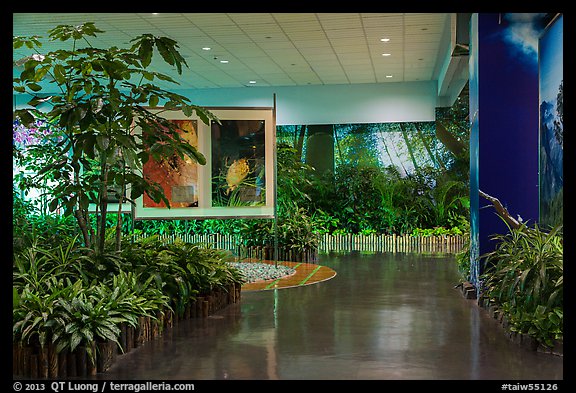
The airport provided an impressive array of free amenities, including computers to access the Internet, showers (toilet kit provided), and a relaxation room with massage chairs, however my arrival was less than smooth. At a fork, instead of paying attention to announcements, I followed a sign that said “Luggage Claim”, only to find out that I had ended at the wrong terminal. After getting wrong information from airport staff, I then waited in a long line for a visa on arrival – which wasn’t needed for a US Passport holder. I repacked to leave most of my belongings with the luggage service, not even taking my Macbook Air with me. Except for the tripod, all my travel and photo gear fit inside a carry-on size Think Tank Airport Accelerator. By the time I got out of the airport shuttle, it was quite late, so instead of trying to locate the hostel which I knew to be within walking distance, I hoped in a taxi. It took the driver a good fifteen minutes to locate it, although it was literally across the street.

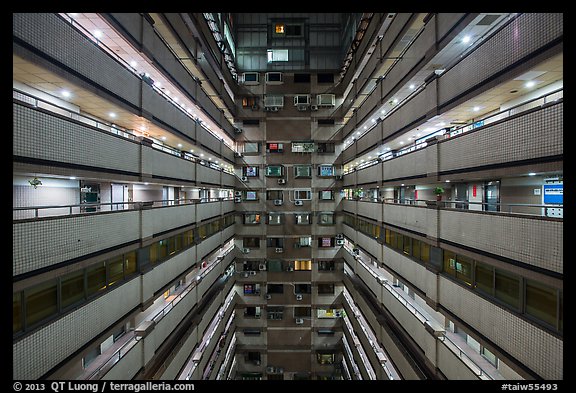
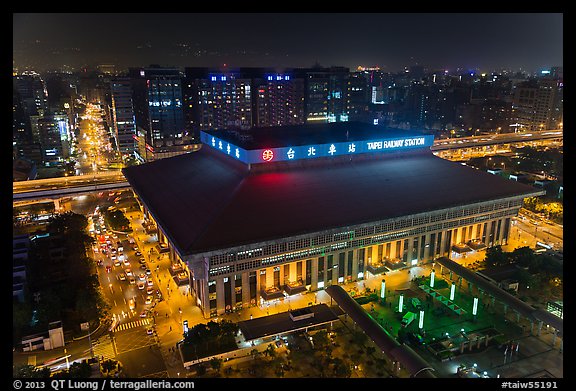
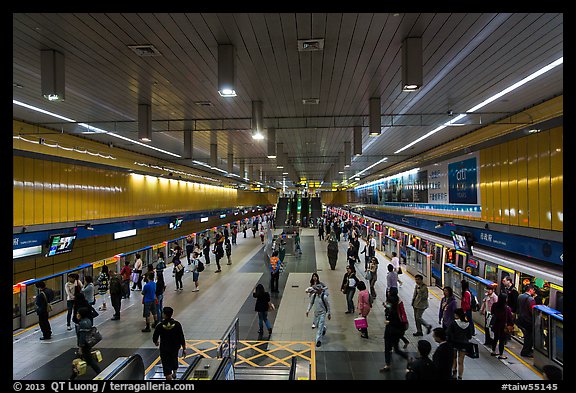
Upon eventually walking into the Holo Family House (picked because as it was the first entry in the Lonely Planet), I understood why. That’s not your typical hostel: it consists of a set of rooms situated near the top of a huge high-rise building which is part of a shopping mall. The staff was friendly and helpful, the internet access (wifi or self-service computers) reliable, the rooms quiet (except for those facing the Central Station) and the location as central as could be. What else ? Maybe good photo opportunities ? Here are a few images made from the hostel’s community room. If you are wondering why there are no rail tracks out of the Taipei Central Station, they are all underground.

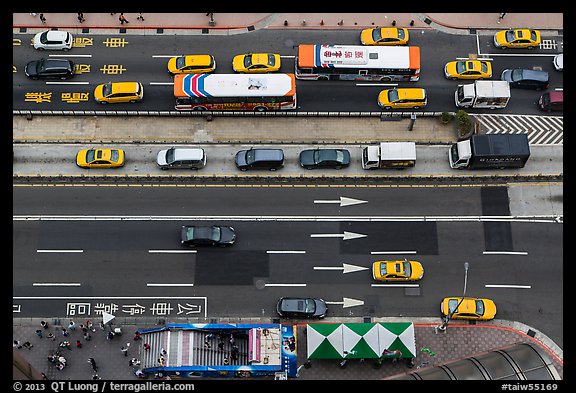
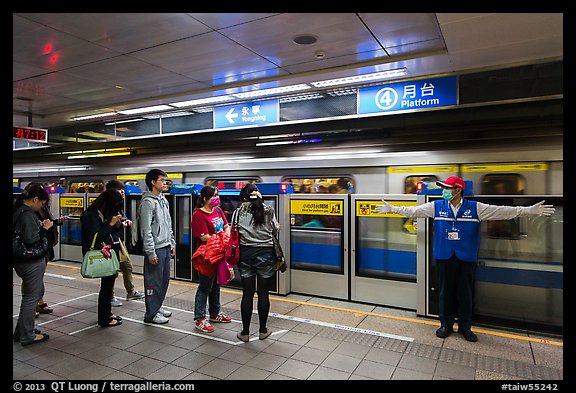
I spent a total of three days in Taipei. It turned out to be a pleasant and sophisticated metropolis with a variety of attractions, easily navigated thanks to a good transit system including the efficient subway (MRT) and inexpensive taxis. See how the locals wait orderly in line ? This isn’t Paris.

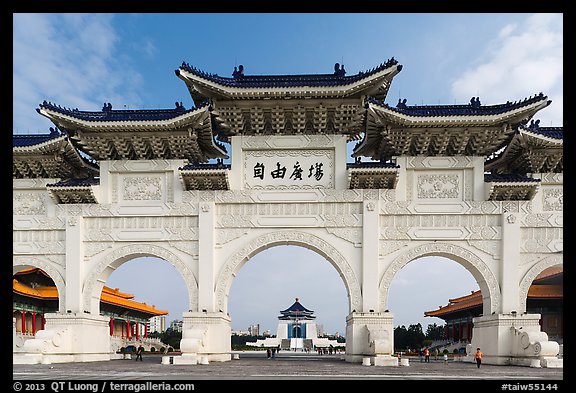
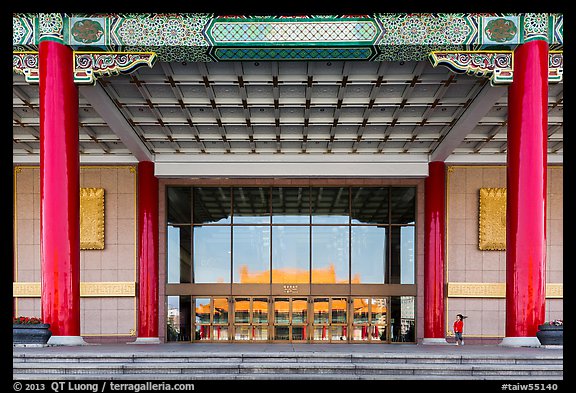
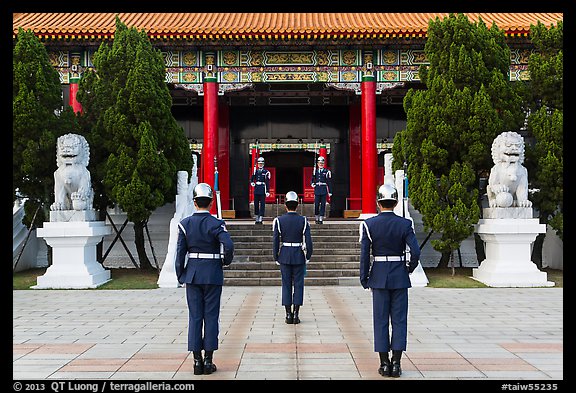
More on the orderly side, I paid a visit to the three imposing main memorials (Chiang Kai-shek Memorial Hall, Sun Yat-sen Memorial Hall, Martyr’s shrine) sporting martial-looking honor guards who rotate hourly in a meticulously choreographed ceremony.

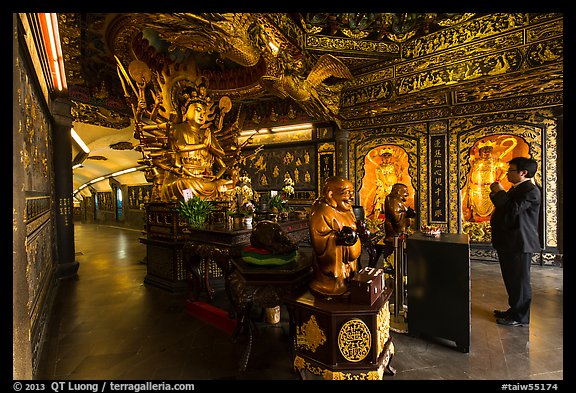
On a more peaceful side, I lingered at several temples, my favorite being the Guandu Temple, one of Taiwan’s oldest (1661), situated next to the Danshui River, impressive with its height and tunnel carved in the hillside, lined with statues.

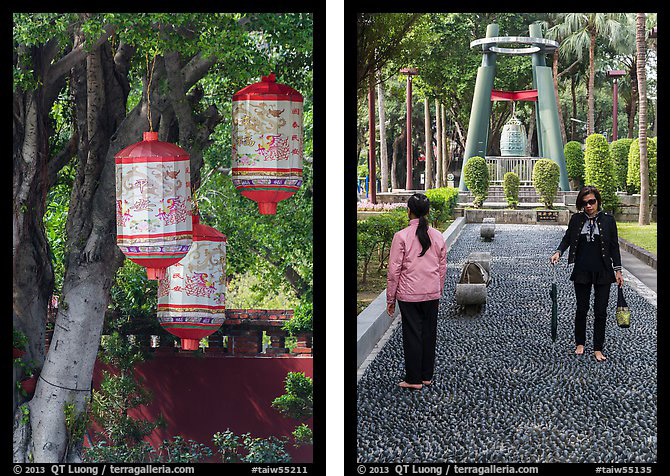
I also relaxed on the beautiful grounds of the Taipei Confucius Temple, which offered instructive exhibits, and at the Peace Park – where I tried a foot massage path consisting of pointed blunt stones.

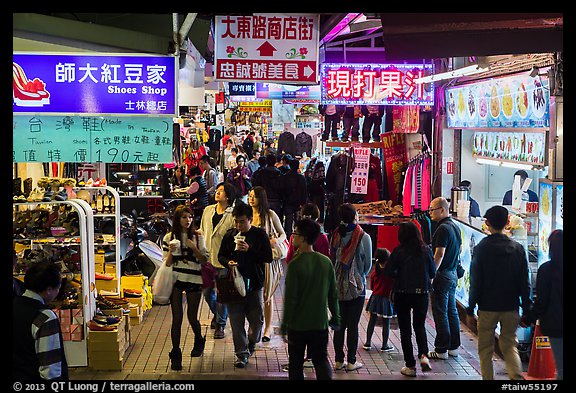
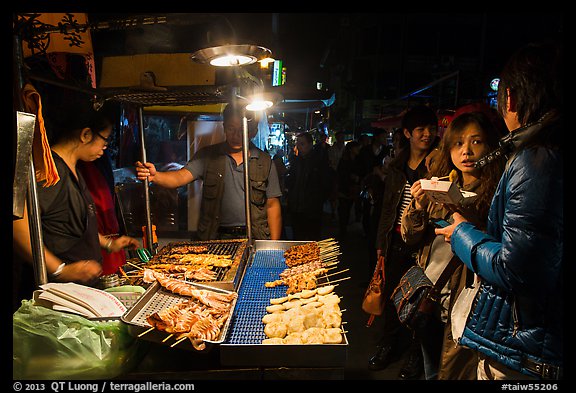
I encountered Taipei at its liveliest at the Shilin Night Market, where you can find anything, including all sorts of local delicacies – if you can cope with the crowds.

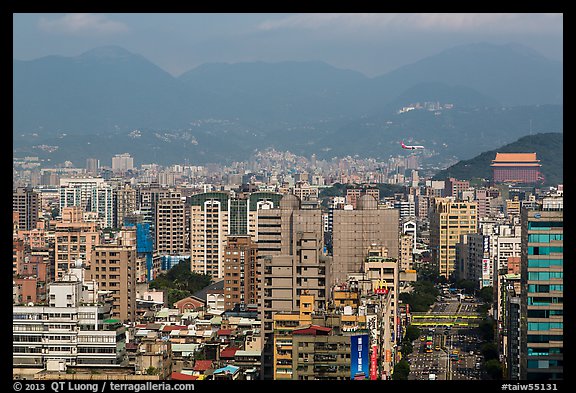
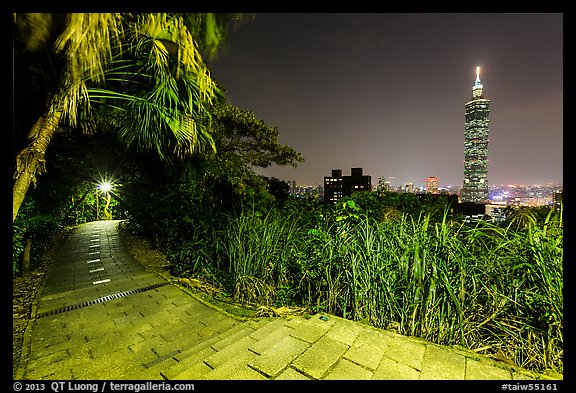
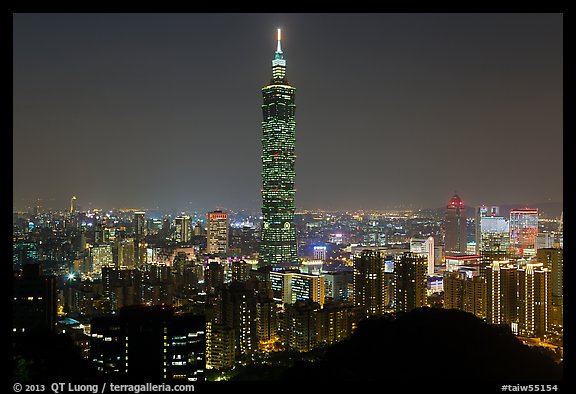
I even got to do a bit of nature hiking within the city. Searching for a panoramic view, I found out about Elephant Mountain, a tall forested hill rising next to the hip Xinyi district. A steep paved trail led to a great view of the skyline and Taipei 101, which was the tallest building in the world from 2004 to 2010 (508 m), now second to the Burj Khalifa in Dubai. After sunset, the other photographers quickly went down, leaving me in relative solitude.

I’ve been told that there is even a great National Park (Yangmingshan) on the outskirts of the city, but on the day I planned to check it out, the weather wasn’t favorable. Next time !

More images of Taipei

Part 1 of 4: 1 | 2 | 3 | 4

Outdoor Photographer Magazine profiles QT Luong

The opening feature in the March 2013 issue of Outdoor Photographer Magazine is an article about my nature landscape work. Read the web version.

I am honored to be called a “modern master” and “artist” by such a prestigious magazine, and to have been interviewed by a writer as perceptive as William Sawalich, who distilled the wide-ranging interview into a cohesive story. I happened to see my copy yesterday, on the birthday of Ansel Adams. He gives the general theme of the March 2013 issue, and is mentioned enough in the article that it is almost a fitting tribute.

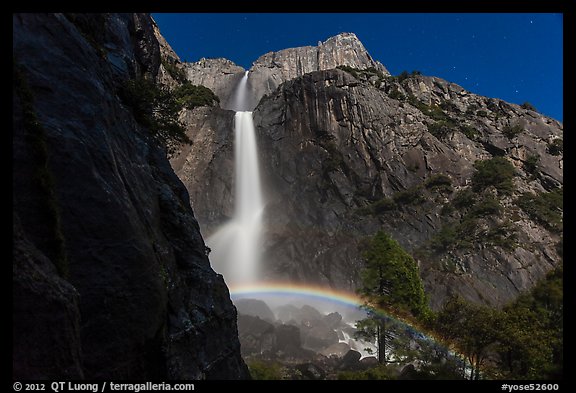
To complement the article, I’d like to share a few images which did not appear in the final version of the article, although they are discussed in it. Here is one version of the “nighttime Lower Yosemite Falls image”:

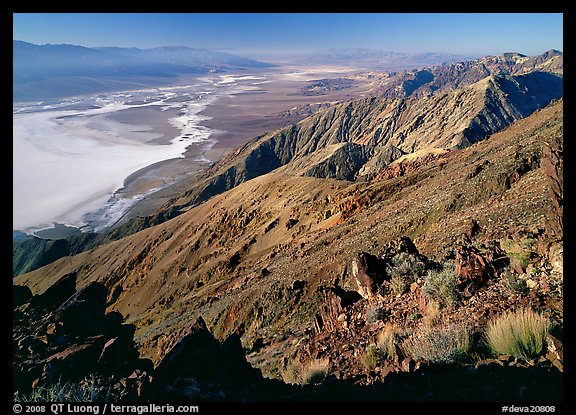
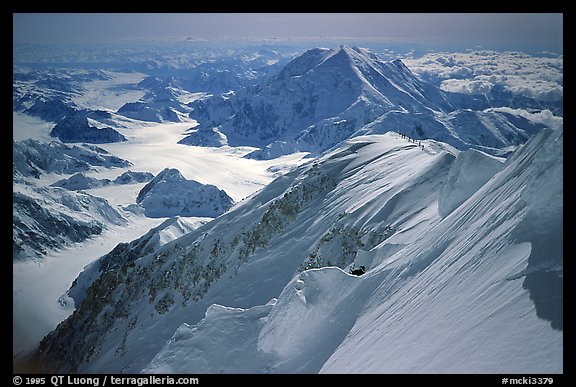
Here are the “two very similar views of Death Valley and Denali” which helped start the National Parks project:

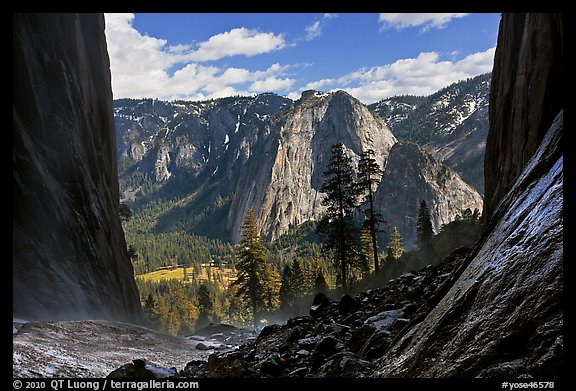
I feel that this image, part of the initial edit – and of the conversation about the ease of finding new images – was a good counterpoint to the Tunnel View image since the later is such an iconic location while this one is so little visited that I did not encounter a single person during the springtime hike from the Valley floor to the base of Ribbon Falls and never saw this composition before:

Myanmar Photo Tour 2014 with QT Luong

Rudyard Kipling described Burma (now Myanmar) as “unlike any land you know about.” Having visited all the countries in continental South-East Asia, some several times, I have indeed found Myanmar to be the most fascinating of them. The sites by themselves would be compelling enough. They have a magical quality which defies the imagination and amply justify the “Golden Land” given to Myanmar.

However, what makes Myanmar so interesting is that it has retained its unique traditional culture much more than other countries, because of the isolation of 40 years of military rule it is emerging from. Myanmar for now remains one of the most authentic destinations in our ever more modern and homogenized world. There are opportunities at every turn to capture moments of a lifestyle which hasn’t changed much over the last century. Unlike in more developed places where the sight of a camera raises suspicions, residents of all ages and genders still graciously welcome photographers.

As highlighted by President Obama’s visit, Myanmar is opening to the West, so changes are coming fast. The flip-side for us is that comfortable accommodation and transportation are now available, which make possible a luxury travel tour with stays at four and five star hotels. Since traveling in Myanmar in 2000, I have always wanted to return, so I am pleased to announce that I will be co-leading a Myanmar photo tour with Insiders Asia tour director, Phuoc Babcock, just like in our Fall 2012 Vietnam Photo Tour which was a great success with participants.

Classic Myanmar in Focus will take place January 3-14, 2014. During this time of the year, Myanmar has the most moderate temperatures and driest weather. We will visit the four most well-known destinations in Myanmar, using air transportation between them in order to minimize travel time. But we will not entirely shy away from bumpy rural roads, as our fifth destination, Pindaya, will definitively take us out of the classic tourist trail. Our schedule is expressly tailored for photography, with many sunrise and sunset sessions at spectacular locations. At each of the sites, we will take excursions into lesser visited areas, and enjoy special access and arrangements not available to normal tour groups to help us create unique images.

The tour will provide us with an extraordinary diverse range of photographic opportunities, including landscape, architecture, street photography, and environmental portraiture.

We start in Yangon with the amazing Shwedagon Pagoda, one of the oldest, largest, most gilded, revered, and active Buddhist edifices in the world. Bagan is the most impressive archeological site in South-East Asia, and in my opinion one of the man-made wonders of the world. In two and half centuries of extraordinary religious fervor, thousands of Buddhist monuments and temples (as many as all European cathedrals) were built in the small valley. Although many are ruined, they still stand almost as dense as a city and form an unforgettable sight when viewed at dawn from a high platform or a hot-air balloon. The center of Buddhism and Myanmar arts then shifted to Mandalay, an old royal city, particularly rich with traditional workshops, pagodas and monasteries, which will provide for close interactions as well as iconic landscapes. In Pindaya, we will experiment with light painting to photograph a mysterious cave filled with 8,000 Buddha statues, discovering on the way rural scenes that have not changed for centuries. Our exploration of a traditional way of life culminates in Lake Inle. We will visit floating villages and gardens built in the middle of this huge and beautiful mountain lake surrounded by high hills, enlivened by Intha fishermen with unique dress and technique of leg rowing and fishing.

The tour is limited to a small group of 10 photographers. Upon informal announcement of the tour via private correspondence, half of the seats have already been claimed.

When is the best time to travel to Myanmar ? Now — for tomorrow things will not be the same in this country which is moving fast towards its future. Come and join me on this incredible photography adventure to Myanmar.

Detailed information about Classic Myanmar in Focus photo tour

More images of Myanmar

Best Photobooks 2012: the meta-list

I like to look at photographs, in genres very different from my own, particularly in book form. I may write some about this obsession later, but for now let me just mention that in some years, I have spent more on photobooks than on photography gear. I also like best-of lists for many things. Despite their limitations, they are a useful way to try and bring order to possibilities that are so numerous as being practically infinite.

Despite the digital onslaught, there is more interest in printed photobooks than ever. The last few years have seen “best photobooks of the year” lists mushroom in November and December. Last year, curator and writer Marc Feustel compiled a meta “best of” 2011 photobooks list by gathering 52 lists, and giving one vote to a book for each appearance on a list. After completing the exercise, he wrote “if I see another list at this stage, I will probably have to take my own life”. As expected he didn’t compile the meta-list for 2012 photobooks. So here I have done the work, using the same methodology, based on a list of 56 lists gathered by Photot(o)lia that you should definitively explore – plus a few others. When you consider that some of the lists within (most notably Photo-Eye) are already themselves meta-lists, that’s actually more than 90 lists and 500 different titles.

The votes are very spread out. While the clear “winner” received about 25% of nominations, the runner up got only 14%, and from there many titles are tied. This large dispersion reflects the considerable number of titles published. The vitality of the photobook is encouraging, even though the lack of consensus may give the disorienting impression that everything is worth the same.

Non-inclusion on the meta-list doesn’t preclude greatness. American Photographs, one of the two most important books in the history of American photography, was reprinted in 2012 for the first time in a quarter century. Other relatively obscure reprints made it to the meta-list, but not American Photographs (maybe because most photobook lovers own already a copy ? the reprint looks better than my 1938 copy). It appeared only on the list by Mike Johnston’s TOP, initially as the top choice because it is that site’s all-time best seller, with readers ordering more than 1,200 copies.

Many of the top-nominated titles are from small publishers, such Mack Books, a small publishing house focusing on intellectually challenging projects, which started only in 2011 (Michael Mack is a Steidl veteran, though) and doesn’t even use traditional mass-distribution. Well-established Aperture and Steidl appear only from the 10th place. I am only beginning to look at the list. So far, my favorite is “(based on a true story)” which is self-published. I haven’t seen “Afronauts” and don’t expect to do so. Well before any of the lists was written, its 1000 copies had already sold out, which is quite remarkable for a debut, self-published book, published in May 2013. If you do something interesting, despite the avalanche of new photobooks, it is still possible to get noticed, coming out of nowhere !

1st Place (23 votes)

  • The Afronauts. CRISTINA DE MIDDEL Self Published

2nd Place (13 votes)

  • Elementary Calculus. J CARRIER Mack

3rd Place (12 votes)

  • The Present PAUL GRAHAM Mack

4th Place (11 votes)

  • Coexistence. STEPHEN GILL Nobody Books (Self Published)
  • Lebensmittel. MICHAEL SCHMIDT Snoeck
  • Lick Creek Line. RON JUDE Mack

5th Place (10 votes)

  • Looking for Love, 1996. ALEC SOTH Kominek Books

6th Place (9 votes)

  • Dive Dark Dream Slow. MELISSA CATANESE The Ice Plant
  • Down These Mean Streets. WILL STEACY B. Frank books
  • Heaven. PAUL KOOIKER Van Zoetendaal Gallery

7th Place (8 votes)

  • Another Language. MÅRTEN LANGE Mack
  • Jeddah Diary. OLIVIA ARTHUR Fishbar

8th Place (7 votes)

  • Circulation : Date, Place, Events. TAKUMA NAKAHIRA Osiris
  • City Diary. ANDERS PETERSEN Steidl/Swedish Books/GUN
  • Deutschland. GERRY JOHANSSON Mack
  • Uncle Charlie. MARC ASNIN Contrasto

9th Place (6 votes)

  • Found Photos in Detroit. ARIANNA ARCARA Censura Publishing
  • Here Far Away. PENTTI SAMMALLAHTI Dewi Lewis Publishing (Hier weit entfernt, Kehrer)
  • Out to Lunch. ARI MARCOPOULOS PPP Editions
  • Two Thousand Light Years from Home. PIETRO MATTIOLI Kodoji Press
  • Vanilla Partner. TORBJØRN RØDLAND Mack

10th Place (5 votes)

  • (based on a true story). DAVID ALAN HARVEY BurnBooks (Self Published)
  • A Natural Order. LUCAS FOGLIA Nazraeli Press
  • A New American Picture. DOUG RICKARD Aperture
  • Billy Monk: Night Club Photographs. BILLY MONK Dewi Lewis
  • Concresco. David Galjaard Self-published
  • In the Car With R. RAFAL MILACH Czytelnia Sztuki
  • Kiev. ROB HORNSTRA The Sochi Project
  • Life Size. SAM FALLS Karma
  • Los Alamos Revisited. WILLIAM EGGLESTON Steidl
  • Petrochemical America. RICHARD MISRACH & KATE ORFF Aperture
  • Photographs Not Taken. WILL STEACY Daylight
  • Scrapbook 1969-1985. WALTER PFEIFFER Patrick Frey
  • Soho. ANDERS PETERSEN Mack
  • The Father of Pop Dance. TIANE DOAN NA CHAMPASSAK Self Published
  • Touch. PETER DEKENS Self Published
  • USSR 1991. KEIZO KITAJIMA Little Big Man Books

11th Place (4 votes)

  • A Girl and Her Room. RANIA MATAR Umbrage
  • A Retrospective. RINEKE DIJKSTRA Guggenheim Museum
  • House of Coates. BRAD ZELLAR & LESTER B. MORRISON Little Brown Mushroom
  • Kodachrome. LUIGI GHIRRI Mack (reprint)
  • Lange Liste 79 – 97. CHRISTIAN LANGE Spector Books
  • Life’s a Beach. MARTIN PARR Aperture
  • Lovesody. MOTOYUKI DAIFU Little Big Man Books
  • Margret:Chronik einer Affäre, Mai 1968. NICOLE DELMES Walther König
  • Mrs. Merryman’s Collection. ANNE SOPHIE MERRYMAN Mack
  • On the Mines. DAVID GOLDBLATT Steidl (reprint)
  • Pictures and Words. JUERGEN TELLER Steidl
  • Poppy: Trails of Afghan Heroin. ROBERT KNOTH & ANTOINETTE DE JONG Hatje Cantz
  • Project Prints. LUIGI GHIRRI JRP Ringier
  • Sailboats and swans. MICHAL CHELBIN Twin Palms
  • Strip-O-Gram. SEBASTIEN GIRARD Self Published
  • Sunburn. CHRIS MCCAW Candela Books
  • The Americans List. JASON ESKENAZI Red Hook Editions (Self Published)
  • The Netherlands. HANS VAN DER MEER YdocPublishing

12th Place (3 votes)

  • Anima. CHARLOTTE DUMAS Self Published
  • Bottrop Ebel 1976. MICHAEL WOLF Peperoni
  • Cette Montagne C’est Moi. WITHO WORMS FW books
  • Closed cities. GREGOR SAILER Kehrer
  • Companion. CHARLOTTE DUMAS Editions Filigranes
  • Face City. PINO MUSI, self-published.
  • Fushikaden ISSEI SUDA Aiko Nagasawa
  • Gary Briechle. GARY BRIECHLE Twin Palms Publishers
  • Handbook to the Stars. PETER PUKLUS Stokovec (Self Published)
  • INFRA by RICHARD MOSSE Aperture
  • Los Restos de la Revolucion. KEVIN KUNISHI Daylight
  • Metsästä. ANNE GOLAZ Kehrer Verlag
  • Murals & Portraits. RICHARD AVEDON Abrams
  • My Dakota. REBECCA NORRIS WEBB Radius Books
  • NYLPT. JASON EVANS Mack
  • Nocturnes. AM PROJECTS dienacht Publishing
  • Nurture Studies. DIANA SCHERER van Zoetendaal Gallery
  • Ohio ALEC SOTH & BRAD ZELLAR Little Brown Mushroom
  • Rachel Monique. SOPHIE CALLE Siglio
  • She. LISE SAFARTI Twin Palms
  • Singular Beauty. CARA PHILLIPS Fw:
  • Summertime MARK STEINMETZ Nazraeli
  • Taking My Time. JOEL MEYEROWITZ Phaidon
  • The Actor. JOHN GOSSAGE Loosestrife
  • The Quest for the Man on the White Donkey. YAAKOV ISRAEL Schilt Publishing
  • The River Winter. JEM SOUTHAM Mack
  • Thinspiration (Must not Eat). LAIA ABRIL Self Published
  • Tim Walker: Story Teller. TIM WALKER Abrams

13th Place (2 votes)

  • 2013. JUSTIN JAMES REED Horses Think Press
  • 207 West 17th Street #20c NY NY 10011. MATTHIAS HERRMANN Fotohof
  • A Possible Life. Conversations with Gualbert BEN KREWINKEL f0.23 publishers
  • American Portraits. LEON BORENSZTEIN Nazraeli Press
  • Anarchy Photobook Mania. NOBUYOSHI ARAKI Izu Photo Museum
  • Anyway. ARI MARCOPOULOS Dashwood Books
  • Arbeit / Work. CHRIS KILLIP Steidl
  • Babe MICHAEL NORTHRUP J&L Books
  • Before Tomorrow. YANNIK WILLING Self Published
  • Behind the curtains of 21st Century Communism. TOMAS VAN HOUTRYVE Intervalles
  • Black Market. BROOMBERG & CHANARIN, Chopped Liver Press.
  • Brutal. MICHAL LUCZAK Michal Luczak
  • Call and Response. CEDRIC NUNN Hatje Cantz
  • Cardiff After Dark MACIEJ DAKOWICZ Thames & Hudson
  • Censorship Daily. JAN DIRK VAN DER BURG Self Published
  • Cindy Sherman. CINDY SHERMAN MOMA
  • Classroom Portraits. JULIAN GERMAIN Prestel
  • Distant Place. AGNIESZKA RAYSS, JAN BRYKCZYNSKI, ADAM PANCZUK, MICHAL LUCZAK & RAFAL MILACH Copernicus Science Centre
  • Documenting Science. BERENICE ABBOTT Steidl
  • Ed van der Elsken: Sweet Life: Books on Books No. 13
  • Este Seu Olhar. MAÍRA SOARES. Self Published
  • Fabrik. JAKOB TUGGENER Steidl (reprint)
  • From the Archives. DON HUDSON Éditions FP&CF
  • Furtivos. VICENTE PAREDES Fiesta Ediciones/RM
  • Harold Feinstein. HAROLD FEINSTEIN Nazraeli Press
  • Heavy Hand, Sunken Spirit. DAVID ROCHKIND Dewi Lewis
  • Imaginary Club. OLIVER SIEBER Bohm/Kobayashi
  • In Almost Every Picture 11. ERIK KESSELS KesselsKramer
  • Isolated Places KEIZO KITAJIMA Rat Hole Gallery
  • Jitka Hanzlová JITKA HANZLOVÁ Kehrer Verlag
  • Kazan. MAYUMI HOSOKURA Artbeat publishers
  • Keld Helmer-Petersen: 122 Colour Photographs: Books on Books No. 14
  • Kim Jong Il Looking at Things. JOÃO ROCHA Jean Boîte Editions
  • Kodama.KIMURA HAJIME Mado-sha
  • Krass Clement: Drum: Books on Books No. 16
  • Lewis Hine LEWIS HINE DAP
  • Labyrinth DAIDO MORIYAMA Aperture
  • Larry Sultan & Mike Mandel. LARRY SULTAN & MIKE MANDEL Distributed Art Publishers
  • Left Behind. JONATHAN HOLLINGSWORTH Dewi Lewis
  • Lenore. ERIK VAN DER WEIJDEN 4478zine
  • Malick Sidibe. Portrait of Mali MALIK SIDIBE Skira
  • Matatabi. KOJI ONAKA Super Labo
  • Michigan ALEC SOTH & BRAD ZELLAR Little Brown Mushroom
  • Modern Times. PATRICK TSAI Nanarokusha publishing
  • Moments before the flood. CARL DE KEYZER Lannoo
  • Nathan Lyons. JESSICA S. MCDONALD University Of Texas Press
  • Neue Welt. WOLFGANG TILLMANS Taschen
  • New Colour Guide. JOHN MACLEAN Hunter & James
  • Night and Day DAVID ARMSTRONG Morel
  • Nobuyoshi Araki: The Banquet: Books on Books No. 15
  • Nora. JUAN VALBUENA. phree
  • On borders. OSTKREUZ PHOTOGRAPHERS Hatje Cantz
  • Photo Express Tokyo KEIZO KITAJIMA (reprint)
  • Photography Changes Everything. MARVIN HEIFERMAN Aperture
  • Pieter Hugo. This Must Be The Place PIETER HUGO Prestel
  • Reading Ed Ruscha. ED RUSCHA Kunsthaus Bregenz
  • Red Thistle. DAVIDE MONTELEONE Dewi Lewis Publishing
  • Reprinting the City. STEPHAN KEPPEL FW:
  • Retinal shift. MIKHAEL SUBOTZKY Steidl
  • Revolutions. RÉMI OCHLIK Emphas.is
  • Rien. ANDRÉ CEPEDA Pierre von Kleist
  • Rosette, Mauricette et Roby. ZOÉ BEAUSIRE, Kominek.
  • Ruth on the Phone. NIGEL SHAFRAN Roma
  • Saluti da Pinetamare. SALVATORE SANTORO, self-published.
  • Somewhere. ANDRES GONZALES Self-published.
  • Stay Cool. RJ SHAUGHNESSY Self Published
  • Still. PATRICK HOGAN Self Published
  • Tales of Tono DAIDO MORIYAMA Tate (reprint)
  • The Children Living in Washington Heights 1959-1962. GASHO YAMAMURA Yagisha
  • The Collared Dove Sound. SABRINA RAGUCCI & GIORGIO FALCO self-published
  • The History of Photography in Pen and Ink. (Second Edition) CHARLES WOODARD A-Jump Books
  • The Lost Album DENNIS HOPPER Prestel
  • The Photograph as Contemporary Art. Melinda Gibson Self-published
  • The Table of Power 2. JACQUELINE HASSINK Hatje Cantz
  • There’s a Place in Hell for Me & My Friends. PIETER HUGO Oodee
  • This Folder May Contain Clippings and Other Ephemeral Material LIZ SALES Conveyor Arts
  • Toilet Paper. MAURIZIOU CATTELAN & PIERPAOLO FERRARI Freedman Damiani
  • Upstate ALEC SOTH & BRAD ZELLAR Little Brown Mushroom
  • Vivian Maier Out of the Shadows VIVIAN MAIER CityFiles Press
  • Vanitas. JOEL-PETER WITKIN Arbor Vitae
  • Vol I. ADAM BROOMBERG Self Publish Be Happy book club
  • War/Photography: Images of Armed Conflict and Its Aftermath, ANNE TUCKER, WILL MICHELS, NATALIE ZELT Museum Fine Arts Houston/Yale University Press
  • Wegweiser zum Glück. Bilder einer Straße 1979-1981 WILHELM SCHÜRMANN Hatje Cantz
  • Welcome to Springfield. MICHAEL ABRAMS Loosestrife
  • Wolfgang Tillmans. WOLFGANG TILLMANS Taschen

14 th Place (1 vote)

  • 333 books not listed here