An Art Walk Along Coyote Creek
No Comments
On October 17, 2026, I brought The Trail back to Coyote Creek by leading a photographic walk as part of Reimagining Our Waterways, the Second Art + Climate Symposium organized by the San Jose Museum of Art and the City of San Jose Climate Art Program. I’m grateful to both organizations for the invitation and for making this opportunity to share my work possible.
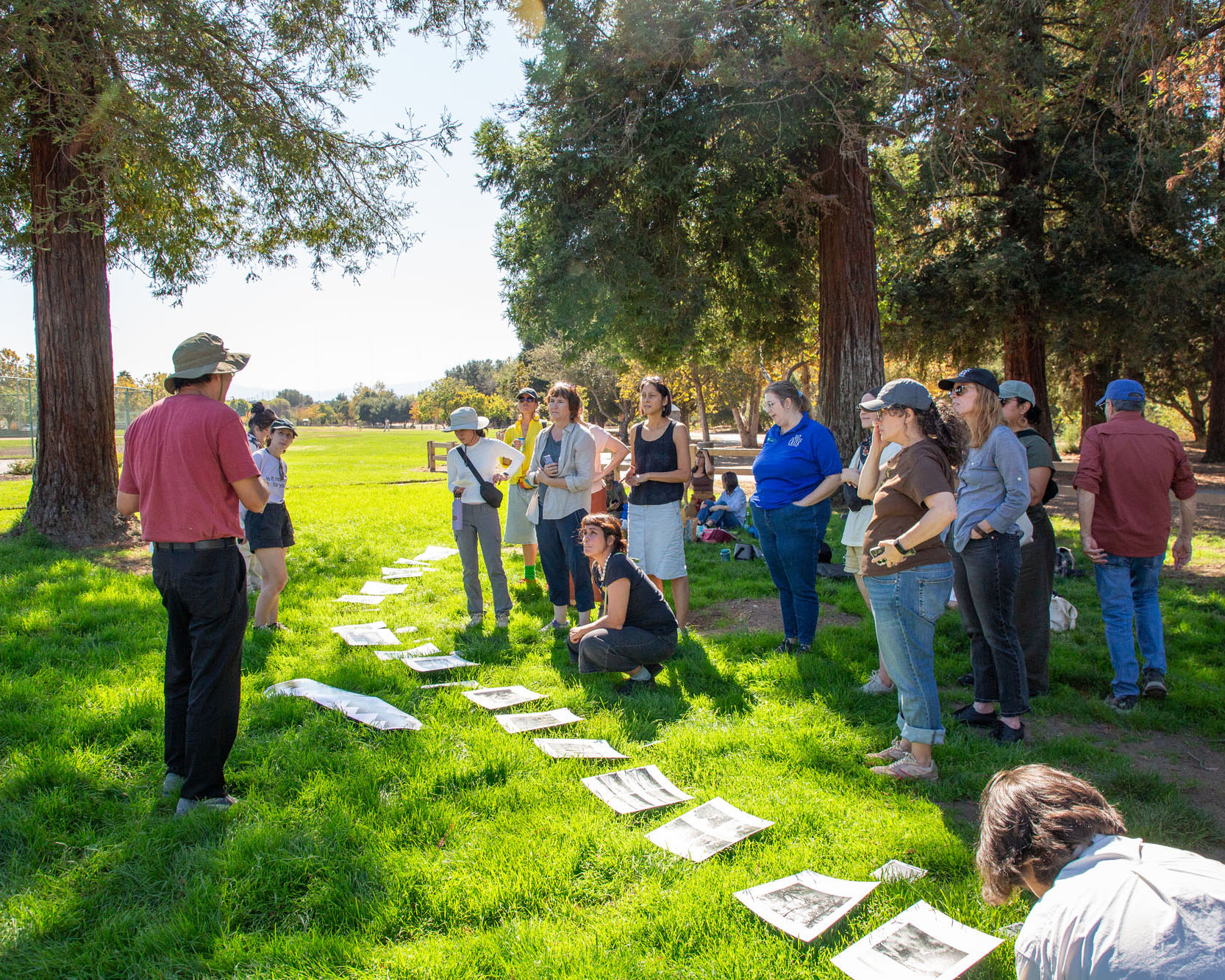
Photo courtesy of Frederick Liang / San Jose Museum of Art
The walk was something like a gallery talk without walls. For more than a decade, I have returned to the same locations along Coyote Creek to photograph how they change. This time, I brought prints back to the places where they were made, inviting participants to compare the photographs with the landscape before their eyes and reflect on how it has changed over time. This was my first public presentation of The Trail, and it felt particularly meaningful to share the work in the very places where it originated.
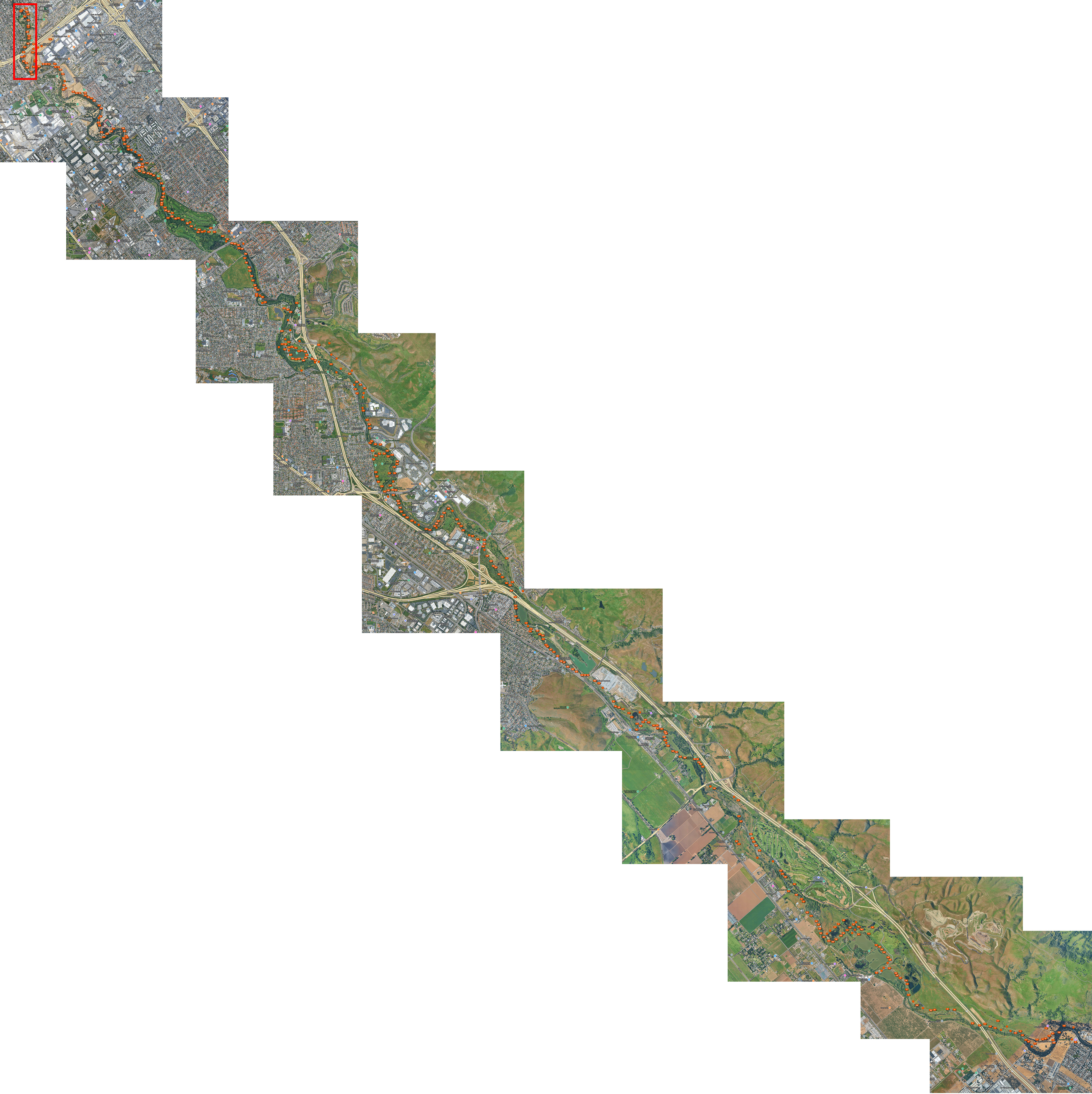
The main section of the Coyote Creek Trail stretches for 21 miles. Our planned route covered only the northernmost mile between William Street Park and the Coyote Creek Trestle. I’ve visited the trail more than 200 times, exploring one section at a time. In the aerial view below, the number on each orange pin indicates how many photographs I made at that location, and the red rectangle at the upper left corner marks the walk’s location.
The walk offered an opportunity to consider some of the questions that have emerged from my evolving project, The Trail, which depicts a landscape that is simultaneously wildlife habitat, recreational corridor, engineered waterway, and home to people living outside conventional housing. Along the short stretch of Coyote Creek we explored, human habitation was particularly evident in my photographs, so I focused on that aspect. To encourage meaningful exchanges, attendance at the symposium was limited, and tickets sold out. For those who couldn’t attend, I wanted to share a recap of my presentation here. The photographs that follow are organized around the four planned stops of our walk, each revealing a different aspect of how people use and transform the landscape.
A landscape altered
The creek is both a natural corridor and a barrier. The Coyote Creek Trestle, constructed in the early 1920s as part of the Western Pacific Railroad, is a survivor of San Jose’s agricultural past, when the Santa Clara Valley was known as the Valley of Heart’s Delight. The wooden structure has acquired historical significance, and proposals affecting its future have prompted preservation efforts. One of my photographs shows the trestle surrounded by what might appear to be mist. In reality, it was smoke from a fire. The smoke evokes the romantic age of steam locomotives, suggesting a past that is no longer present. There is a tension, however, between the photograph’s aesthetic appearance and what it actually depicts.

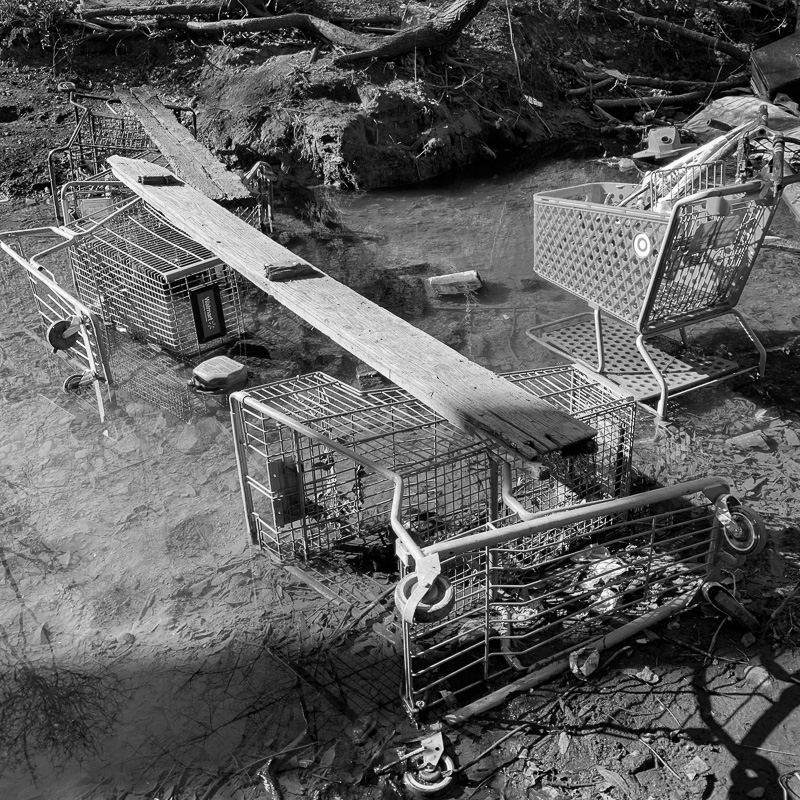
The history of this place is more complicated than its present appearance suggests. Across the creek lies the former site of the Jungle, once one of the country’s largest homeless encampments. Hundreds of people lived there before its widely publicized clearance in 2014. The site was occupied again in subsequent years and underwent another major clearance in 2026 Nearby, I photographed an improvised creek crossing incorporating discarded shopping carts.
These two crossings were built for very different purposes and with vastly different resources. Yet both represent efforts to overcome the same geographical obstacle. One is recognized as historic infrastructure, while the other might initially appear to be debris. Only when we understand its function does it become recognizable as a crossing. The contrast raises questions about how we perceive human modifications to the landscape. Why do some become part of our cherished heritage, while others are regarded as intrusions? Who gets to modify the landscape? .
A landscape inhabited
A little farther north along the trail, I photographed a sofa, a shopping cart, and a cat in a wooded setting. The photograph, which I titled “Home Comforts”, juxtaposes objects and a creature that we normally associate with different environments. It is one of most frequently exhibited photographs in the project (Griffin, BAPO, SFC), and I have previously commented on its components. What makes these elements seem out of place in a natural setting? The sofa is an ordinary piece of furniture, but its appearance beside the creek changes how we interpret it. The cat further complicates the distinction between domestic and wild. Along Coyote Creek, some cats have been abandoned by their owners, while others depend on people living nearby or volunteers who feed them. Their presence points toward networks of human and animal relationships that extend beyond the visible scene.


At the same location, I also photographed an improvised footbridge connecting the two sides of the creek. Together, these photographs suggest that the wooded corridor was not simply a collection of isolated campsites. It was a lived landscape, with places to stay and informal routes for moving between them. People are absent from these photographs, yet their presence is apparent through the objects, structures, and modifications they leave behind. This is one of the possibilities that interests me in photography: an image can reveal traces of lives without describing those lives completely. What can we learn about people who aren’t pictured, and what remains beyond the photograph’s ability to tell us?
A landscape given meaning
Continuing along the creek, I found gardens, decorations, religious imagery, and carefully arranged objects. They suggest activities beyond the immediate necessities of shelter and survival: efforts to personalize surroundings, cultivate plants, and invest a place with meaning. As a photographer, I am drawn to these unexpected visual discoveries. At the same time, I want to recognize the creativity and care invested in these places without romanticizing the hardships of living there. These expressions exist in precarious circumstances. The environments people have shaped may change or disappear, sometimes leaving little trace of what was once there.
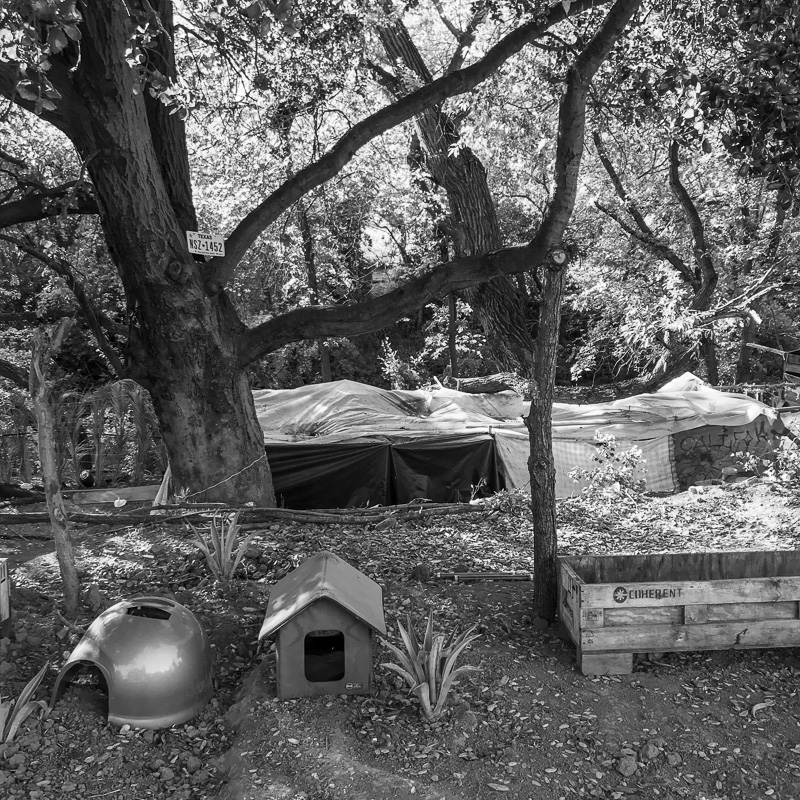
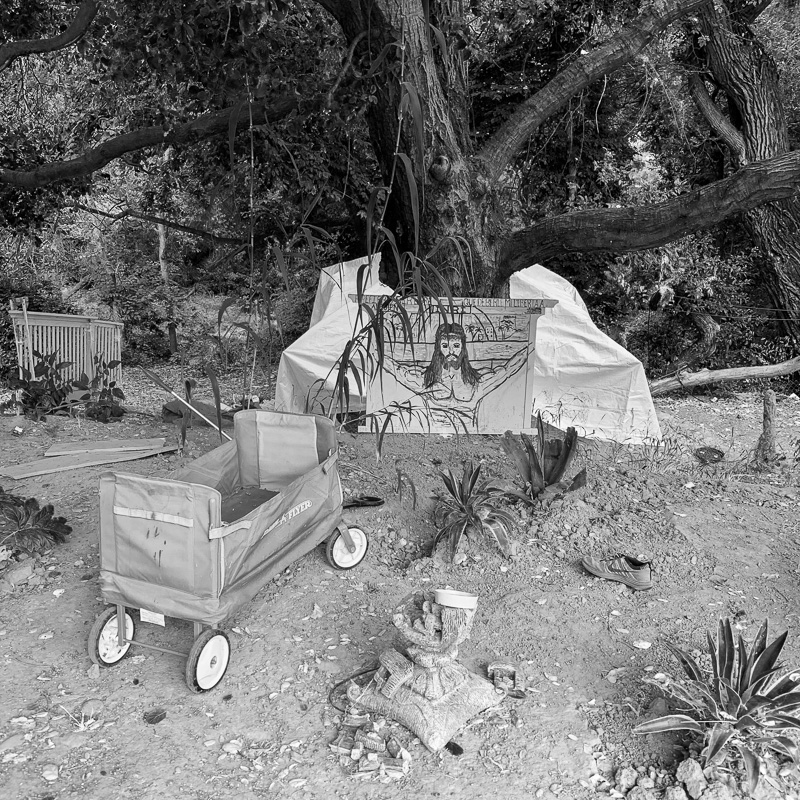
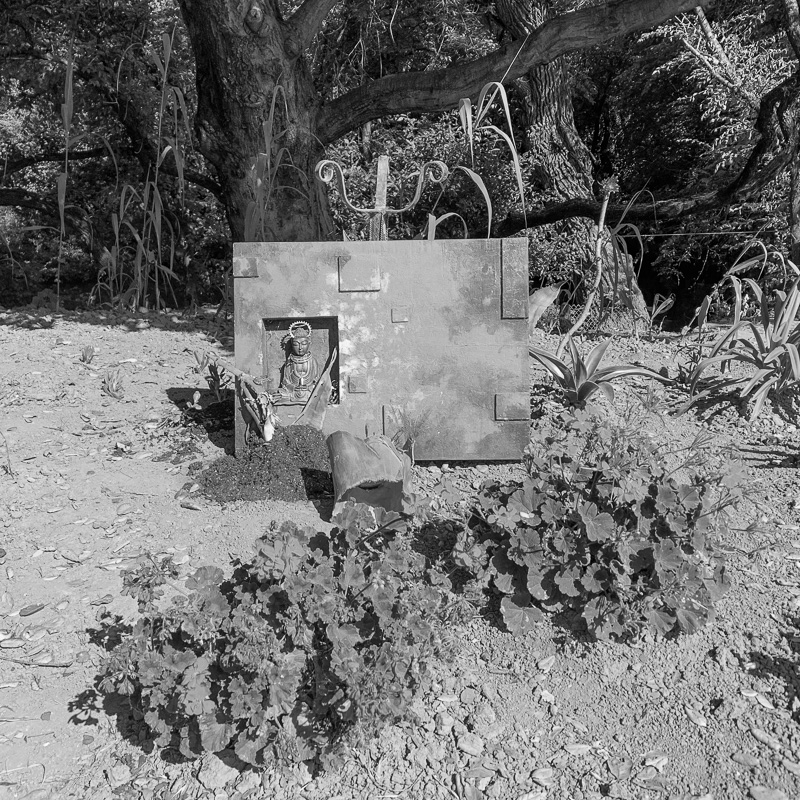
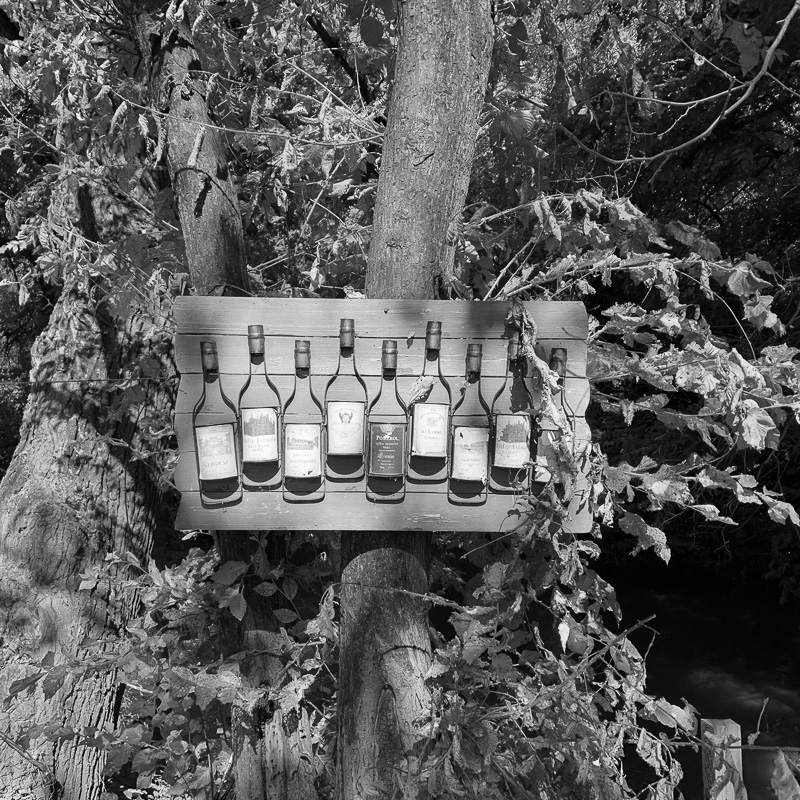
Gardening particularly is poignant in this context. Cultivating plants implies care and attention over time, even when one’s ability to remain in that location is uncertain. The planted vegetation also complicates a straightforward division between human occupation and the natural environment. Here, nature is not simply something people disturb. It is also something they tend, shape, and incorporate into their daily lives.
Some arrangements attracted my attention for their visual qualities. A collection of bottles, for example, can suggest an installation. Religious objects placed among vegetation introduce relationships between natural forms and spiritual expression. I cannot know whether the people who made these arrangements thought of them as art. Yet their choices raise questions about how we recognize artistic expression. Does something need to be intended as art to have aesthetic significance? How does the setting affect our perception of it?
A landscape transformed
Over the years, I have watched many of the places I photographed change. Floods reshape the creek, vegetation grows and recedes, and encampments are established and cleared. I have explored changes at cleared encampments more systematically in The Trail, Cleared, using repeated photographs from the same viewpoints to document successive states of former encampment sites. Farther south along the creek, some locations have undergone multiple transformations, which I have recorded over time. Along the short section covered by our walk, however, I had only before-and-after pairs to show. At this location, an earlier photograph shows a grill, belongings, and other signs of habitation beneath a large tree. A later photograph shows the same place, but the visible traces of human occupation have disappeared. To someone encountering the site for the first time, it might seem like an ordinary patch of woodland.
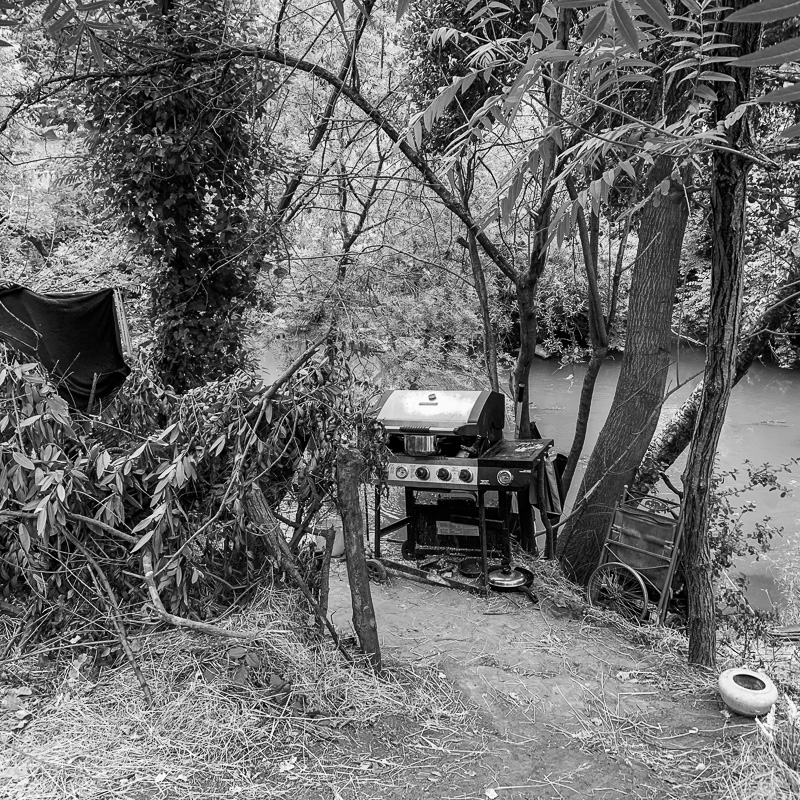
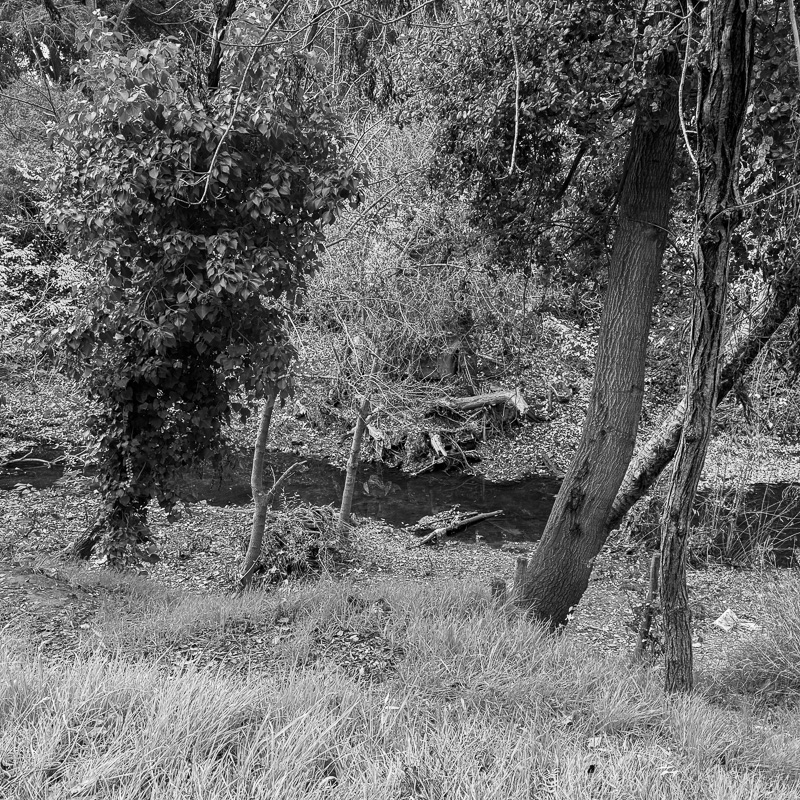
This transformation raises two questions: If the creek looks more natural now, does that necessarily mean it has been restored? What has been gained, and what has been lost? Those questions cannot be answered by appearance alone. Removing waste and reducing pollution can benefit a waterway, but the disappearance of an encampment also removes evidence of the lives once established there. The photographs do not establish the ecological condition of the site or tell us what happened to its former inhabitants. They do, however, preserve a visual history that is no longer evident in the landscape itself.
The changing nature of the creek was evident even during the walk. New encampments or signs of habitation had appeared since I scouted the locations just two weeks earlier. The changing nature of the creek was evident even during the walk. At one stop, a man was camping, and I appreciated his willingness to let our group come nearby after I asked him. These developments forced me to improvise parts of my presentation. Since I was busy leading the walk, I returned a week later intending to photograph the changes, only to find that the new encampment had disappeared. Even after more than a decade of observation, I was reminded how quickly this landscape can change.
Looking again
I began photographing Coyote Creek because I wanted to find wildness in an ordinary place close to home. More than a decade later, I have come to understand that the distinction between wild and human landscapes is far less clear than it initially seemed. Repeated observation has been essential to that understanding. A single photograph captures one moment, while returning over the years reveals seasonal cycles, gradual transformations, unexpected events, and disappearances. It also exposes the limitations of any single view.
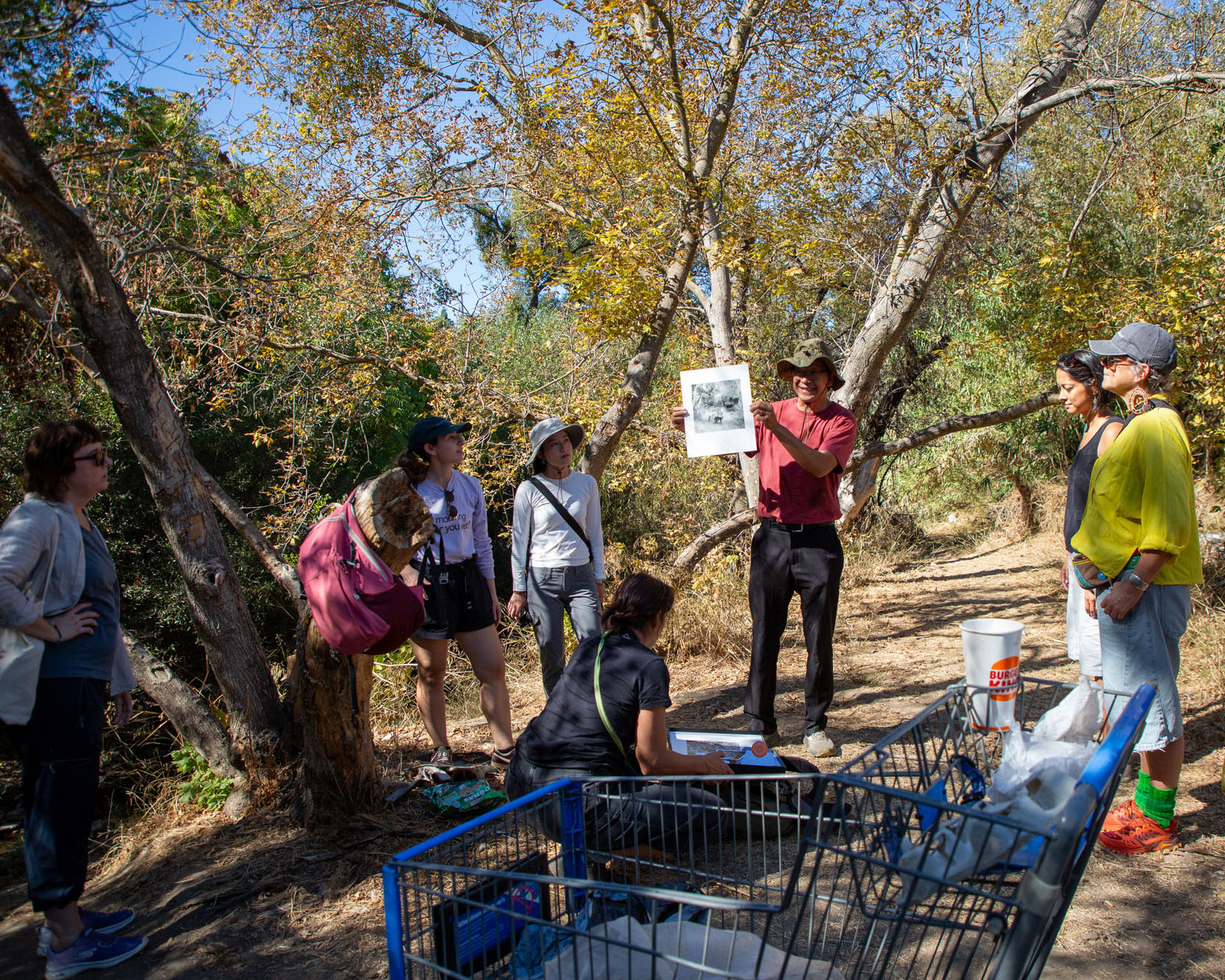
Photo courtesy of Frederick Liang / San Jose Museum of Art
During the walk, I invited participants to make their own photographs at the locations where I had photographed years earlier. The scenes before their eyes differed from those in my prints. Their images would become another record of those places, made at another moment in their history. That is perhaps the central experience I wanted to share: a place is never quite what it first appears to be. Photography offers a way to pay attention, to recognize what is present, and to remember what is no longer there.