Grand Staircase–Escalante, Dismantled
No Comments
On July 13, President Trump once again stripped national-monument protection from most of Grand Staircase–Escalante National Monument in Utah. In 2017, his first administration reduced the monument by nearly half. Together with the drastic reduction of Bears Ears (just renewed, and even worse), the action was widely described as the largest rollback of federal land protections in American history. Public opposition was intense, and President Biden restored the monument’s boundaries in 2021.
This time, a far more extreme attack has barely registered in the national news. Trump reduced Grand Staircase–Escalante from approximately 1.87 million acres to just 181,541 acres—a 90.3 percent reduction. The 2017 reductions fractured Grand Staircase–Escalante into three separate units: Grand Staircase, Kaiparowits, and Canyons of the Escalante. The 2026 proclamation effectively eliminates two of those three units. The Grand Staircase Unit disappears entirely, while the Kaiparowits Unit survives only as an 8,900-acre fragment renamed Kaiparowits Horizons. What remains of the monument is largely confined to the Canyons of the Escalante, leaving most of the landscapes that gave Grand Staircase–Escalante its national significance outside the monument. A more precise map can be seen here.
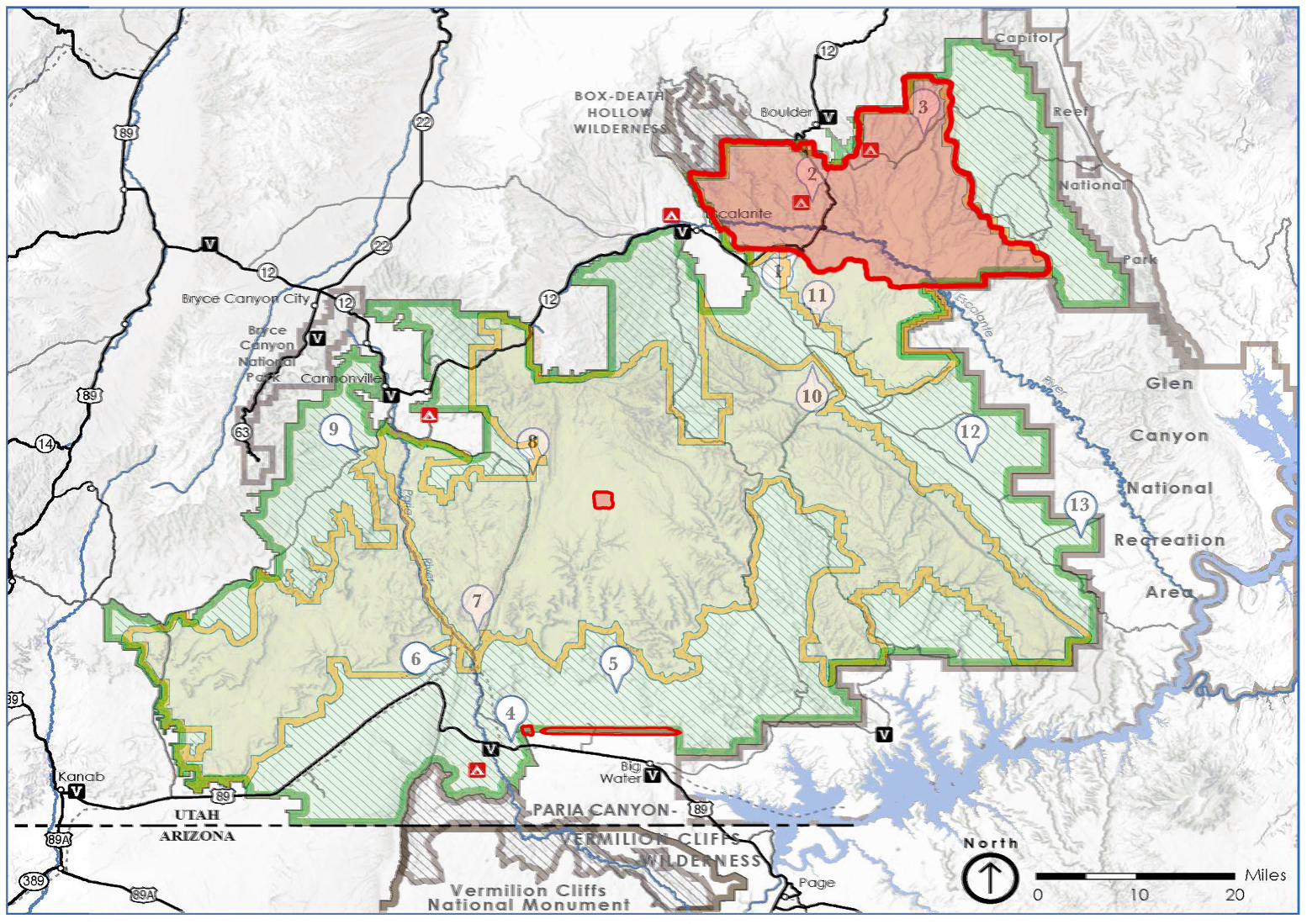
Green: original boundaries of Grand Staircase–Escalante National Monument. Yellow: 2017 boundaries established during the first Trump administration. Red: boundaries established by the July 13, 2026 proclamation. Numbered markers identify locations featured in the Grand Staircase–Escalante chapter of Our National Monuments.
Grand Staircase–Escalante marked an important point in the evolution of the Bureau of Land Management (BLM). I have written before about how the 1976 Federal Land Policy and Management Act transformed the BLM from the caretaker of lands once expected to be disposed of into the steward of a permanent public estate, with conservation among its responsibilities. Twenty years later, Grand Staircase–Escalante became the first national monument managed by the BLM, establishing a precedent for recognizing exceptional conservation values within lands that remained under the agency’s multiple-use mandate. Four years later, building on that precedent, the Interior Department created the National Landscape Conservation System, now known as the National Conservation Lands. Seen in that longer history, the dismantling of Grand Staircase–Escalante represents more than the loss of protection for individual places. It reverses part of a decades-long expansion in how we have understood the value and purpose of our public lands.
The lines on the map do not make the landscapes themselves disappear, nor does exclusion from the monument mean that every other protection vanishes. Much of the land remains federally owned, and some areas retain protections such as Wilderness Study Area status. What changes is the framework governing what those lands are for. The 2026 proclamation makes that shift unusually explicit: it cites the region’s mineral resources as a reason for reducing the monument and provides for excluded lands to be opened to mineral leasing and other uses under the public-land laws. The proclamation itself thus frames the reduction as a move away from the conservation priority embodied by the monument and back toward the broader extractive and multiple-use possibilities of BLM lands.
My book Our National Monuments was created in response to the 2017 review of national monuments. Through photographs, maps, and essays by writers and advocates closely connected to each place, it documented the twenty-seven monuments then under threat. The introduction to Grand Staircase–Escalante was written on behalf of Grand Staircase Escalante Partners by Stephen Trimble, one of the foremost writers on the Colorado Plateau and the American West. The author or editor of more than two dozen books on nature, landscape, and conservation, he has spent decades documenting the region’s ecology, history, and cultures. He is also a recipient of the Sierra Club’s Ansel Adams Award for Conservation Photography.
The photographs that follow were originally published in the Grand Staircase–Escalante chapter of Our National Monuments. Rather than attempting a comprehensive survey, the portfolio highlights a selection of places chosen for their ability to convey the monument’s remarkable variety of forms, colors, and experiences: sweeping slickrock landscapes, sculpted badlands, delicate hoodoos, natural arches, and narrow slot canyons. Seen together, they suggest the richness of a landscape far larger than any portfolio can encompass. Their locations are keyed to the accompanying map. Every one of them now lies outside the monument’s boundaries.
Rather than relying on political talking points about lands that are supposedly “empty”, “not walkable”, or lacking in value, I encourage everybody to visit these places and judge for themselves. To help make that possible, I am making available two free PDF downloads at the bottom of this post. The first presents the Grand Staircase–Escalante chapter from Our National Monuments as originally published, preserving its design. The second is from the companion mobile-friendly field guide with expanded maps, directions, coordinates, and location information. Of the thirteen featured locations, only two remain within the monument’s drastically reduced boundaries. The other eleven—those pictured in the portfolio below—have all been excluded. Whether your interest is in conservation, exploration, or photography, the best way to understand what lost monument protection is to experience these landscapes firsthand. The politicians who removed protection from these lands may have seen them only on a map. I hope you will encounter them in person.
Grand Staircase-Escalante, by Stephen Trimble, GSE Partners
Grand Staircase-Escalante is so big, so diverse, that choosing a favorite place resembles the proverbial blind man touching the elephant. There’s that beloved secret side canyon lush with orchids, monkeyflowers and maidenhair ferns. There is an otherworldly dome of sculptured, cross-bedded, butter-yellow rock. What about the big views across the Escalante River basin at sunset, leading your gaze past shadowed clefts and ruddy bands of slickrock to the elegant skyline of the Henry Mountains? Every canyon, every mesa, every back road has its special delights.The monument’s enormity contributed to its founding. When President Bill Clinton signed the Grand Staircase-Escalante National Monument proclamation in September 1996, he created a gigantic natural laboratory. Scientists applauded his use of the 1906 Antiquities Act to grant special designation for 1.9 million acres of public lands, embracing sufficient space and multiple habitats to conduct innovative research on climate change, speciation, and migration corridors. As the first unit of the Bureau of Land Management’s (BLM) National Landscape Conservation System, the monument became the model for a new conservation mission for the BLM.
The monument proclamation acknowledged geologic and cultural treasures first noted 150 years ago by geologist and explorer John Wesley Powell. The monument’s rocks provide “one of the best and most continuous records of Late Cretaceous terrestrial life on Earth,” as the proclamation puts it. Scientists find new dinosaurs nearly every time they visit — notably in the Kaiparowits Formation, a fossil locality so rich that Grand Staircase turns out to be the best place on earth to study the extinction of the dinosaurs.
The president recognized the scientific importance of the hundred-mile elevation gradient between Grand Canyon and Bryce Canyon, with cliff-barricade risers and plateau treads, christened by pioneer geologists the “Grand Staircase.” He protected what was left of the Escalante rivershed above Lake Powell. This dissected sandstone wonderland formed the western anchor of a legendary national park proposal in the 1930s. Clinton’s proclamation ended a 30-year debate about whether we should strip-mine coal on the remote and pristine Kaiparowits Plateau.
Or so we believed.
The non-profit Grand Staircase Escalante Partners began working here in 2004 to advance monument science and “honor the past and safeguard the future,” with programs in research, conservation, and education. A decade of restoration partnerships eliminated invasive Russian olive from 90 river miles in the Escalante watershed. Recent efforts to acknowledge the monument as the ancestral lands of eight Native nations strengthen connections with indigenous neighbors on the Colorado Plateau.
None of this mattered once Donald Trump was elected president. Utah politicians saw an opening. Still incensed about President Clinton’s executive order, they believed the president had disrespected their insistence on the primacy of states-rights. Local officials lobbied the new administration to reduce and dismantle the monument. They dreamed of jobs and profits from extractive industry, with little regard for irreplaceable spiritual and scientific values.
President Trump opened the door for desecration in December 2017, when he reduced Grand Staircase by half, creating management chaos and legal confusion. He chopped a cherished and successful national monument into incoherent fragments, removing protections from lands excluded by these new boundaries. Controversial new BLM resource management plans would open vast areas of Grand Staircase-Escalante to clearcutting, unmanageable recreation, and increased off-road vehicle use.
In 2017, Grand Staircase Escalante Partners joined other conservation and scientific organizations in the legal battle to restore the monument’s integrity. One way or another, defenders of Grand Staircase believe we will see the day when we celebrate the reconsecration of this international treasure.
Some Places Removed from Grand Staircase–Escalante
The eleven locations below, from the Grand Staircase–Escalante chapter of Our National Monuments, now lie outside the monument’s boundaries. Numbers are keyed to the map above.
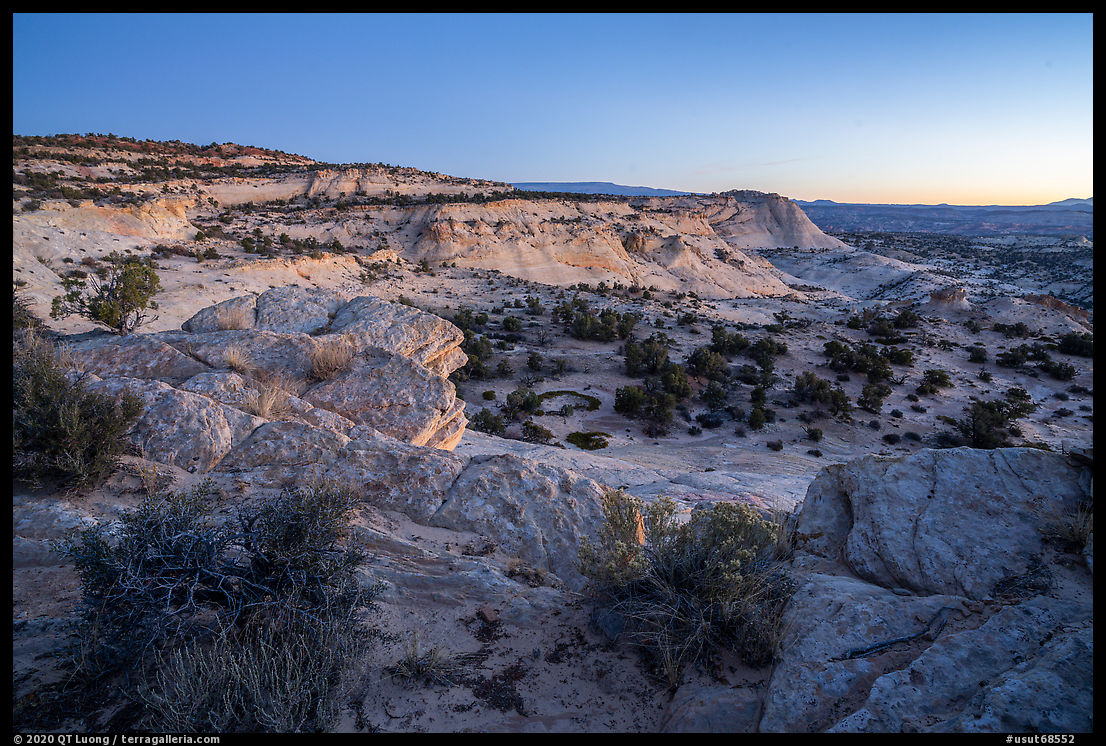
1. Head of the Rocks (Scenic Byway 12), dawn
One of the most expansive roadside viewpoints in the monument, Head of the Rocks overlooks a vast slickrock landscape stretching toward the horizon. The exposed layers reveal the geological complexity that defines Grand Staircase–Escalante.
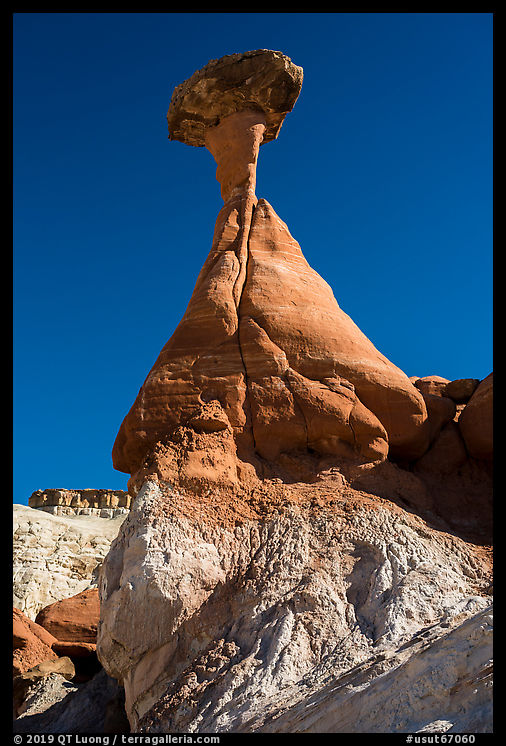
4. Toadstool Hoodoo (Rimrocks Hoodoos), morning
These improbable formations were created when resistant capstones protected softer rock beneath them from erosion. Their fragile forms illustrate geological processes still actively shaping the landscape.
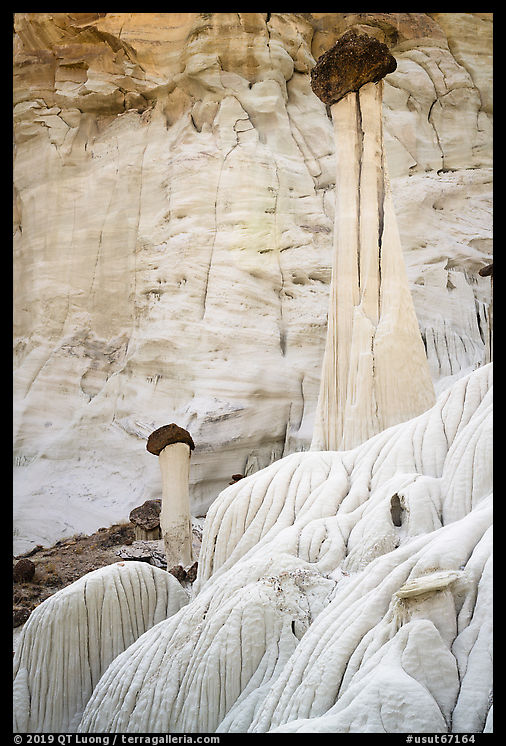
5. Towers of Silence (Wahweap Hoodoos), early morning
Rising from pale badlands, the Wahweap Hoodoos rank among the monument’s most elegant natural sculptures. Their slender forms appear almost architectural against the surrounding desert.
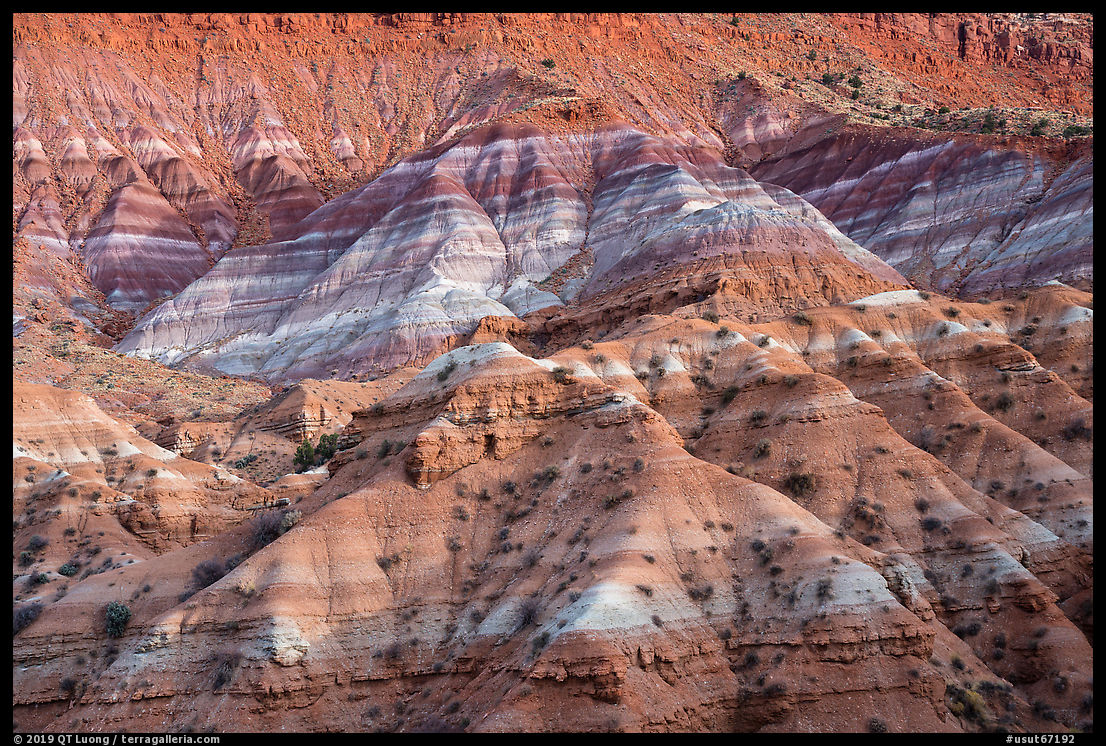
6. Paria Badlands, late afternoon
Layers of sediment weather into hills of extraordinary color and texture. What first appears barren reveals remarkable complexity when explored on foot.
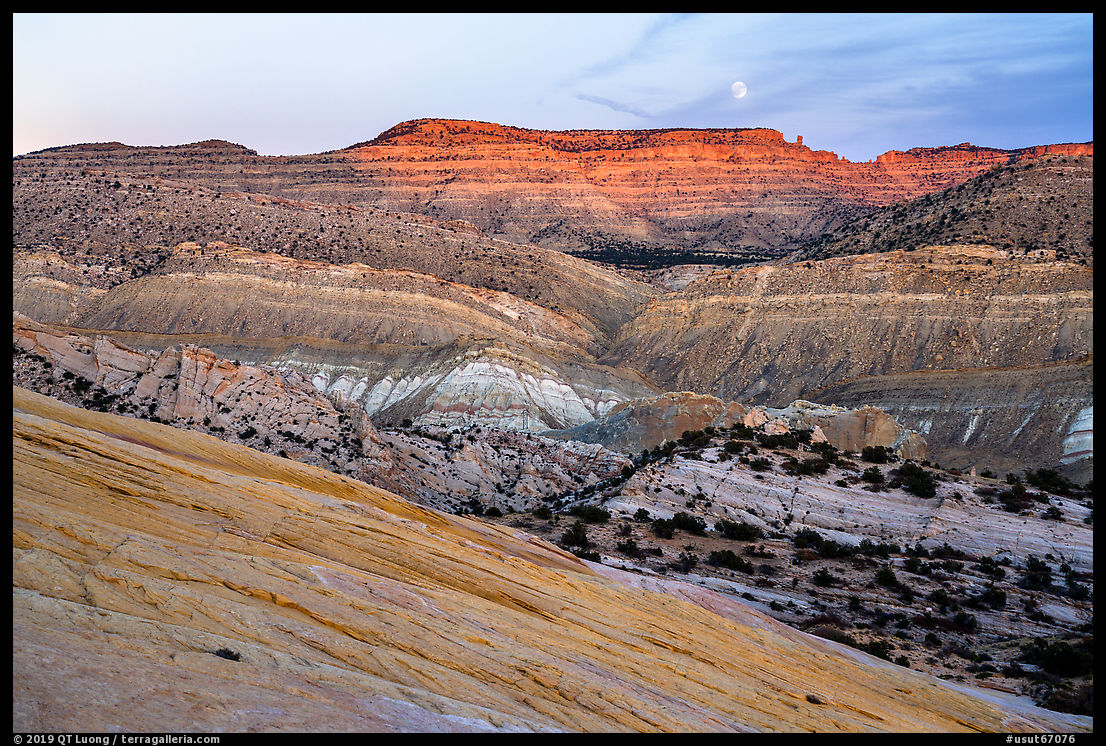
7. The Cockscomb from Yellow Rock at sunset
A vast dome of cross-bedded Navajo Sandstone rises above the surrounding badlands. From its summit, a sweeping panorama reveals many of the geological formations that make Grand Staircase–Escalante unique.
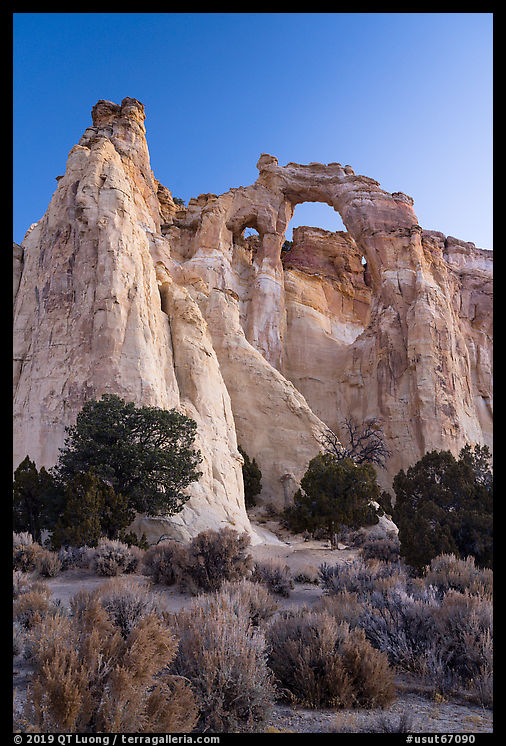
8. Grosvenor Arch, dawn
One of the monument’s best-known landmarks, Grosvenor Arch spans nearly ninety feet and rises 150 feet above the desert floor. Its scale reflects the immense forces that shaped the Colorado Plateau.
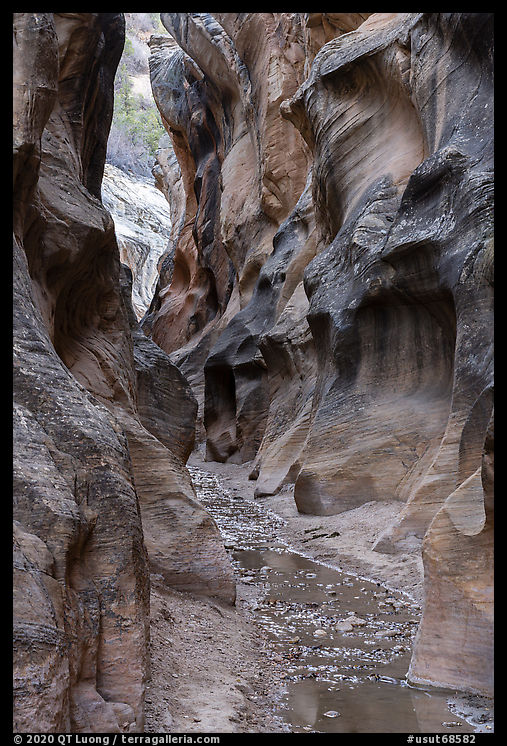
9. Narrows of Willis Creek, late afternoon
A modest stream still flowing has carved graceful passages through pale sandstone, creating one of the monument’s most accessible slot canyons. The constantly changing curves transform each bend into a new composition.
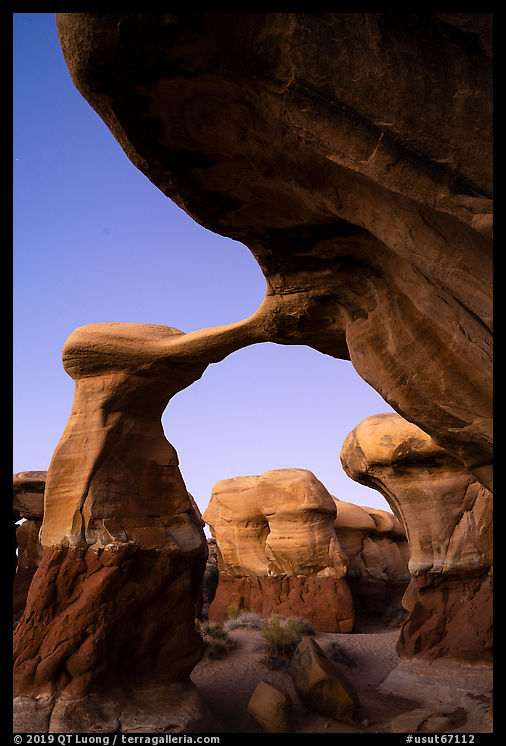
10. Metate Arch (Devils Garden), dusk
Hoodoos, arches, and balancing rocks emerge unexpectedly from open desert. Devils Garden demonstrates the playful variety of forms that erosion can create.
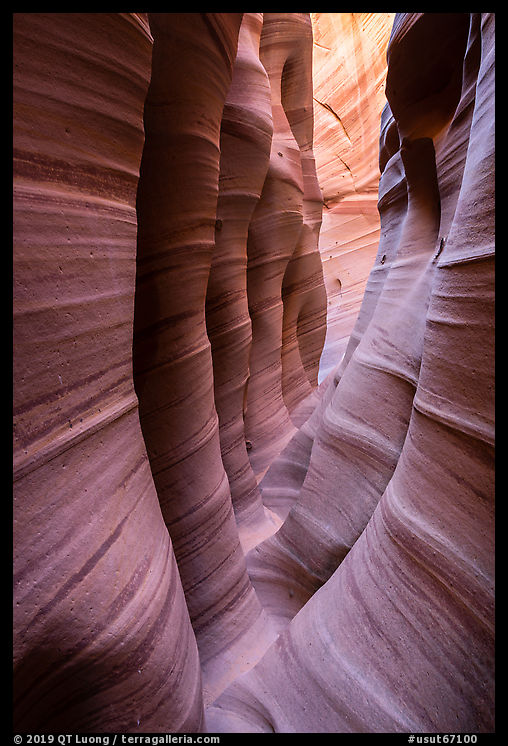
11. Zebra Slot Canyon (Cottonwood Wash), late morning
Named for the striped patterns that sweep across its walls, Zebra Slot Canyon compresses color, texture, and form into an extraordinarily narrow space. In places, the canyon is so constricted that passage becomes part of the experience.
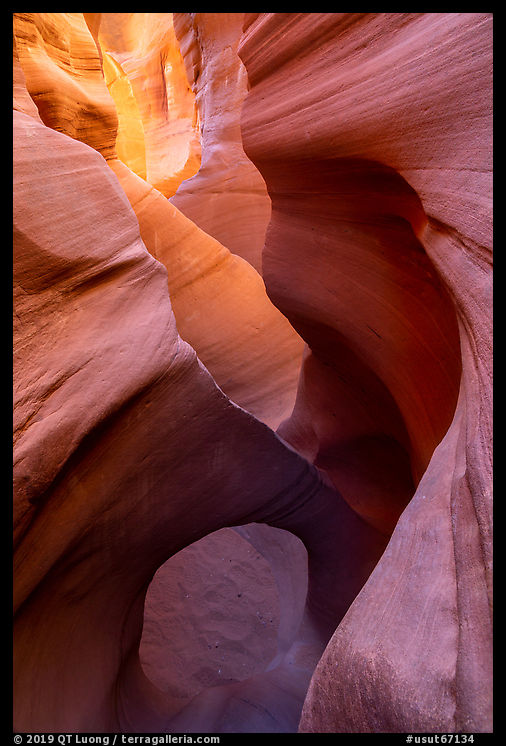
12. Peek-A-Boo Canyon (Dry Fork Coyote Gulch), late morning
Peek-A-Boo and Spooky are among the most celebrated slot canyons of the Escalante region. Their contrasting forms demonstrate the astonishing diversity hidden within the monument’s maze of sandstone.
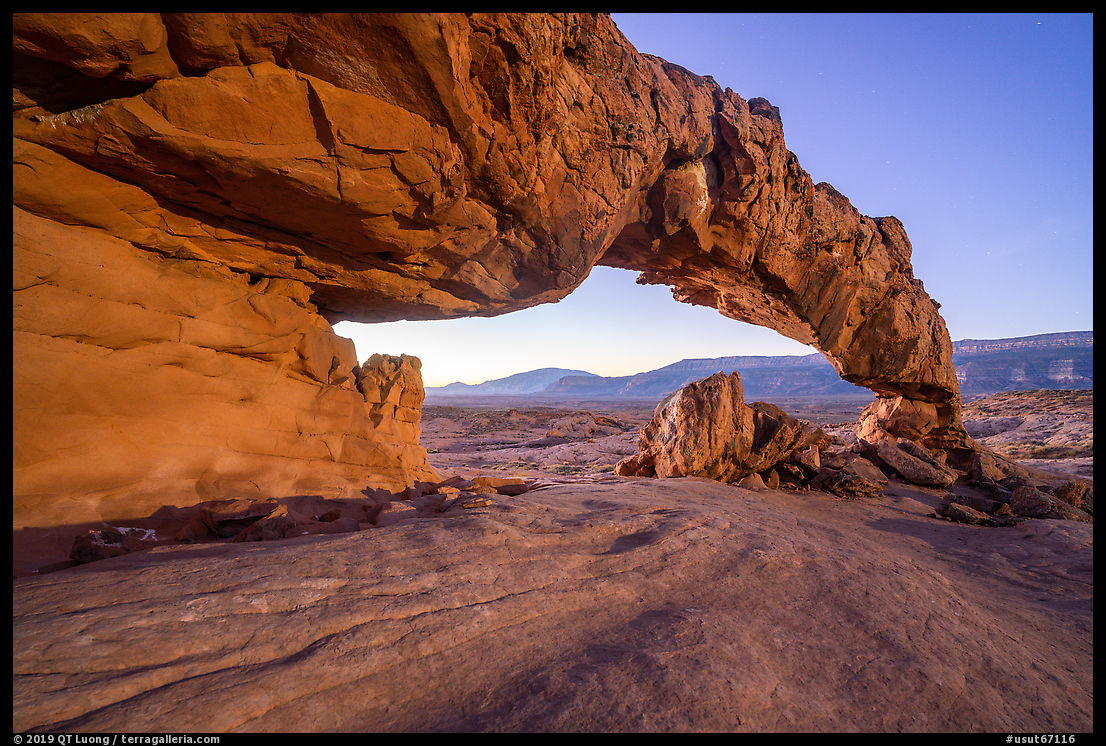
13. Sunset Arch (Forty Mile Bench), dawn
Hidden within an apparently featureless landscape, Sunset Arch reveals itself only at the end of a cross-country walk. Its unexpected appearance is a reminder that many of the monument’s greatest treasures remain invisible from the road.
Downloads from Our National Monuments
Original Grand Staircase–Escalante book chapter (PDF, 4MB)Preserves the photography, sequencing, and design of the book.
Grand Staircase–Escalante mobile field guide (PDF, 8MB)
Expanded maps, coordinates, directions, and location notes for visitors and photographers. Note that internal links do not function unlike in the full guide.