
Photo Spot 37: Dry Tortugas National Park – Fort Jefferson Moat
9 Comments
updated Aug 18, 2003
A few weeks ago, we ventured into the northernmost of the Florida Keys, Elliott Key in Biscayne National Park. Today, we visit the Key situated at the opposite end of the chain. Dry Tortugas National Park, 70 miles of Key West, Florida, like Biscayne is mostly an underwater park. The land area consists of seven diminutive islets, totaling only 40 acres of sand.
Few people visit Dry Tortugas, because of its remote location, however it is a unique place with one unexpected sight. There are two ways to visit Dry Tortugas National Park: by ferry, or by seaplane.
For my first visit to Dry Tortugas, in December 1997, I wanted to see the islets from the air, since this would provide an interesting perspective on this very flat terrain. At that time I was still so fond of large format photography that I tried to shoot everything with my 5×7 camera, including aerials. I have to confess that lacking the experience and technique of a Brad Washburn or William Garnet, none of those images turned out to be even competent. This helped teach me “horses for courses”, using the right camera for each situation.
The big downside was that while a trip by ferry would have let me spend five hours on the main island, Garden Key, or even camp overnight, the trip by plane gave me only a little over two hours there (note: as of 2010, full day plane trips are available, but they cost twice as much). The island is so small that if I was just sightseeing, I could easily see every nook and cranny of it in that time, however photographing it was another matter. Since the park has two components, nature and history, I tried to capture both. I first focused on the Caribbean atmosphere on the sandy beaches, then rushed inside Fort Jefferson, the massive brick structure (largest in the Western Hemisphere) that takes up much of the surface area of Garden Key, and milled around the courtyard and galleries, looking without much success for a defining image of the place.
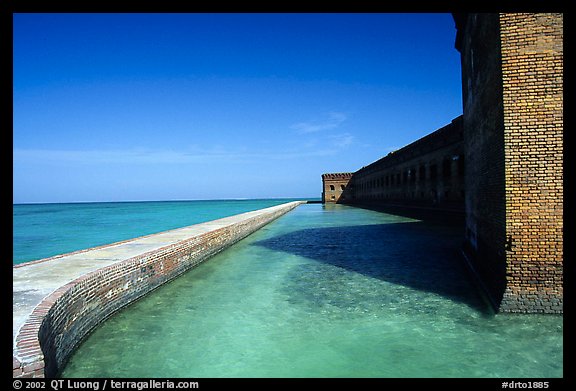
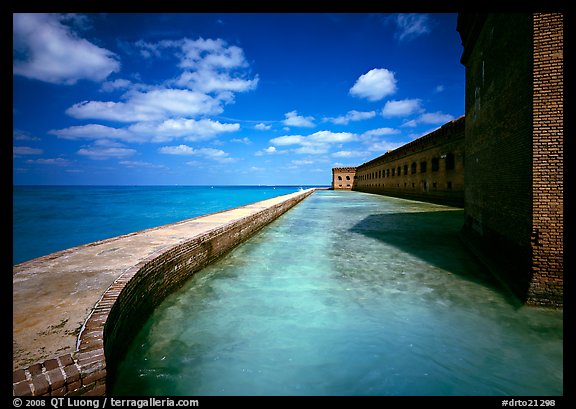
The fort is so large that two-thirds of it drops directly into the water, just protected from the ocean by a low seawall, the spot that I had missed, because of its unusual position. With less than ten minutes left before the departure time, as I took a quick look there, I saw instantly the image that captured what I felt to be the essence of the location: the geometric meeting of the luminous sky, turquoise waters and the brick walls, at the same time so incongruous, but so integrated into this environment, with the slight curve of the seawall leading the eye into the image. As there was not enough time left for a large format photograph, I settled for a quick shot with my 35mm camera, already planning to come back by ferry.
Since this blitz trip I’ve returned three times to the tiny Dry Tortugas. This particular spot has become my favorite in the park, almost a “signature image”. The seawall may look symmetric, but I prefer that particular corner (situated NW) of the fort for shooting mid-day, or the previous one (situated W) for shooting at sunset, because of the open views over water, and the angle under which the sun strikes the wall. Others just don’t work as well for me. The West corner has the advantage of being un-interupted, while the North-West corner has an opening which allows the water to flow between the moat and the ocean, which can be distracting while shooting with a very wide angle lens. At sunrise on the East side of the fort, because of the orientation of the walls, it is not possible to get good cross-lighting. This leaves mid-day to sunset as the best time to photograph on the West and North-West side.
Despite photographing there on each of my subsequent trips, I have not been able to duplicate the mid-day “quick shot” taken on my first sight of the moat. Not that nature hasn’t been generous in her variety: I’ve witnessed overcast days, stormy days with gale-force winds, sunny days with clouds. However, only an almost cloudless day (that some declare to be uninteresting) with a mid-winter sun made it possible to create the stark and minimal composition with the pointed shadow that initially caught my eye. As the year progresses, the higher position of the sun produces a shadow that becomes less and less interesting. It is still acceptable in late winter, but in summer is just too flat.
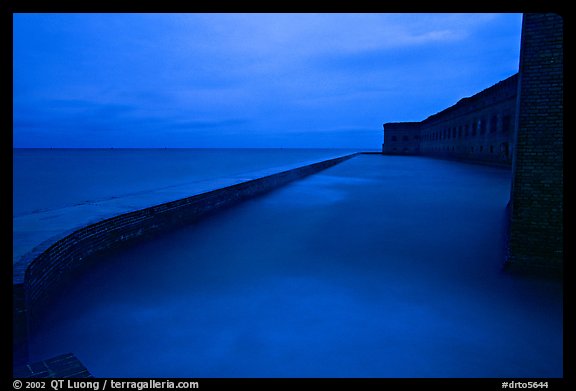
On my third trip to the island, an unexpected storm moved in. As waves washed over the seawall, I had no choice but to create a monochromatic composition with a long exposure, at dusk. Because of the cloudy sky, sunset and night photographs would have to wait for a fourth trip, which I made in the summer of 2013.
Which one is your favorite ?
View more images of Dry Tortugas National Park




#drto5644 Qt / sounds like cutee / its my dark side and i love the blue..and the one with the clouds too ! do you have a BW of the cloudimage ? love the blue / tungstenfilter or nightime ?
greetings
dietmar
Hey, I’m glad to see your back. I’ve actually just found your blog recently and I really enjoy it. Looking forward to all the new posts.
They are all nice, but the first one is my favorite. It is the shadow that makes the image, not the lack of clouds in my opinion.
All three images were exceptionally rewarding all though i have chosen the dusk (3) because of the created time of night fall from morning -you have capture the time of change-
Dietmar, the B&W version is here: http://www.terragalleria.com/black-white/parks/np-image.drto21298-bw.html
The last image was shot at nightfall, you can see that the long exposure blurred the water. As a storm was moving in, waves were constantly sweeping over the seawall, so I had to pin down the tripod with both hands. Fortunately the water was warm !
I have visited 50 of the 58 National Parks in the system, including Dry Tortuga NP. My goal is to visit the other 8 in the next year. Your pictures have motivated and inspired me to both visit and capture their essence on film. Keep up the good work.
Interesting responses so far. Technically, the first is the best, but there is a lack of drama that the second image has in a superb way, and which to my eyes is the winner (some may object to the strong vignetting, but I really like it and it enhances this particular image). The night image gives off a very different mood, and probably would be less of a seller. It is beautiful though.
The vignetting is a consequence of physical light fall-off on large format wide-angle lenses. For many years I did not use a center filter to counteract it, since I thought that more often than not, it improved the image. The two other images were shot on 35mm film, hence do not have it.
Love your pictures, brought back memories of our 1-day trip from Key West to Dry Tortugas. We loved walking the huge fort and some snorkeling too. Thanks for pictures. My son sent me this he found on the internet, so i just now viewed this post. Will try to look at your other posts.