Inside the Mont-Blanc range
Glaciers
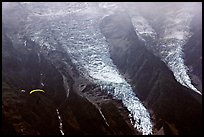
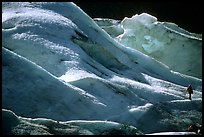
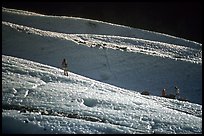
The Bossons glacier is the highest icefall in the Alps. It
goes down from the summit of Mont-Blanc
at 4807 meters to a mere 1300 meters. The two
pictures at the right show alpinists training at the bottom
of this glacier, only a quarter of an hour from the parking
lot.
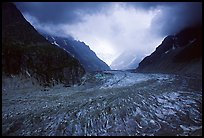
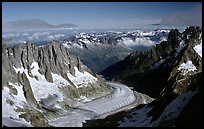
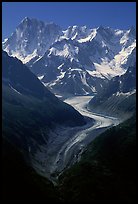
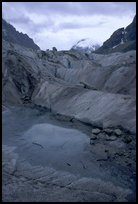
The second longest glacier in the Alps is Mer de glace (aka the
sea of ice). It is pretty much like a very slow and solid stream.
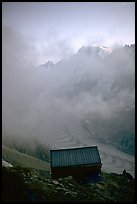
The building in the foreground of the left picture is an alpine
hut, which serves as a base for climbers. The existence of a dense
network of huts makes the logistics of alpine climbing considerably
easier.
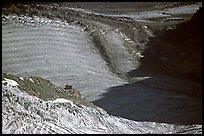
On the close-up of Mer de glace on the left,
you can see the Forbes bands, whose
shape indicate the differential in flow speed; the Requin hut gives the
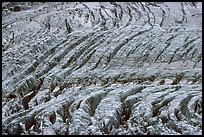
scale. A closer look on the right show a continuous crevasse field. These
are caused by irregularities of the ground on which the glacier moves.
Peaks
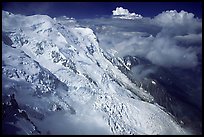
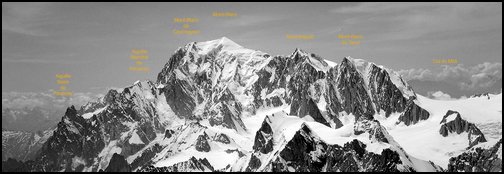
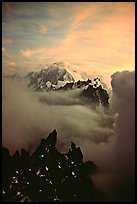
Mont-Blanc, the highest mountain in the Alps,
dominates its range.
More pictures on Mont-Blanc
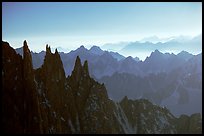
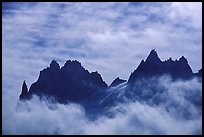
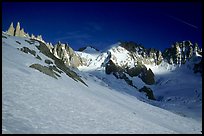
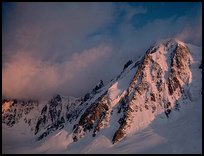
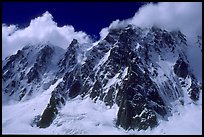
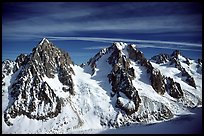
There are spectacularly jagged rock spires all around the range.
The Mt Blanc range is divided in two by a ridge of high mountains.
The left view shows the south side of this ridge, which is rather
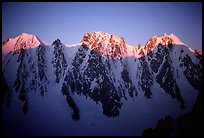
rocky and moderately steep. The right view show the north side, which
forms a formidable barrier of very steep faces. From left to right, there
are Les Courtes, Les Droites, Aiguille Verte.
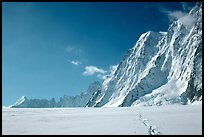
At the north of this barrier, lies the Argentiere Basin, a unique
circus of high mountains. The first pictures above show details on mountains
of the North side:
the North face of Les Courtes and Les Droites, two very steep climbs.
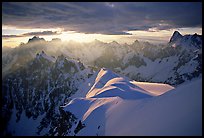
The picture below shows the South side, with the Chardonet pass, the
starting point of the famous Chamonix-Zermatt ski traverse.
All photos and text Copyright © QT Luong