| Home / Mountain Adventure / Alps/ Alpinism |
Map
|
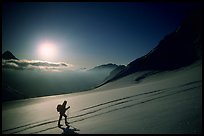
The less steep ranges of the Alps (here Vanoise) are perfect for
ski-mountaineering (also called "alpine touring", or "randonnee
skiing"). You scale a peak or a pass on skis using adhesive skins to
go uphill, and then you enjoy a long run in nearly immaculate snow.
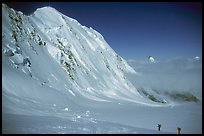
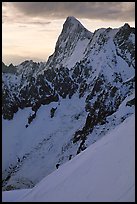
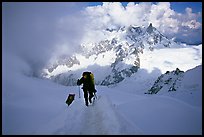
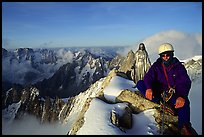
In the Wallis, Swiss Alps. On the left, skiers are seen bellow the huge
North face of Liskam (note summit of
Matterhorn emerging from the clouds)
on their way to Mt Rose, the second summit of the
Alps, which is reached by an easy ridge (right).
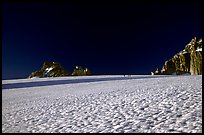
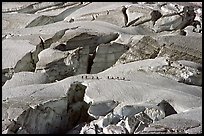
The high ranges of the Alps are heavily glaciated, and to get
almost anywhere you have to travel on glaciers. The gentle Trient Glacier is similar to a snow field with no open crevasses (left).
A large party
crosses a snow bridge on the upper Vallee Blanche in summer (right)
Does the rope-up distance seem sufficient to you ?
The most natural way to ascend montains is to follow ridges, as they are less steep and less exposed to
rockfall and avalanches than faces.
Then, there are the
large snow and ice slopes of classic inclination (less than
55 degrees). There are many climbs in this range of difficulty in the Alps.
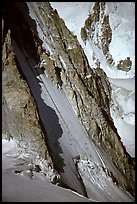
Have a closer look at the two parties climbing on the lower half
of the North face of Tour Ronde, a classic of 300m high in the Mt Blanc range,
where slopes tend to be rather steep.
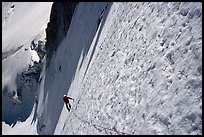
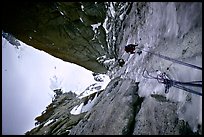
On the North face of Grande Casse, Vanoise, a climb of comparable steepness,
but which is much longer. Looking up (left), and sideways (right).
More difficults ice climbs involve steeper ice, smaller and
thinner gullies, or mixed terrain, which is
a demanding mixture of rock and ice, as examplified by
the Super-Couloir on Mt Blanc du Tacul.
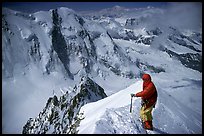
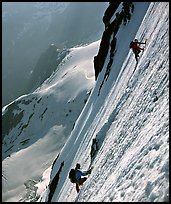
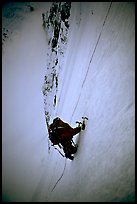
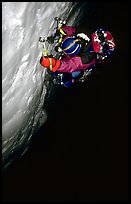
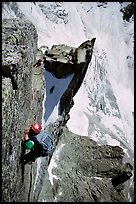
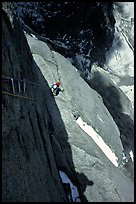
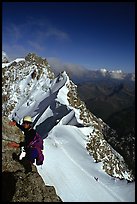
Long alpine routes (here the North face of Les Droites,
Mt Blanc range, with
Frank) require very
early starts to get acceptable snow conditions and to avoid being
benighted. It is important to move fast also to avoid being caught in,
or to escape the fast moving storms characteristic of the Northern
Alps.
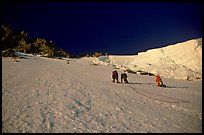
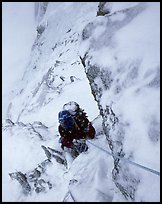
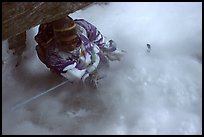
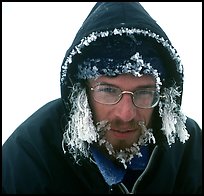
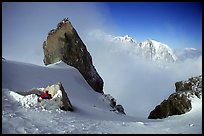
These two pictures, taken during a climb of Mt Gelas, Maritime Alps,
show that severe conditions can also be
found in the Southern Alps, a hundred kilometers from the
Meditarranean. The combination of steepness and harsh conditions make
alpinism a quite demanding activity.
By contrast with snow and ice climbing, which can usually be done
in any weather conditions, rock climbing calls for dry days.
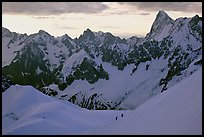
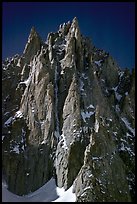
The set of spires which form Aiguilles de Chamonix has
one of the best granite in the Alps,
and is at lower elevations than the rest of the range (Aig. des Pelerins).
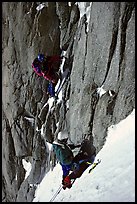
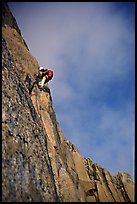
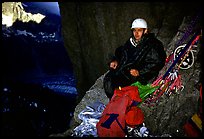
On the Bonatti Pilar on Le Dru, Mt Blanc range. The first ascent, solo,
by Walter Bonatti of this very elegant line was one of the greatest
accomplishments in the history of climbing. To overcome the difficulties,
Paul Arene and I had to resort to aid climbing and to
bivy on the route.
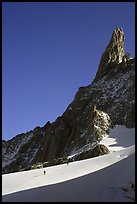
The approach, a bivy at the base, and the climb of the Dent du Geant, one of the
most striking spires in the Mt Blanc range.
All photos and text Copyright © QT Luong
|
|
Outside glance | Aiguille du Midi | Inside the range | Alpinism | Mont-Blanc
|
|
|
Home
·
Terms of use
·
Contact
·
Guestbook and Mailing List
Large Format · Buy fine art prints · License stock photos · Hi-res wallpaper |
|---|