| Home / Mountain Adventure / Mount McKinley expedition/ To the main camp |
Map
|
| Home / US National Parks / Denali National Parkk / Mount McKinley expedition |
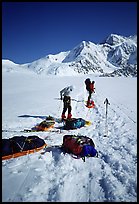
The first days are spent hauling heavy loads (80 lbs for me)
including mostly food and fuel for
three weeks and polar-grade gear. The climb takes a dozen
days round trip (including acclimatization time)
but there are normally some downtime spent waiting in storms.
Each of us had a big backpack and a
big sled.
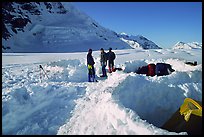
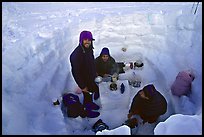
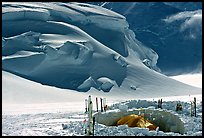
Snow camping luxury. The first night, we found a nice abandoned site.
They are rather common, due to the large frequentation of the route.
My partners for this part of the trip are three Canadians. I prefered
to join a team to travel the lower glaciers because of the crevasse falls
danger, and was glad to be accepted by them.
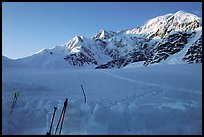
The West Buttress route goes behind the ridge above the Kahilna pass.
Totally invisible from the land, it has been discovered in the 50s by
Bradford Washburn thanks to his large format aerial photographic surveys.
This discovery would revolutionize Mt Mc Kinley climbing.
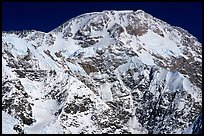
Here is the mighty West face of Mc Kinley. The West Buttress is the ridge on
the left on the skyline, the Cassin the ridge on the right.
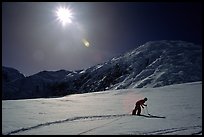
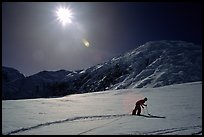
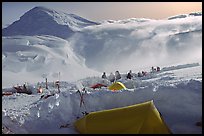
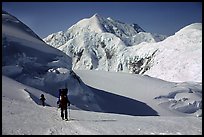
The terrain is not steep, and therefore, you can camp anywhere.
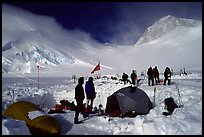
The second night, we probe a circle for crevasses, before unroping.
Alaskan glaciers
are among the biggest in the world, and have very deep crevasses,
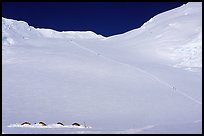
which are difficult to spot. Note on the right picture the two
parties on the track which reaches Kahilna Pass.
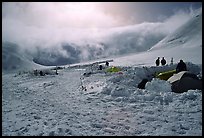
The first important camp, where people gather at a same spot,
is found at 11000. Above, the route becomes steeper, making
sleding or sking unpractical.
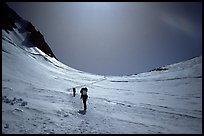
This evening fog is nothing to worry about, since the 7pm weather forecast is
optimistic.
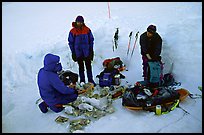
Like most people, we leave our snowshoes and sleds here, and organize
ourselves to do a double carry the next morning.
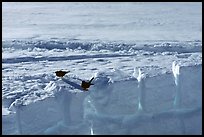
Everything which is left is buried under the snow, to
prevent the ravens from destroying your cache. They can rip
open a backpack if you don't bury it deep enought.
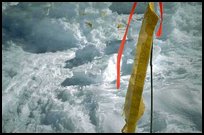
To find it, you leave a wand, and you write your name on a sticker.
Since everybody does this, there is a forest of wands and skis at this camp.
Our first carry day, up to the 14300 camp, down to 11000. It was a rather
hard day, but the next day we would have to do the 3300 push again.
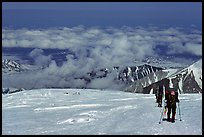
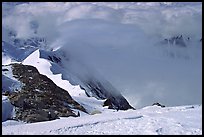
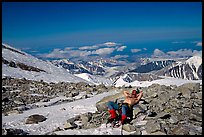
Up again the next day. This place is the Windy Corner. There is a secondary
summit which creates a funnel with the West Buttress, generating incredibly
high winds there during storms.
You can notice that the
texture of the snow is different from other pictures, because it is
so wind-blown...
... although it was not that windy this day. An example of the exeptionnal
conditions that I met during the climb.
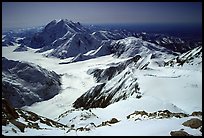
This picture shows the route so far (outlined in red):
the Kahilna glacier in front of Mt
Foraker, Windy Corner, and the camp 14300 which is nested in a snow bowl.
All photos and text Copyright © QT Luong
|
|
To the base camp | To the main camp | First attempt | To the summit | Descent
|
|
|
Home
·
Terms of use
·
Contact
·
Guestbook and Mailing List
Large Format · Buy fine art prints · License stock photos · Hi-res wallpaper |
|---|